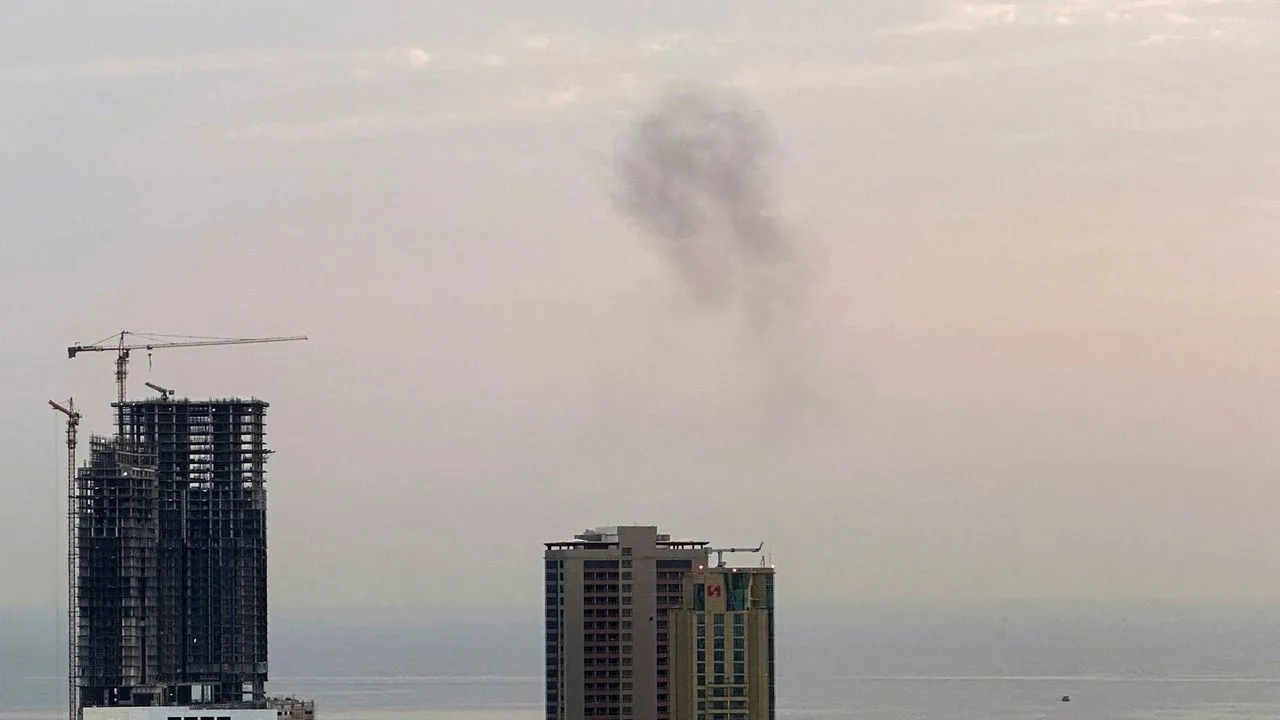
Explosions were reportedly heard in Bahrain after the country issued threat alert on Tuesday, with the Islamic Revolutionary Guard Corps (IRGC) saying it targeted US radar system at Sheikh Isa air base of in what they described as a “precise operation”.
A few hours before the reports of explosions being heard, Iran — setting what it called a “new rule” — threatened to retaliate against civilian infrastructure located near US or Israeli military bases if those countries targeted similar sites in the Islamic Republic.
“Prepping the next round on civilian infra, their “experts” tell NYT: “dams near Iran’s missile sites are dual-use," Iran’s parliamentary speaker and lead negotiator with the US, Mohammad Bagher Ghalibaf, said Tuesday on X.
"Cool. New rule: Any dam, port, or power plant near a US or Israeli base is dual-use,” Mohammad Ghalibaf's X post added.
Ghalibaf was responding to a New York Times report — citing unnamed analysts — that many water infrastructure sites in Iran “may have been developed to support the country’s military buildup.”
“We’ll apply your logic consistently and even-handedly,” Ghalibaf said.
The New York Times article did not say the US or Israel were considering blowing up Iranian dams, though US President Donald Trump has since the start of the war threatened to hit civilian sites, including power plants.
Bahrain ‘drone attack’
Strike on US radar in Bahrain followed continued US drone violations of Iran’s airspace, the IRCG said, according to Sepah News - the official media and news outlet of the Iran's Guards.
“Combat drones belonging to the Revolutionary Guards carried out a precision operation this morning, targeting a radar system operated by US forces at the Sheikh Isa Air Base in Bahrain,” a statement on the Guards’ Sepah news website read, adding that the attack was in response to the “repeated violations of Iranian airspace by US military drones”.
The Bahrain interior ministry warned in a post on X of an alert of potential threat, while asking the public to remain calm.
The ministry later announced an "all-clear alert".
“The Ministry of Interior urged citizens and residents to remain calm, proceed to the nearest safe location, and follow news through official channels for the protection of public safety,” the Bahrain interior ministry said on X, shortly after which AFP news agency reported its journalists heard explosions.
Blasts echoed over the Bahraini capital Manama after residents received mobile-phone alerts, AFP reported, citing a journalist.
Iran war status
The fresh drone attack claim comes as tensions from the war that started on February 28 with joint US-Israel strikes on Iran linger on months after, with no concrete signal of a longstanding peace agreement between the two warring sides.
On February 28 this year, under the code name Operation Epic Fury, initiated by massive, coordinated US and Israeli airstrikes targeting Iran's core military infrastructure and leadership. The opening salvo resulted in the assassination of Supreme Leader Ali Khamenei and several top defense officials, prompting the regime to quickly consolidate under a hardline succession led by his son, Mojtaba Khamenei.
In retaliation, Iran also unleashed drones and missiles against US bases and embassies across Gulf states like Bahrain, Qatar, and Kuwait, while effectively shutting down the Strait of Hormuz — which the Islamic country has a greater control of due to its geographical advantage.
This chokehold on a fifth of the world's energy transit triggered an unprecedented global fuel crisis, soaring inflation, and heavily inflamed regional proxy fronts, including a massive resurgence of the Israel-Hezbollah war in Lebanon.
Since the conflict broke out, it seesawed between periods of intense drone-missile exchanges and fragile diplomatic maneuvering. A brief, Pakistan-mediated memorandum of understanding temporarily halted large-scale fighting in June, but the truce collapsed by August after the interim agreement expired and maritime skirmishes re-escalated. Since then, the efforts to come to agreement to come to peace permanently have not progress enough to stop the intermittent drone and missile exchange completely.