Gold jewellery buyers may find it difficult to judge the actual purity of the metal they purchase after reports of an adulteration scam that involves heavy metal powders.
A report by Dainik Bhaskar has claimed that rhenium powder was mixed with gold to increase its weight, while the resulting jewellery continued to pass several purity tests. The investigation has also pointed to a possible Chinese connection.
According to the report, they contacted an agent based in Shenzhen, China, who claimed that his company manufactured rhenium powder and had dealers in several Indian cities.
The agent reportedly claimed that the powder could be mixed with gold in proportions of up to 25% without being detected by standard testing methods.
How was rhenium powder allegedly mixed with gold?
The report claimed that they obtained a one-gram sample of rhenium through a Mumbai-based dealer after contacting the Chinese agent. The sample was then used in an experiment with a jeweller in Jodhpur.
According to the investigation, one gram of rhenium powder was mixed with 7.83 grams of 24-carat gold, increasing the total weight to 8.83 grams. The mixture was identified as 24-carat gold during testing.
The jeweller later added another metal to prepare a 22-carat ornament. Although the jewellery was reportedly certified as 22-carat gold at a hallmarking centre, the report claimed its actual gold content was only 81.73%, equivalent to approximately 20-carat purity.
The report said that the adulterated ornament passed tests at several jewellery showrooms and testing facilities. These findings relate to the sample used in the investigation and do not establish that all hallmarking centres or testing machines are unable to detect rhenium.
Other heavy metals reportedly used in gold adulteration
Separately, Mint reported concerns among jewellery traders in Indore over the use of heavy metals such as ruthenium, iridium and osmium in gold. According to traders in the city's Sarafa market, these metals have been mixed with gold to increase its weight.
The metals are denser than gold, which can make the adulterated material difficult to identify through conventional acid and touchstone tests. Traders also raised concerns about a material referred to as 'gold powder', which is reportedly entering Indian markets through Maharashtra and West Bengal.
While there were suspicions that this powder could be manufactured in China, its origin had not been independently established, the report added.
What does the CAG audit say about gold hallmarking?
The reports have brought attention to concerns over the monitoring of gold hallmarking in India. According to a draft report by the Comptroller and Auditor General (CAG), 81% of registered jewellers were not inspected during 2024-25.
The report also found that the Bureau of Indian Standards (BIS) fell short of its surveillance targets for recognised Assaying and Hallmarking Centres by 43.7%. BIS attributed the gaps to staff shortages and difficulties in collecting samples from remote areas, an explanation the CAG rejected.
How can gold adulteration be detected?
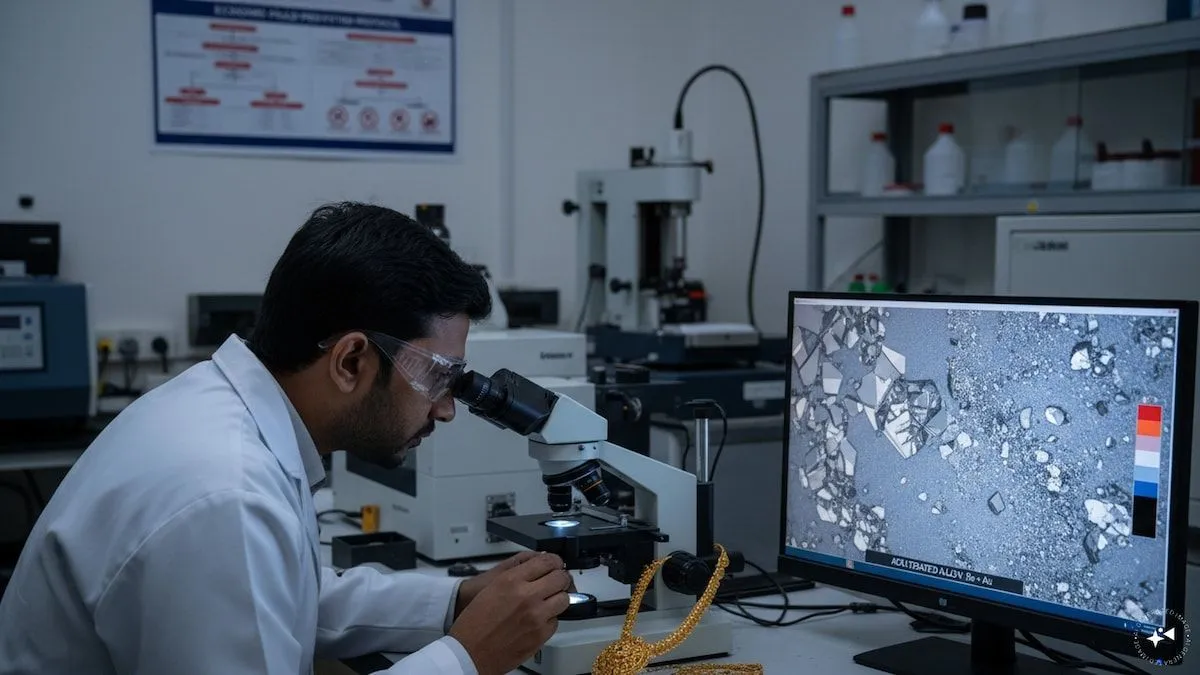
The report said that advanced methods such as X-ray fluorescence (XRF) analysis and electron microscopy may help identify foreign metals and examine the composition of gold samples.
Consumers are advised to buy hallmarked jewellery from reliable sellers and check the purity details before making a purchase. Keeping the purchase bill and GST invoice is also important.