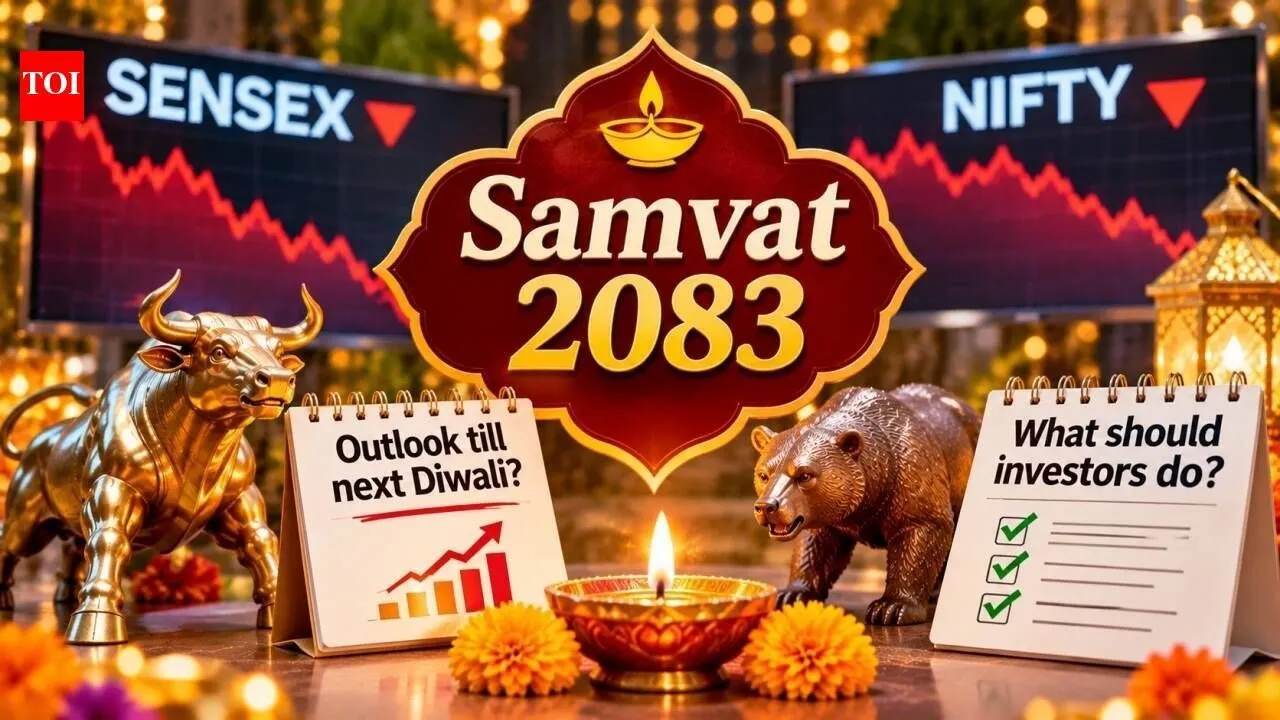
Experts are positive about Samvat 2083 and the recent stock market rally has added to their optimism.
Samvat 2083, the beginning of the new accounting year, has started with BSE Sensex and Nifty50 ending marginally in red.The declines meant that both the Sensex and Nifty ended their eight-year streak of gains during Diwali trading sessions, a run that had continued since 2018. But investors' wealth surged by Rs 2.60 lakh crore to Rs 5,06,87,267.96 crore. The Nifty-50 declined 0.18 per cent to close at 24,986.40, slipping just below the psychological 25,000 mark after opening higher at 25,070 and touching an intraday high of 25,132.Muhurat trading is a special symbolic session conducted on Diwali, which also marks the beginning of the new Hindu calendar year. The tradition is rooted in the belief that trading during the 'Muhurat', or auspicious period, brings prosperity and financial gains to market participants. The volatile Muhurat trading session comes after a record seven-day rally by the indices which saw BSE Sensex and Nifty50 rise over 10%. The gains over the preceding seven consecutive sessions had lifted the Sensex by 7,781.99 points, or 10.62%, and the Nifty by 2,331.5 points, or 10.27%. But Samvat 2082 was a year of negative returns. While BSE Sensex ended 2082, down over 4% from last year’s Muhurat trading, Nifty50 ended with over 3% decline. According to Motilal Oswal, India stands at a point where a resilient domestic economy meets a challenging external backdrop. Samvat 2082 tested investors’ patience and Samvat 2083 begins on a cautious note, as an external energy shock overshadows a resilient economy. Will the new year bring cheer for investors? What are the sectors that they should be focusing on? Let’s take a look:
Samvat 2082: The macro-shock year
With negative returns, Samvat 2082 saw several global shocks that took a toll on the stock markets. Indian markets were affected by several global and domestic factors. Geopolitical tensions in West Asia, elevated crude oil prices, uncertainty around US trade policies and persistent FII selling impacted investor sentiment. According to Somil Mehta, Head of Retail Research at Mirae Asset Sharekhan, concerns around artificial intelligence also led to selling in IT stocks. Slower earnings growth and expensive valuations in some market segments added to the pressure, he tells TOI. Neeraj Gaurh, Director & Fund Manager, Anand Rathi AMC sees Samvat 2082 as a year of macro-shocks and not an earnings-shock. The US-Israel-Iran conflict pushed crude above $110, global bond yields rose and the rupee weakened sharply. That triggered record FPI selling of about Rs 3 lakh crore and a 25 bps RBI hike to 5.50%. “Domestic money absorbed most of it, with SIPs at a record Rs 32,490 crore. Growth held at 7.8% in Q1 FY27 and bank credit stayed near 18%, so the indices fell on cost of capital and de-rating, not on earnings,” he explains. Motilal Oswal in a report notes that action also remains in the primary market: “Jio Platforms’ record IPO and NSE’s listing headlined a busy year, with over 225 companies in the pipeline. Key monitorables include the RBI’s rate trajectory, crude prices, FII flows, trade agreements and earnings growth,” it says.
What’s the outlook for Samvat 2083?
Experts are positive about Samvat 2083 and the recent stock market rally has added to their optimism. Somil Mehta tells TOI, “We are positive on Indian equities in Samvat 2083 and expect markets to recover gradually. Improving corporate earnings, strong domestic consumption, infrastructure spending and India's long-term growth potential should support market performance.” “A recovery in foreign investor flows could provide further momentum,” he adds. Neeraj Gaurh sees Samvat 2083 to be earnings-led, not multiple-led. With nominal GDP at 10–10.5%, FY27 earnings growth of 13%–15% and credit growth near 18%, he expects index returns in the low teens. “There’s an upside kicker if crude holds below $85–90, the rupee stabilises and global yields ease,” he tells TOI. Motilal Oswal perceives FY27 to mark a return to double-digit earnings growth, with Nifty EPS expected to grow 16%/14% YoY in FY27/FY28 vs 5% in FY26.
What should investors do?
According to Mehta, investors should use market corrections to accumulate quality companies with strong fundamentals and reasonable valuations. “A staggered investment approach and diversification across sectors can help create long-term wealth,” he says. Neeraj Gaurh believes that investors should stay with large caps and select midcaps, keep small caps light, favour private banks, manufacturing/capex and discretionary consumption, stay selective in IT and real estate, and deploy in stages rather than chase the recent rally. “I’d revisit if crude holds above $90, developed-market yields rise further, or RBI tightening runs past 50–75 bps,” he adds. Over the last 10 completed Samvat years (2072–2081), the Nifty delivered a compounded annual return of approximately 12.6%, while the Sensex delivered around 12.5%. The Nifty generated positive returns in nine out of these ten years. Somil Mehta points out that this highlights the long-term wealth creation potential of Indian equities despite periodic corrections and volatility. Motilal Oswal says that Nifty valuations are attractive at 17.5x forward earnings, 16% below the long-term average. “After a nearly 10% correction from record highs, midcaps trade 6% below their long-term average, while smallcaps remain at a 25% premium; thus one needs to follow a selective approach in stock picking,” the brokerage says. “For Samvat 2083, we are positive on BFSI and Capital Markets, Manufacturing, Global Outsourcing/Exports, and Consumption & Digital. Banks are set for steady loan growth with improving margins, while rising participation supports the capital markets segment. Manufacturers in healthcare devices, aerospace and auto components are scaling up on strong order books.” “Pharmaceutical ingredients, garments and port cargo are expected to gain from global outsourcing and trade agreements, while organized jewellery and quick-commerce platforms continue to gain market share,” the Motilal Oswal report says.(Disclaimer: Recommendations and views on the stock market, or any other asset classes or personal finance management tips given by experts and analysts are their own. These opinions do not represent the views of The Times of India.)
End of Article