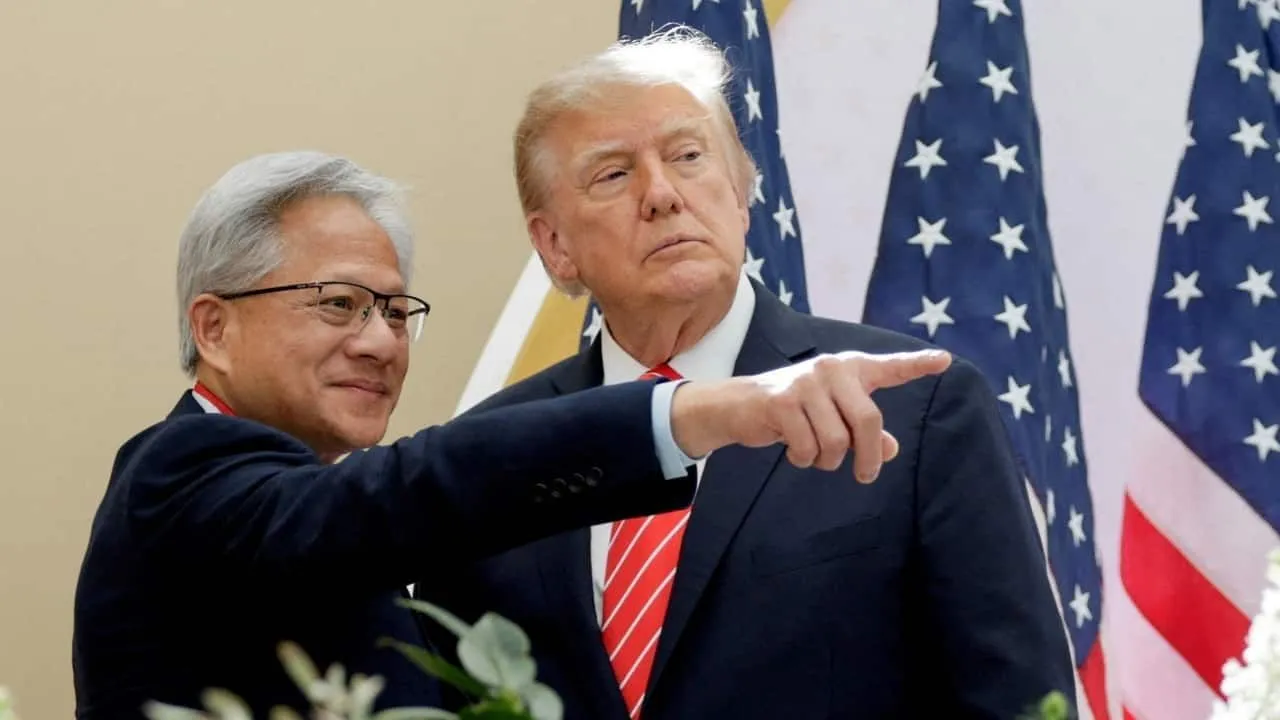
Several officials in US President Donald Trump’s administration wanted to curb Nvidia co-founder Jensen Huang’s influence over Washington’s China policy, with Secretary of State Marco Rubio playing a central role in the effort, according to a report by The Washington Post.
The report describes an internal struggle between technology executives who supported continued sales of advanced American chips to China and national security officials who warned that access to such technology could strengthen Beijing’s military and technological capabilities.
Some officials within the administration were reportedly unhappy with the access Huang enjoyed to Trump, particularly as the Nvidia chief successfully lobbied the president to permit the company to sell certain artificial intelligence chips to China.
“They wanted to destroy the influence Jensen had over the president," a former official who worked on chip policy told The Washington Post, describing the sentiments among some administration officials.
Rubio emerged as a key figure in the campaign to challenge Huang’s position. According to the newspaper, he prepared a memo for Trump warning him about Huang’s relationship with Alice Huang, a businesswoman suspected by US intelligence agencies of having links to Chinese intelligence.
The memo drew on a CIA assessment, but a person familiar with the matter told the newspaper that Rubio had rewritten the agency’s findings using more forceful language. The individual spoke on condition of anonymity because the intelligence information was confidential.
"Huang's downfall, which has the potential to mark a dramatic shift in power, was ultimately set in motion by one of the capital's most influential China hardliners, national security adviser and Secretary of State Marci Rubio," the Washington Post report said.
The memo’s findings subsequently reached the media, bringing renewed attention to Huang’s personal relationships and his proximity to the US President. The controversy was followed by an Nvidia board investigation and reports of another alleged affair involving a subordinate.
Huang eventually resigned as Nvidia CEO on November 12. Trump, however, publicly praised the former chief executive after his departure, describing him as a “legend” who had “done a fantastic job.”
Rubio declined to answer several questions from reporters about his role in alerting the White House to Huang’s relationship during a Group of Seven summit in Paris. Asked whether the allegations of Chinese intelligence links had changed his approach to negotiations with Beijing over artificial intelligence, Rubio said: “The Chinese system is always going to act in the best interest of the Chinese system, and the United States will always act in the best interest of the United States. I work for the American people.”
How many Trump officials opposed Jensen Huang?
The Washington Post did not specify how many administration officials wanted Huang’s influence reduced. It cited two former officials who said members of Trump’s national security team resented the Nvidia chief’s access to the president.
A former official involved in chip policy said several members of the national security team disagreed with Trump’s approach to exports. The official compared Huang’s relationship with the president to handing officials a “nuclear bomb".
The opposition was not shared across the administration. Commerce Secretary Howard Lutnick had publicly described the chip-export arrangement as an understanding between Trump and Huang. Former Commerce Department officials also told the newspaper that a Trump appointee had accelerated Nvidia’s export licence applications.
Huang’s departure could give China hawks in Washington greater scope to push for tighter restrictions on advanced chip sales to Beijing. In Congress, lawmakers are seeking to include additional curbs on China’s access to American technology in a major defence bill expected to be considered by the end of the year.
Representative John Moolenaar, chairman of the House Select Committee on China, has called for further restrictions on chip exports and urged Nvidia’s new leadership to give greater priority to national security concerns.