“It belongs to that category of films where you could feel its potential but could only achieve it partially.” This was my closing note on my review of Rejin S Babu’s directorial debut, Pendulum, a high-concept film that dealt with time travel and lucid dreaming. When it comes to his second film, Bouma, a gothic horror thriller, the evaluation pretty much remains the same. The flaws I felt with Pendulum about the way its dialogue is structured are visible in the case of Bouma as well. Bouma’s writing has too many predictable beats. But after a handful of such beats, it would deliver a twist we wouldn’t anticipate, keeping us interested in the movie.
Celine, an independent girl living in Kochi with her partner Jacob, one day learns that she has an ancestral property with an enormous real estate value, and a major hospitality group wants to purchase this property. An overjoyed Celine and Jacob decide to go to that place before selling it. What we see here are the events that unfold after their arrival.
The second half of this movie begins with a discussion between a police forensic surgeon and an investigating officer. That conversation then goes on to certain parts of the investigation, and the writing of those portions has a very realistic, practical energy which makes us interested in the developments. I felt somewhere that this movie would have been a lot more consistent if it were solely from the investigative officer Eesho’s point of view. I am saying this because whenever we see parts of the movie that don’t feature Eesho and team, it starts to feel excessively dramatic and, to an extent, spoon-feeding the viewers.
Rejin S Babu, who previously directed Pendulum, has a thing for these supernatural elements, and if it was lucid dreaming in his first directorial, here he is trying to explore the workings of an occult. In the present-day track in the movie, the way he has placed distractions is smart. Even though it is partially predictable from a distance, he is adding some new information along with the revealing of those twists, which makes it interesting despite us sort of anticipating it. The problem is with the dramatic tone of certain dialogues. The lines at times become way too rigid, and there are these dialogue exposition patches in the movie that were borderline insulting to an audience who accepted something like an Eko. The repeated occurrence of certain situations in the movie was impressive as it gave us an idea about how the whole setting works.
It is kind of sad that a movie envisioned in flat ratio had to settle for scope ratio screens because Ramayana is playing in all PLF screens. The irony is that since the flat ratio Ramayana is an IMAX exclusive, even if you watch it in any PLF screen, you won’t get the full-screen experience. Sharan Velayudhan’s reason to go for the flat ratio for visuals makes sense, as the key moments in the movie are very intimate. Towards the interval, there is a visual of actor Madhupal, and I am imagining it would have looked spectacular on a PLF flat-ratio screen. In revealing certain key aspects, the movie’s script-edit is done in an impressive manner. But when it comes to holding frames in scenes, the creative choice to show a couple of more seconds of a character adds more to the predictability than surprise. The movie features songs with a certain level of calmness, a space we don’t tend to associate Christo Xavier with. When it comes to the background score, it gets that typical horror-movie treatment where the audience gets a cue on what to feel.
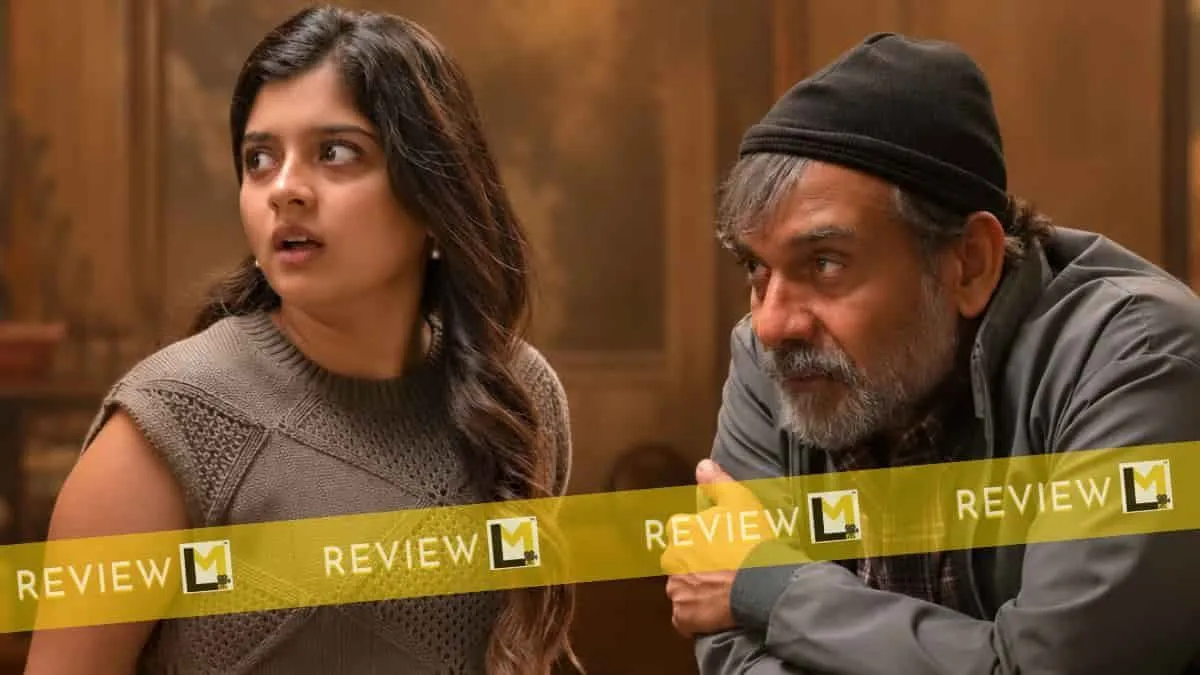
Dileesh Pothan as the investigating officer Eesho Mathew is easily the best performer in the movie. Even in the final bits of the film where the character goes through a tone shift, Dileesh Pothan managed to deliver a consistent performance. Thalavara -fame Revathy Sharma plays the character of Celine. While her Malayalam diction wasn’t much of a problem in the first half, the heft in dialogues in the second half made it a bit more obvious that she isn’t that fluent in Malayalam. Sagar Surya as Celine’s partner is mostly in that impulsive lover-boy space, and towards the end, the movie manages to add some ambiguity around his character. Vineeth as Samuel gets to play a very intense character, and he is one of those actors who can play with voice modulation and deliver theatrical dialogues in a believable meter. Jaffer Idukki gets to play a small yet memorable role. Madhupal, Lenaa, Moksha, Merin Philip, Aditi Balan, and several others are there in roles with relatively minimal screen time.
Looking at how Rejin S Babu constructed the thrills on a script level, he surely knows how to keep us guessing or how to place add-ons even if we guess what is about to happen. The issue is mostly with the explanation that happens through dialogue. If the pitch of the conversation between characters had the same normalcy with which the police characters were interacting and exploring things related to the case, Bouma would have had a steady graph with occasional spikes. Right now, even though the spikes are definitely there, you have to sit through some generic moments to get there.