

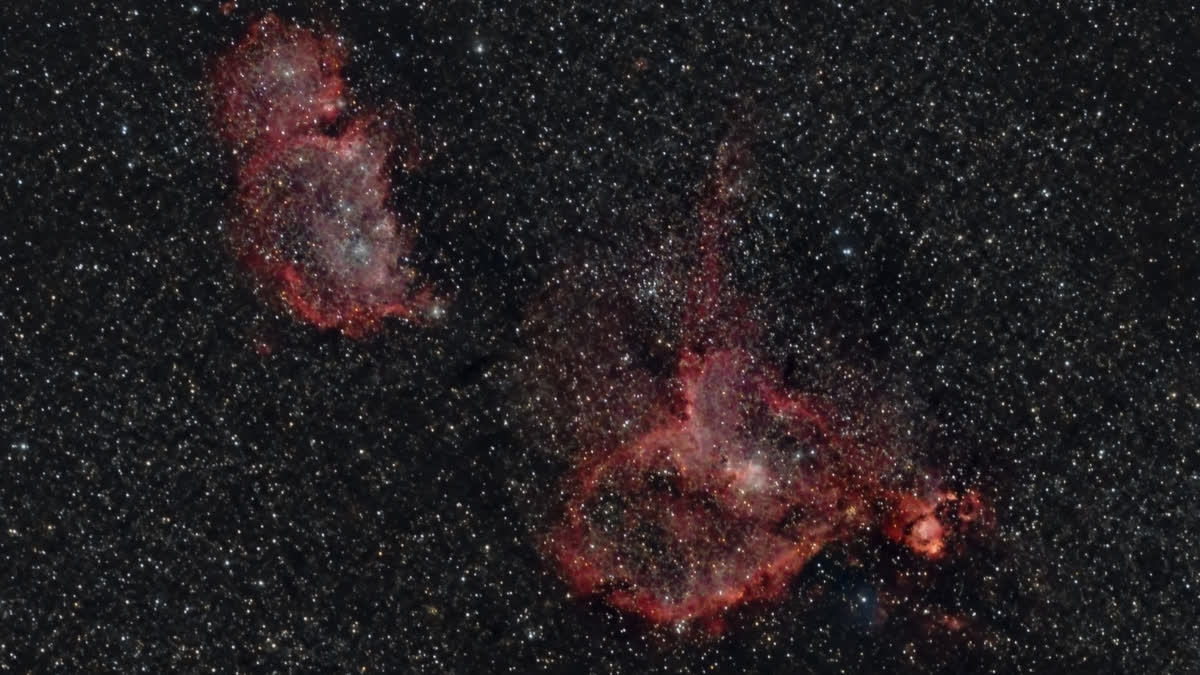
The study, published in The Astronomical Journal, was led by Samrat Biswas, a DST INSPIRE Senior Research Fellow at Gauhati University, in collaboration with researchers from the Bengaluru-based Indian Institute of Astrophysics (IIA) and other international institutions.
The researchers combined data from the European Space Agency's Gaia mission with machine-learning techniques and computer simulations to distinguish the two stellar populations. By analysing the positions, distances, movements, brightness and colours of stars, they were able to study the distribution and motion of both clusters. They also used a computational tool called galpy to trace the clusters' past trajectories and model their future movements within the Galaxy.
“This discovery is important because it gives us a rare opportunity to understand how star clusters influence each other through gravity, how their shapes and structures change during such encounters, and how stars form and gradually disperse into the wider Milky Way,” noted Maheswar Gopinathan, Professor, Astronomy and Astrophysics Group, IIA, in an interview with ETV Bharat's Anubha Jain.
A 541-million-year age gap: Did the two clusters form in a common star-forming environment?
Prof. Gopinathan said the two clusters have very different evolutionary histories. UBC 63A, at about 21 million years old, has undergone relatively little dynamical evolution. UBC 63B, on the other hand, is approximately 562 million years old and has experienced a much longer period of evolution.
The colour–magnitude diagram of UBC 63B contains two red-clump stars, which have exhausted the hydrogen in their cores and are now burning helium. These stars provide independent evidence of the cluster's advanced age. The older cluster also has a more dispersed stellar population, likely shaped by gravitational interactions within the cluster and with the Milky Way over hundreds of millions of years.
Interestingly, simulations suggest that the clusters were about 60 parsecs (nearly 200 light-years) apart when UBC 63A formed, a distance comparable to the typical size of a giant molecular cloud (around 100 parsecs). This raises the possibility that they originated in the same larger star-forming environment, despite forming at different times. Their possible common origin could be investigated further by comparing the chemical compositions of stars in both clusters, as stars born from the same molecular cloud generally carry similar chemical fingerprints.
Their close encounter may also have influenced the structures of both clusters. Prof. Gopinathan explained that both clusters have stars extending beyond the regions they can normally retain against the Milky Way's gravitational pull. The interaction may have drawn stars away from the younger cluster, UBC 63A, while further dispersing the already extended outer population of UBC 63B.
Moving apart: Why the two clusters are not gravitationally bound and what lies ahead
The two clusters are not gravitationally bound because their relative speed is too high for their mutual gravitational attraction to hold them together. Prof. Gopinathan explained this with the example of a comet passing close to the Sun. Despite the Sun's gravitational pull, the comet's forward motion allows it to continue along its path. Similarly, the clusters' relative velocity exceeds their mutual escape velocity, the speed required to escape each other's gravitational pull.
The two clusters are now moving away from each other and are expected to drift farther apart. Orbital calculations and computer simulations suggest their separation could increase to 450–490 parsecs over the next 100 million years, though the exact distance remains uncertain. Over time, the Milky Way's gravitational pull will gradually disperse stars from both clusters into the wider Galaxy.
Uncovering hidden star clusters to understand the Milky Way's evolution
Prof. Gopinathan said the finding could help astronomers identify other overlooked star clusters in the Milky Way by combining Gaia data with machine-learning techniques. Future studies and computer simulations could show how close encounters reshape clusters, disperse stars and influence their evolution. Comparing stellar ages, chemical compositions and movements may also help establish whether different clusters originated in the same region or formed during successive episodes of star formation.
“With future Gaia data releases, large spectroscopic surveys and advanced simulations, we will be able to study these systems in greater detail and gain a deeper understanding of how the Milky Way has evolved,” he said.