By Dr Syed Riyaz Ahmed
When someone develops Type 2 diabetes, doctors usually look at their diet, body weight, physical activity and family history. These are well-established factors that help explain why the disease develops.
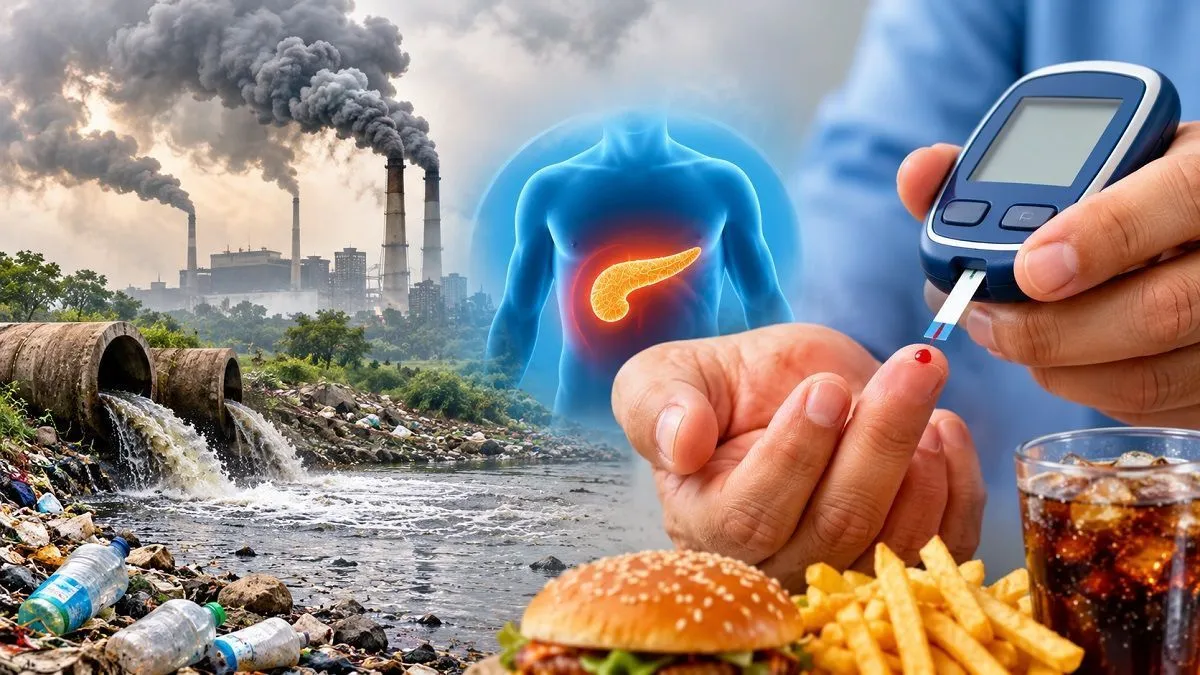
Genetics, ageing, excess body fat, an inactive lifestyle, diet and social conditions remain the main risk factors. However, scientists are now looking at another possible influence: the chemicals people breathe, drink, eat and come into contact with at work may also affect their chances of developing diabetes.
This takes the discussion beyond the doctor’s consulting room, towards polluted streets, agricultural fields, industrial areas and even household kitchens. It raises an important public health question: how much does environmental pollution contribute to the growing number of diabetes cases?
Research is beginning to provide some answers, although the strength of the evidence differs from one pollutant to another.
Scientists studying endocrine-disrupting chemicals have found reasons for concern. These substances interfere with the body’s hormone system, which helps control metabolism.
Laboratory experiments suggest that some chemicals may encourage the development of fat cells, interfere with insulin production and function, and trigger inflammation and oxidative stress.
These findings help explain how chemical exposure could potentially increase diabetes risk.
However, laboratory findings need careful interpretation.
Some experiments use chemical concentrations much higher than those people normally encounter. A reaction observed in an animal or an isolated cell also does not prove that the same effect occurs in humans. Scientists need stronger human evidence before drawing firm conclusions.
Studies involving people provide more convincing reasons to examine this connection, particularly in the case of air pollution and arsenic.
A 2018 study by Bowe and colleagues, published in The Lancet Planetary Health, examined 1.7 million US veterans. It found that people exposed to higher levels of fine particulate matter, known as PM2.5, faced a greater risk of developing diabetes.
The researchers estimated that air pollution contributed to around 3.2 million new diabetes cases worldwide in 2016.
This finding gives polluted air significance beyond its well-known effects on the lungs. Traffic emissions, industrial activity and the burning of solid fuels release tiny particles that people breathe during ordinary daily activities. When exposure continues over long periods, polluted air can become a serious public health concern.
The study found a strong association, although this does not mean that air pollution alone causes diabetes in everyone exposed to it.
Arsenic is another concern, particularly in areas where groundwater contains high concentrations of the substance. Research reviewed by Maull and colleagues in 2012 linked high levels of arsenic exposure to diabetes.
Parts of eastern India and Bangladesh face this problem, making contaminated groundwater an important environmental health issue. Families using unsafe water may therefore face health risks beyond the immediate effects of arsenic poisoning.
The evidence involving other chemicals is less clear.
Persistent organic pollutants, which can enter the food chain through fatty foods and remain in the environment for many years, have shown possible links with diabetes.
Research on PFAS, often called forever chemicals, has also attracted attention. These substances are found in drinking water, food packaging and treated fabrics.
A 2022 US study by Park and colleagues, published in Diabetologia, found that middle-aged women with the highest combined exposure to PFAS were more likely to develop diabetes. Earlier studies, however, reported mixed results.
This suggests a possible connection, but scientists need more research to understand how strong it is.
The evidence surrounding BPA and phthalates is even less certain. These chemicals are commonly associated with food packaging, plastics and personal-care products. However, the body removes them within hours or days.
A single urine sample, therefore, cannot reliably show how much a person has been exposed to over several years. Pesticides are another concern, particularly for agricultural workers, although research has yet to establish a clear connection with diabetes.
These differences are important because finding a link between chemical exposure and a disease does not automatically prove that one causes the other.
Body weight and changes in the way the body stores chemicals can influence exposure measurements. Diet, income, occupation and body fat can also affect both chemical exposure and diabetes risk, making it difficult to identify the effect of an individual substance.
The challenge becomes greater when people encounter several chemicals at the same time.
Research focusing on one substance may miss the combined effects of different exposures. Limited exposure measurements and publication bias, which makes studies reporting positive findings more likely to appear in scientific journals, create further difficulties.
There is also a question of who faces the greatest risk.
Agricultural and industrial workers, people living near contaminated sites, residents of heavily polluted cities and households using solid fuels for cooking often experience greater environmental exposure.
These communities may also have fewer resources to protect themselves.
A worker handling pesticides may have little control over workplace safety, while a family dependent on contaminated groundwater may have no easy alternative source.
Public discussion can sometimes make the science harder to understand.
Headlines often report relative risk without explaining what the numbers mean. If six out of 1,000 people develop diabetes in a year, a 50 per cent increase would raise that figure to nine.
The increase becomes significant when millions of people are exposed, although age and family history may still be stronger predictors of an individual’s risk.
Governments have an important responsibility in addressing these concerns.
Public health agencies should monitor environmental exposure, enforce safety standards and update regulations as scientific evidence improves.
Uncertainty about the link with diabetes should not delay action against chemicals already known to cause other health problems. Several persistent pollutants have faced restrictions, while regulations on BPA and some PFAS have also been tightened.
Employers who handle pesticides and industrial chemicals should provide safe working conditions, proper ventilation and protective equipment. Workers also need access to occupational health services where they can report concerns about exposure.
Individuals can take some practical precautions without becoming fearful of everyday life.
Household and garden chemicals should be used according to their instructions. Food should be stored in suitable containers, and unsuitable plastics should be kept away from heat.
People living in areas with known arsenic contamination should use water that has been tested and found safe. During periods of heavy air pollution, exercising indoors can help people remain physically active.
There is also a need to be careful about commercial claims that exploit public anxiety.
Detox kits, cleanses and restrictive programmes often promise to remove unspecified toxins and prevent diabetes. However, such products rarely identify the chemicals involved or provide reliable evidence that their methods work.
People living with diabetes should never replace prescribed treatment with detox products. Blood glucose management, blood pressure control and cholesterol treatment remain essential parts of diabetes care.
Environmental chemicals may contribute to the development of diabetes, but the evidence suggests that their influence varies, with stronger findings involving air pollution and high-level arsenic exposure.
The challenge is to understand the extent of this contribution while reducing exposure wherever possible.
A family should not need to understand complex medical science to know that its drinking water is safe or that pesticides are handled responsibly at a workplace.
Protecting public health must begin long before someone walks into a doctor’s clinic and receives a diagnosis of diabetes.