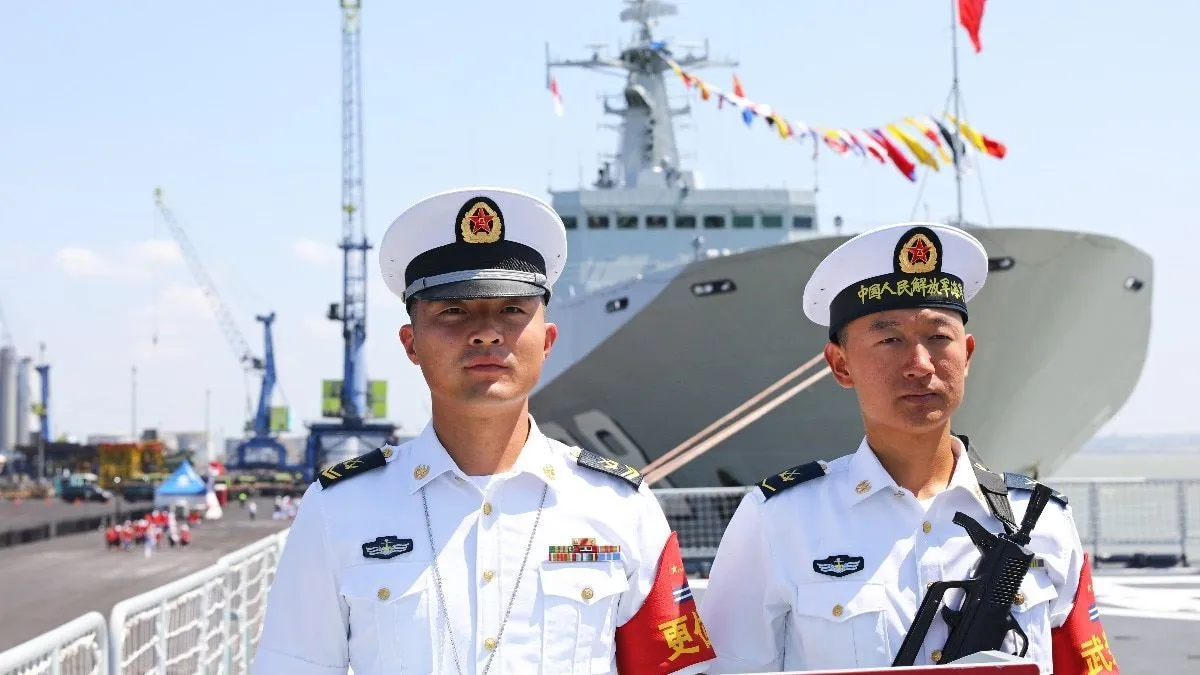
Every day, around 100 Chinese navy vessels are believed to be operating on some of Asia's busiest trade and transportation routes. The constant presence of so many warships has become a growing concern for American military planners, especially as China's fleet has grown larger than the US Navy in the number of ships. The Chinese Navy, which was once mainly a regional force, is now a more ambitious presence that Washington can no longer ignore.
China's battle force now exceeds 400 ships and submarines, making it about 35% larger than the American fleet by hull count, according to a report in The Wall Street Journal. This expansion ranks among the biggest peacetime naval buildups of modern times. It is powered by China's role as the world's leading commercial shipbuilder, which allows it to produce warships faster than the United States.
Chinese naval activity spans a wide stretch of Asian waters, from the busy South China Sea and waters around Taiwan to areas east of the Philippines and off Japan's southern coast. Its ships have also ventured into the wider western Pacific, while maintaining far-sea deployments in the Gulf of Aden and surrounding waters.
On islands near Shanghai, the same yards that produce more than half of the world's merchant ships also build advanced combat vessels at the same time, including large amphibious ships, destroyers and frigates, The Wall Street Journal reported.
This industrial strength has shown up in recent operations close to home. A map shared by a Taiwanese official showed 53 Chinese ships, 34 of them naval warships, with the aircraft carrier Liaoning and its escorts positioned east of the Philippines, Reuters reported.
Other groups were seen off Taiwan's eastern and southeastern coasts, and three more operated near the southern coast of Japan. Japanese defence authorities also tracked three Chinese warships and a coast guard ship as they passed through the Osumi Strait into the Pacific, according to the same Reuters report.
Beijing, as per the report, called the carrier's activity in the western Pacific routine annual training meant to "test long-range combat skills" and said the drills were not aimed at any particular country.
THE ABILITY TO KEEP SHIPS AT SEA FOR LONG PERIODS
The ability to keep ships at sea for long periods adds another dimension to China's growing reach. A Global Times report described the return of the 48th escort taskforce to Qingdao after 378 days at sea. The mission covered more than 150,000 nautical miles and protected 423 commercial vessels in the Gulf of Aden and nearby waters. The group included a modern destroyer, a frigate and a supply ship.
Chinese military experts quoted in the Global Times report said successive taskforces have now regularly stayed deployed for more than 300 days. They pointed to improved equipment reliability, better-trained crews and stronger logistics as the reasons. Support bases in Djibouti and a newer joint facility in Cambodia help by offering rest, repairs and supplies far from Chinese ports.
These long-distance missions run alongside denser activity nearer to China's coasts.
Large Chinese surface warships, comparable in size to cruisers, now regularly operate thousands of miles from China, The Wall Street Journal reported. Carriers have held dual-group exercises in the western Pacific and launched fighter jets that closely shadowed foreign aircraft. Meanwhile, submarine production by Beijing has also increased sharply.
US assessments cited in the WSJ report expect Chinese submarines to operate regularly in the Indian Ocean and possibly the Atlantic within the next 15 years.
Notably, Chinese President Xi Jinping has played a central role in accelerating China's naval expansion. He presented sea power as vital to national strength, drawing on historical examples of how control of the oceans helped earlier powers rise.
In 2013, shortly after becoming president, he told the Communist Party's Politburo that "throughout history, the development of great powers has been inseparably linked to the ocean".
Citing how Western powers had used advances in navigation to open trade routes, expand overseas colonies and control global commerce, Xi argued that maritime strength had helped shape the world order.
He also invoked China's own history, recalling the 15th-century voyages of Admiral Zheng He and warning against the consequences of the country's subsequent retreat from the seas. "Historical experience tells us that orienting to the ocean will lead to prosperity, while abandoning the ocean will lead to decline," he said.
The result is a navy that trains hard, keeps a continuous presence around Taiwan and in the South China Sea, and steadily moves farther into waters once dominated by American forces.
CHINA'S GROWING NAVAL REACH TESTS US MARITIME DOMINANCE
The scale of China's naval expansion is becoming more consequential as tensions rise across the Indo-Pacific, particularly around Taiwan and in the contested waters of the South China Sea.
China's relations with Japan and the Philippines have worsened in recent months, reported Reuters.
Beijing has been angered by Japanese support for Taiwan and remains locked in a dispute with Manila in the South China Sea. Taiwan's defence minister said any attempt to project force in ways that threaten regional stability is unwelcome. A senior Taiwanese security official noted that if the Liaoning group continued north toward Japan, it would suggest a clearer intent to pressure Tokyo.
China has never ruled out the use of force to bring Taiwan under its control, though it says it prefers peaceful reunification. US Army commanders in the Pacific, according to Reuters, have prepared on the assumption that China could move against Taiwan as early as next year.
For the United States, the gap in shipbuilding and daily operations is clear.
Even though the American shipbuilding budget has doubled over the past 20 years, the US fleet is no larger than it was in 2003, reported WSJ. Little commercial cargo now travels on US-flagged ships, and the industrial base for large ocean-going vessels remains limited.
America's programmes to build new frigates, extend the service life of aging cruisers, and operate a large fleet of littoral combat ships have all run into serious difficulties and fallen short of their original goals, The Wall Street Journal also said.
In the meantime, Chinese forces keep a layered daily presence in the western Pacific that no other navy matches, with several ships around Taiwan at all times and far more in the South China Sea.
The mix of high daily numbers at sea, proven ability to sustain long missions far from home, carrier operations near sensitive coasts, and a shipbuilding system that can expand the fleet quickly has changed the strategic picture for the US.
- Ends
(Written By: Anand Singh)