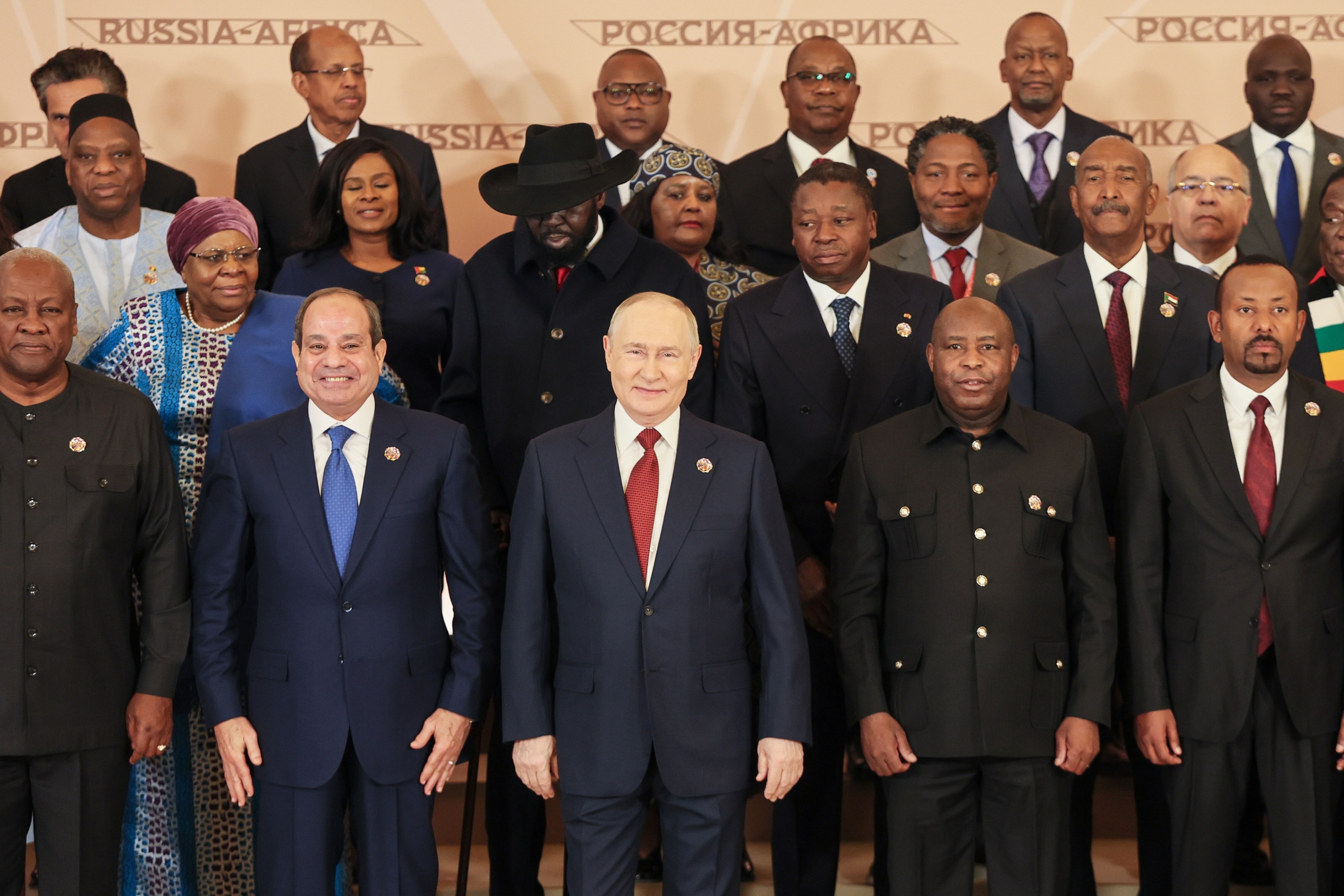
In late October, African leaders arrived in Moscow for the third Russia-Africa summit and a seemingly endless procession of diplomatic meetings. The message was clear: Russia wants to renew its engagement with Africa. The Kremlin seeks to portray Russia as a global power returning to the African continent, carrying the Soviet legacy of support for Africa’s anti-colonial movements.
Vladimir Putin also used the summit to advance another geopolitical ambition ahead of the November 19th meeting with Xi Jinping and Donald Trump: for Russia to have the same global standing once enjoyed by the Soviet Union. Putin is searching for a “new Yalta” in which he, in Stalin’s role, can bargain with two other great powers over spheres of influence. Russia’s hosting of African leaders and Putin’s seemingly offhand references to the Soviet Union’s role in international relations during recent public appearances, as well as his massive publicity efforts, reflect the president’s attempt to portray himself as a statesman with the authority to redraw the world’s political map.
For all Moscow’s claims of uniqueness, however, “Africa+1” summits are commonplace. European governments and other powers across Asia and the Middle East often convene similar gatherings to court the continent. To strengthen their standing in Africa, Europeans should be more vocal about their interests and offer African countries an alternative to Russia.
Moscow expands its Africa bureaucracy
The second Russia-Africa summit in 2023 drew criticism for delivering little benefit to Africa. Putin responded by tasking numerous Russian government agencies and state-backed actors to build stronger ties with Africa. By 2026 these efforts had amounted, among other things, to two ministerial conferences that aimed to strengthen ties between government agencies; the establishment of a new Department for Partnership with Africa in the foreign ministry; and United Russia’s “For the Freedom of Nations!” movement and parliamentary initiatives to bring Russian and African parties into a wider anti-colonial network. The Kremlin also hosted youth gatherings and media forums to promote Russia’s view of the global order.
These initiatives sit alongside Russia’s military presence in Africa, which remains its most consequential source of influence on the continent. However, the war in Ukraine has exposed the limits of Moscow’s economic and financial resources. While African countries are diversifying their partnerships based on national development objectives, Putin missed the target he set in 2019 to double trade with Africa to around $40bn in five years. He is now aiming for $50bn by 2030.
Russia’s goods trade with Africa totalled $27bn in 2025, roughly matching its trade with Kazakhstan, while EU-Africa goods trade reached €356bn. Moreover, Russia accounts for less than 1% of Africa’s inward foreign direct investment stock, far behind China, the US and the EU. Agriculture offers more tangible gains. Russian agricultural exports to Africa reached $2.9bn in the first half of 2026, up 35% in value on the same period in 2025. However, Russia’s war in Ukraine is disrupting Ukrainian grain exports. This creates friction with African governments seeking the return of reliable supplies via the Black Sea.
From trade to sovereignty
Moscow has limited prospects of competing economically on the African continent. It is therefore increasingly framing partnerships with African countries ideologically while simultaneously pursuing more pragmatic cooperation in selected sectors, such as technology and agriculture. Putin’s speeches, final declarations and business programmes at the 2019, 2023 and 2026 Russia-Africa summits demonstrate this attempt.
Over the last seven years, the frequency of use of trade and investment terms has fallen by more than half in Putin’s speeches and by over a third in the business programmes. Putin’s references to military security and terrorism fell even more sharply in his speeches and almost halved in the final declarations. By 2026, references to sovereignty had gained prominence in both programmes and declarations, highlighting the core of Russia’s Africa strategy and tapping into existing anti-French and European sentiment, especially in West Africa. Putin is also placing greater emphasis on colonialism and multipolarity, grounding Russia’s claim to relevance in its vision of a multipolar world, of which the Kremlin is a champion.
Russia is also drawing institutions such as universities and media organisations into its Africa policy, tasking them with facilitating cultural cooperation between Russia and Africa. Such organisations can form part of Russia’s wider disinformation campaigns. Between 2019 and 2026, Putin’s speeches nearly doubled their references to education and the Russian language, while the business programmes used them almost twice as often. The use of information-related terms, such as “media” and “informational agenda”, also more than doubled, largely through new media-forum sessions bringing together Russian and African journalists and media executives as a separate part of the third summit.
Russia’s more selective and pragmatic agenda also includes energy, which regained prominence in the programmes and declarations between 2023 and 2026, drawing on Russia’s expertise in nuclear power. And, as part of Russia’s drive for pragmatic cooperation, the country also pursues seemingly uncontroversial themes such as its 2026 declaration on civilian AI. However, this offers African partners little immediate help. Many have more pressing industrial and economic needs.
Pendulum partnership
Moscow’s bureaucratic expansion and stronger ideological approach are struggling to resonate with its potential partners in Africa.African governments choose partners pragmatically, based on their ability to deliver socio-economic growth, industrialisation and job creation. Even so, most of Moscow’s core partnerships in Africa continue to rest on security cooperation.
For example, Russia has deployed forces in Burkina Faso, Mali and Niger, and in the Central African Republic (CAR), Libya and Equatorial Guinea. It has also formalised defence cooperation with Togo and continues to pursue a military base in Sudan. The share of African speakers from these eight states at the three Russia-Africa summits rose from 5% in 2019 to 23% in 2026. Speakers from Russia’s BRICS+ partners, Egypt and Ethiopia, brought this up to 30% in 2026.
Elsewhere, some African countries’ ties with Moscow fluctuate depending on changes of government and their renewed attempts to diversify partnerships. Ghana’s president John Mahama led his country’s 2026 summit delegation, which saw six Ghanaian speakers in the business programme. Russia and Ghana also reached an agreement on bauxite mining and alumina refining, and Russia has committed to help develop Ghana’s first nuclear power plant.
Yet, despite Mahama’s ties to Russia (he studied in the Soviet Union), the speech data show that Ghana retains a pragmatic approach. Mahama’s renewed engagement with Russia perhaps reflects a search for partnerships that best serve Ghana’s national interests.
The specific terms that Russian and African leaders use in their plenary speeches also illustrate the divide between ideological and pragmatic cooperation. Putin used ideological vocabulary more than twice as often in 2026 as in 2019, while his use of economic terms remained largely static. Among Moscow’s security partners, ideological language held roughly steady between 2023 and 2026, while references to trade, energy and investment doubled. Egypt’s emphasis changed little. President Abdel Fattah el-Sisi used ideological terms as often as Putin in 2019, but by 2026 Putin used them 75% more often than Sisi.
African leaders outside the core group of eight security partners plus Egypt and Ethiopia used ideological terms 25% less frequently between 2023 and 2026, while the use of pragmatic vocabulary rose by more than a third.
Some countries are scaling back their cooperation with Russia amid limited economic returns and tensions over the war in Ukraine. For example, in 2026, South Africa sent its foreign ministry’s director-general and Nigeria a junior foreign minister, replacing the presidents who attended in 2019. Their business programme speaker counts fell from 14 to five and from seven to three, respectively.
An opening for Europe
Insights from confidential conversations between ECFR’s Africa programme and African policymakers suggest that the continent’s governments and leaders appreciate a more pragmatic approach from European partners. This involves Europeans acknowledging the legacy of European colonialism in Africa, but also realising that in a fragmented global order Africa has options to choose from.
Europe would benefit from identifying where Russian political actors are working at cross-purposes and leveraging this fragmentation in diplomatic negotiations with African partners. For example, the former Wagner chief Yevgeny Prigozhin welcomed the Niger coup in 2023, while Russia’s foreign ministry backed ECOWAS in restoring constitutional order. In the CAR, his son Pavel Prigozhin has held on to Wagner’s operations despite the Russian defence ministry’s efforts to absorb them.
As Moscow gives its bureaucratic players a bigger role in Africa, such tensions are likely to grow. The Russia-Africa Action Plan for 2027-2029 contains 236 measures, including joint drone, fertiliser and vaccine production, and cooperation between the African Union and the Russia-led Collective Security Treaty Organisation. But these priorities, and Russia’s bilateral agreements with African countries, can undermine one another: Rosatom requires deep cooperation with Accra to develop the planned nuclear power plant in Ghana, for example, but Russia’s coercive recruitment of Ghanaians for its war against Ukraine risks eroding bilateral trust. Even Mahama, who praised Moscow’s support for Africa’s anti-colonial struggles, has challenged Putin over the practice.
Where Moscow’s competing interests undermine its summit promises, Europe can build trust by backing projects that African partners themselves prioritise. An example is the African Continental Free Trade Area (AfCFTA), for which the EU provided technical and financial support. Despite facing some difficulties, the AfCFTA highlights where European and African strategic interests align—and where Europeans can help Africans reach their objectives, without setting the terms.
Europeans also need to understand that, for African partners, pursuing a narrative in which Europe “counters” other actors such as Russia may not land well. Although Africa has considerable growth and market potential, the continent does not want to be approached as an international bargaining field. European governments should instead sharpen their own offer and advance investments in areas such as education and training, technology and engineering. Forums such as the AU-EU Senior Officials Meeting in Addis Ababa are essential for Europe to stay aligned with African priorities, while the participation of high-level European leaders, such as German president Frank-Walter Steinmeier at the upcoming German-African Business Summit in Ghana, signals how seriously they take cooperation.
*