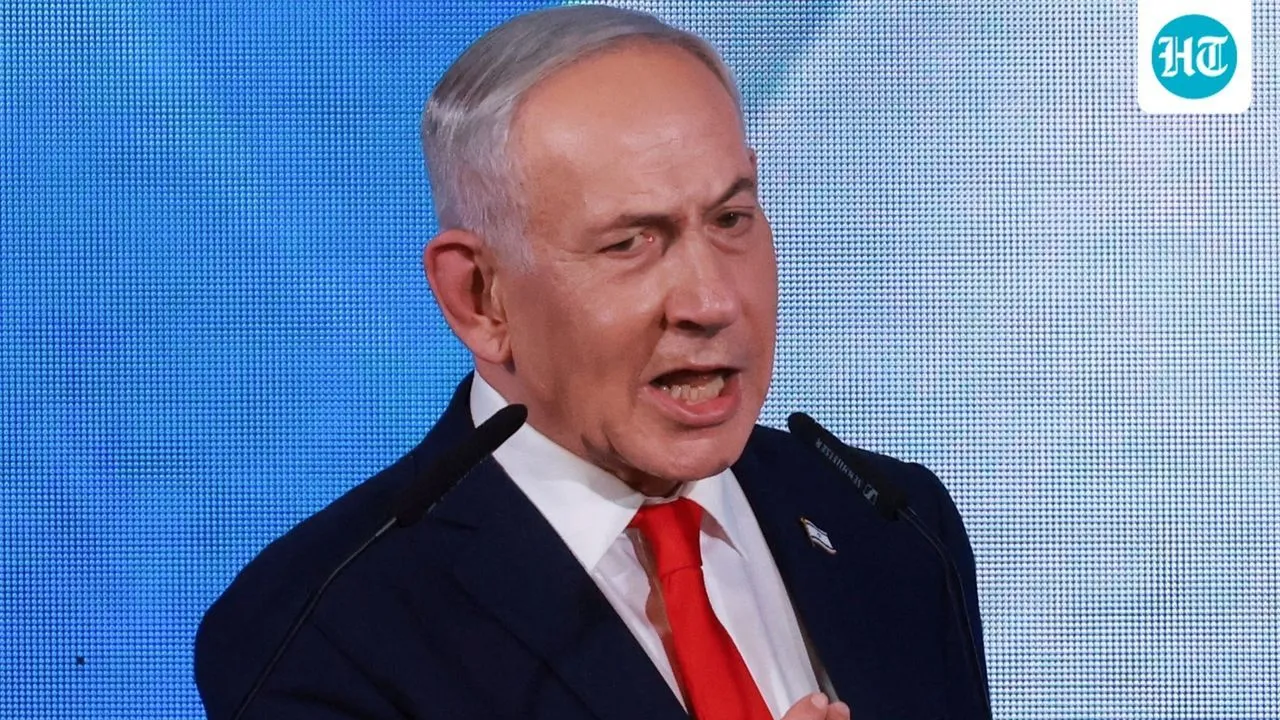
Outgoing Israeli Prime Minister Benjamin Netanyahu has signaled his willingness to explore the formation of a “unity government” of Zionist and Haredi parties under his leadership. Netanyahu stressed that forming a unity coalition was a "vital need".
This comes a day after Israel's former military chief Gadi Eisenkot said he was willing to include Netanyahu and one of his far-right allies in a coalition government, provided he remained its leader.
“I don’t rule anyone out, and no one else should be ruling others out,” Netanyahu said in a video statement released by his office, quoted The Times of Israel.
ALSO READ: Gadi Eisenkot has 6 weeks to prove majority in Israel. How he could get numbers in his favour
“We must join forces in the face of the challenges in front of us,” Netanyahu further said.
Netanyahu maintained that Likud, being the largest political party, should take the lead in forming a coalition bringing together “all the parties in the national camp, including the Haredi parties, and all other Zionist parties.” He also expressed his willingness to begin discussions without delay with any party open to considering the proposal.
Eisenkot begins task of forming govt
Eisenkot on Monday started the task of forming a government as directed by President Isaac Herzog, AFP reported.
Eisenkot received the support of 67 lawmakers, compared with 46 who supported Benjamin Netanyahu's Likud-led bloc. He now has 28 days to form a government. The president can extend the deadline by up to 14 days if required.
"If members of Likud and the Religious Zionist Party truly believe this is a time for unity, as they told the president, I cannot conceive of any reason why they would not support a government under my leadership and the principles I have presented," Eisenkot had said.
ALSO READ: Iran’s reality check after GOP losses? Araghchi says Americans are tired of Israel’s ‘forever wars’
What did the election results show?
The Israeli elections on October 27 threw up a hung parliament, with both coalitions led by Eisenkot and Netanyahu failing to secure a majority in Israel's 120-member Knesset. Likud Party emerged as the largest party with 27 seats, while Yashar won 21 seats. For a government to be formed, a party or a coalition must have 61 seats in the Knesset.
Naftali Bennett's centre-right Together Party won 12 seats and the centre-left Democrats led by Yair Lapid won eight seats. Yisrael Beitenu, Otzma Yehudit and United Torah Judaism (UTJ) bagged seven seats each, while Shas and the Religious Zionism Party–Zehut list secured six each.
Overall, Eisenkot's coalition - including his Yashar party, the centre-left Democrats, Naftali Bennett’s centre-right Together party and Avigdor Lieberman’s right-wing Yisrael Beiteinu - won 48 seats, while Netanyahu's bloc got 53 seats. Arab-led parties Ra'am (United List) and Joint List emerged as kingmakers, winning 19 seats in total.