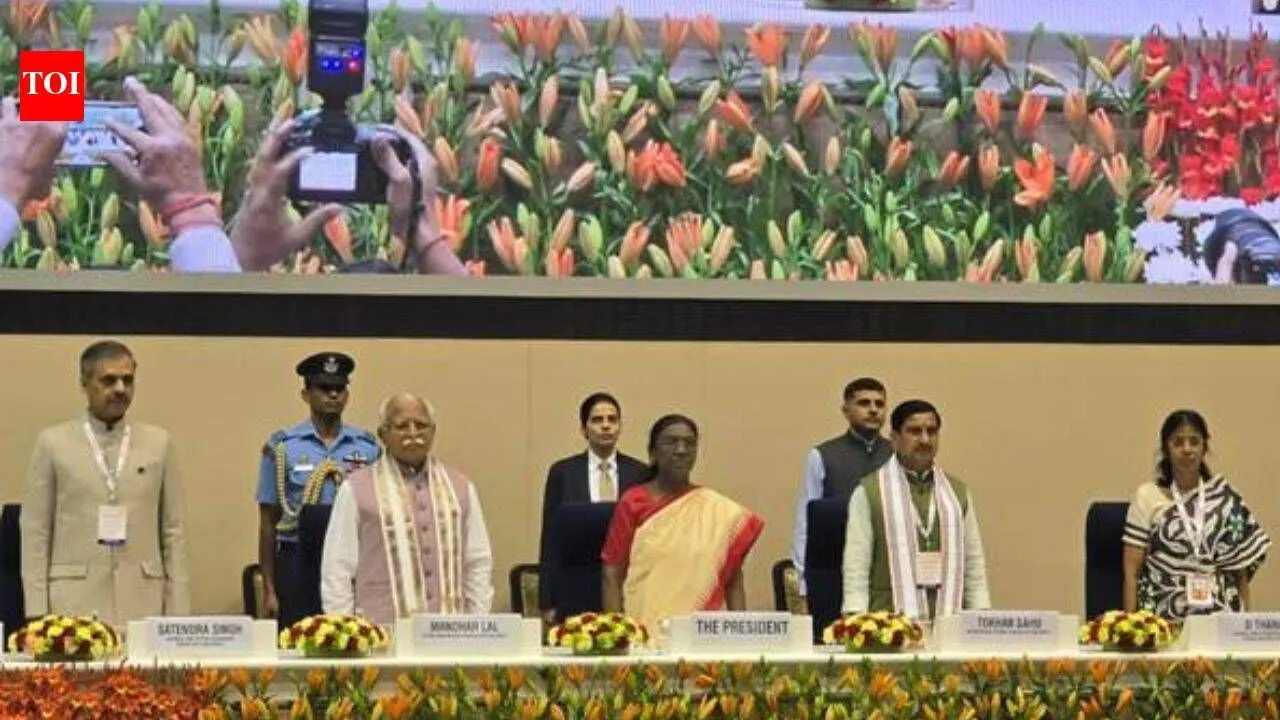
Swachh Survekshan Awards 2025-26 (Image: Press Information Bureau)
In the Swachh Survekshan Awards 2025-26, Maharashtra’s Navi Mumbai has emerged as the top-ranked city in India’s Clean Cities of Super Swachh League category. Gujarat’s Surat and Andhra Pradesh’s Vijayawada secured the second and third positions, respectively. The awards, based on the Central Government’s annual cleanliness survey, were presented by President Droupadi Murmu at a ceremony held at Vigyan Bhawan in New Delhi on Wednesday, November 11. More than 4,700 urban local bodies participated in the survey. Indore, which had held the top position in the country's cleanliness rankings for eight consecutive years, featured in a new category this time. It was ranked second in the Swachh Shehar Jodi category, along with its partner town, Depalpur. This category comes under a new initiative aimed at improving urban waste management through mentorship and knowledge-sharing between cities. Ahmedabad, as the mentor city, and Sanand, as the mentee city, topped the list. Tirupati and Kuppam secured the third position in the category. The initiative was launched under the Swachh Bharat Mission-Urban and is structured as a city-to-city mentorship and peer-learning programme. This year, 70 mentor cities were paired with 191 mentee cities, selected based on their past performance in the cleanliness survey. Top-performing cities were chosen as mentors to help lower-performing towns improve their sanitation and waste management practices. The initiative draws inspiration from India's Guru-Shishya tradition and follows the principle of 'Each One, Teach One'. Its aim is to share knowledge, experience and best practices from one city to another, collectively advancing urban cleanliness and excellence. Other new categories introduced this year for the first time were Swachh River Front Town, Swachh Coastal Town and Clean Himalayan City. While Madhya Pradesh's Rewa was ranked as the cleanest River Front Town, the holy city of Puri in Odisha won the award in the Swachh Coastal Town category. Among the Clean Himalayan Cities, Uttarakhand's Rudrapur topped the list. GVMC Visakhapatnam emerged as the cleanest city in the population category of over 10 lakh, followed by Jabalpur and Lucknow. Among cities with populations between 3 lakh and 10 lakh, Ujjain, Chandigarh and Guntur were the top three, according to the survey results. Moreover, Madhya Pradesh's Dewas, the New Delhi Municipal Council (NDMC) and Sagar in Madhya Pradesh topped the list in the 50,000 to 3 lakh population category.
Swachh Survekshan Awards 2025-26 (Image: Press Information Bureau)
The inclusion of hill and Himalayan cities gave smaller mountainous urban centres an opportunity to feature in the awards. The second and third positions in the newly introduced Clean Himalayan City category went to two cities from the Union Territory of Jammu and Kashmir, with Jammu securing the second spot and Shopian coming third. Kerala's Alappuzha and Maharashtra's Ratnagiri secured the second and third positions, respectively, in the Swachh Coastal Town category. Bilaspur in Chhattisgarh, along the banks of the Arpa River, and Uttar Pradesh's Varanasi, along the Ganga, were ranked as the second and third cleanest River Front Towns this year. In order to increase tourism across Indian cities, maintaining clean and hygienic conditions must be a priority. President Droupadi Murmu also underlined the importance of cleanliness in Indian cities, saying, "Cleanliness cannot be achieved through the efforts of any single institution alone and requires active participation from all stakeholders." She also highlighted the role of citizen participation, administrative accountability and sustained public engagement in achieving better results.
Join conversation
Share your thoughts in the comments
Be respectful · TOI community guidelines
The results this year reflected significant improvements, with more than 350 urban local bodies (ULBs) improving their positions by over 500 ranks. More than 1,700 ULBs with populations below 50,000 also improved their rankings compared with 2024-25. This demonstrates the sustained efforts and growing citizen participation in improving cleanliness standards across urban India. This was the 10th edition of Swachh Survekshan, in which urban local bodies were assessed across 43 indicators covering 10 critical domains. These included various stages of the waste management cycle, such as segregation, collection and transportation of waste, and solid waste management. Other parameters included access to sanitation, visible cleanliness, the welfare of sanitation workers, citizen feedback and grievance redressal. The assessment also covered the mechanisation of desludging services, ecosystem strengthening and institutional parameters, used water management, and advocacy for Swachhata.
End of Article