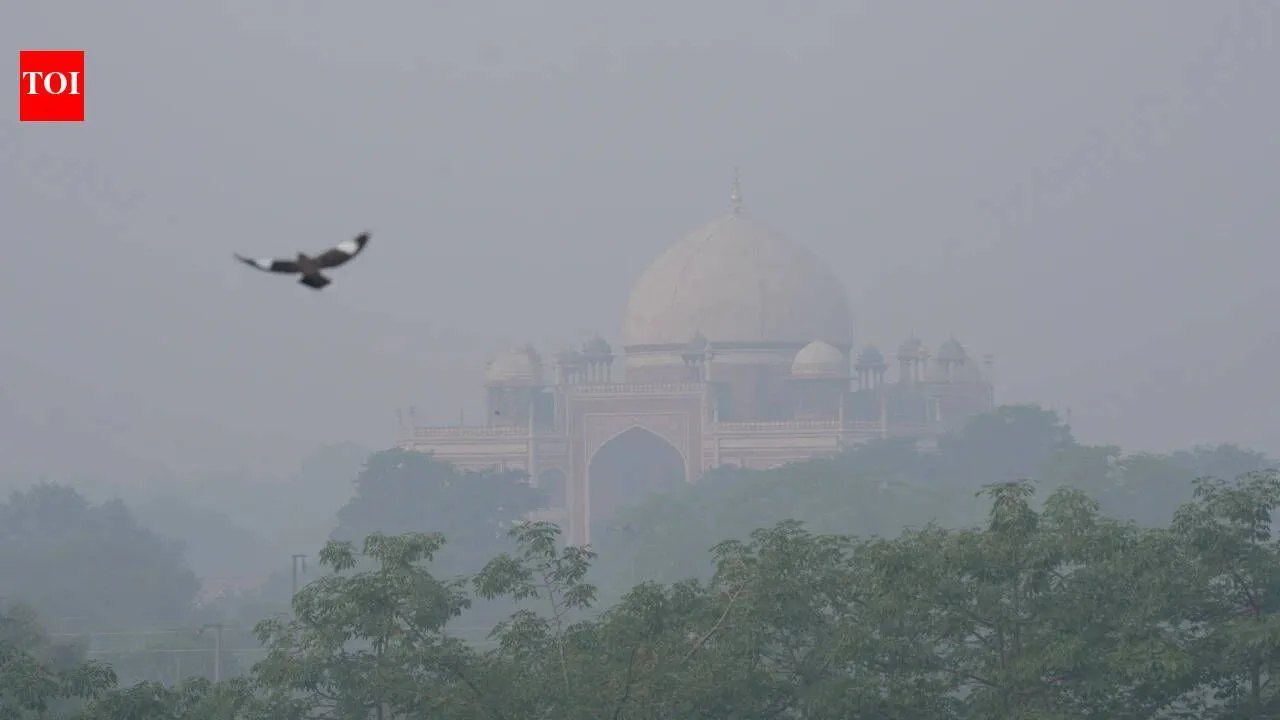
Delhi's air quality continues to be classified as very poor, with an AQI of 367 recorded on Saturday (Representative image)
NEW DELHI: Delhi’s air quality stayed in the very poor range Saturday with the AQI recorded at 367, and a greyish haze enveloped the city. At least 17 stations were in the severe category. Though India Meteorological Department (IMD) has predicted that there is a possibility of very light rain at isolated places Sunday, experts said respite from toxic air quality is unlikely. Gufran Beig, founder of System of Air Quality and Weather Forecasting and Research (SAFAR) and chair professor at National Institute of Advanced Studies (NIAS), said, “During winter, very light rainfall or drizzle is not sufficient to clear pollutants from the atmosphere and it may worsen the air quality. "High moisture levels can instead facilitate chemical reactions between gaseous pollutants and suspended particles, resulting in the formation of secondary aerosols,” he said further. He added that rain washes out pollutants in the winter season only when there is intense and sustained rainfall.
NCR's best and worst
The air quality is forecast to remain in the very poor range till Tuesday, according to the Air Quality Early Warning System. The city saw “severe" air (AQI above 400 on a scale up to 500) for a few hours Friday morning, but it dipped to the very poor range at 367 at 4pm when Central Pollution Control Board released its 24-hour average AQI bulletin. The most polluted locations in Delhi on Saturday were IIT-Delhi and north campus, Delhi University, both recording an AQI of 439 at 4pm. Other stations which witnessed severe air quality were ITO (435), NIH Narela (433), Pusa (431), Burari Crossing (431), DTU (422), JNU (415), NSIT Dwarka (413), NSUT Jaffarpur (412), Commonwealth Sports Complex (411), Punjabi Bagh (409), Bawana (408), CRRI Mathura Road (403), Jahangirpuri (401) and Vivek Vihar in Lajpat Nagar (401). In November so far, the city has recorded 12 very poor days and two poor days. Biomass burning, including stubble burning, domestic solid biofuel, dung cakes and wood, was the dominant source of pollution, accounting for 25.5% of Delhi’s PM2.5 between 1am and 9am on Saturday.
Join conversation
Share your thoughts in the comments
Be respectful · TOI community guidelines
It was followed by secondary organic aerosols at 23.6% and vehicles at 17.4%, according to the Indian Institute of Tropical Meteorology’s real-time source apportionment data. Emissions from mixed combustion contributed 12.6% and secondary inorganic aerosols accounted for 10.7%. The share of burning waste, including municipal, plastic and rubber, was 6.8%. The contribution of emissions from firecrackers became almost negligible at 1.4%. Secondary organic aerosols form when volatile organic compounds released by sources such as vehicles, industries, solvents and vegetation react with other substances in the air, creating particulate matter.
Do you think enough measures are being taken to address air pollution in Delhi?
Yes, substantial efforts are seen No, more needs to be done I'm not sure
3k+ users shared opinion today
5k+ users already voted today
3k+ users shared opinion today
Share Opinion
Secondary inorganic aerosols develop when gases such as sulphur dioxide, nitrogen oxides and ammonia undergo chemical reactions in the atmosphere, producing particles like sulphates and nitrates.
End of Article