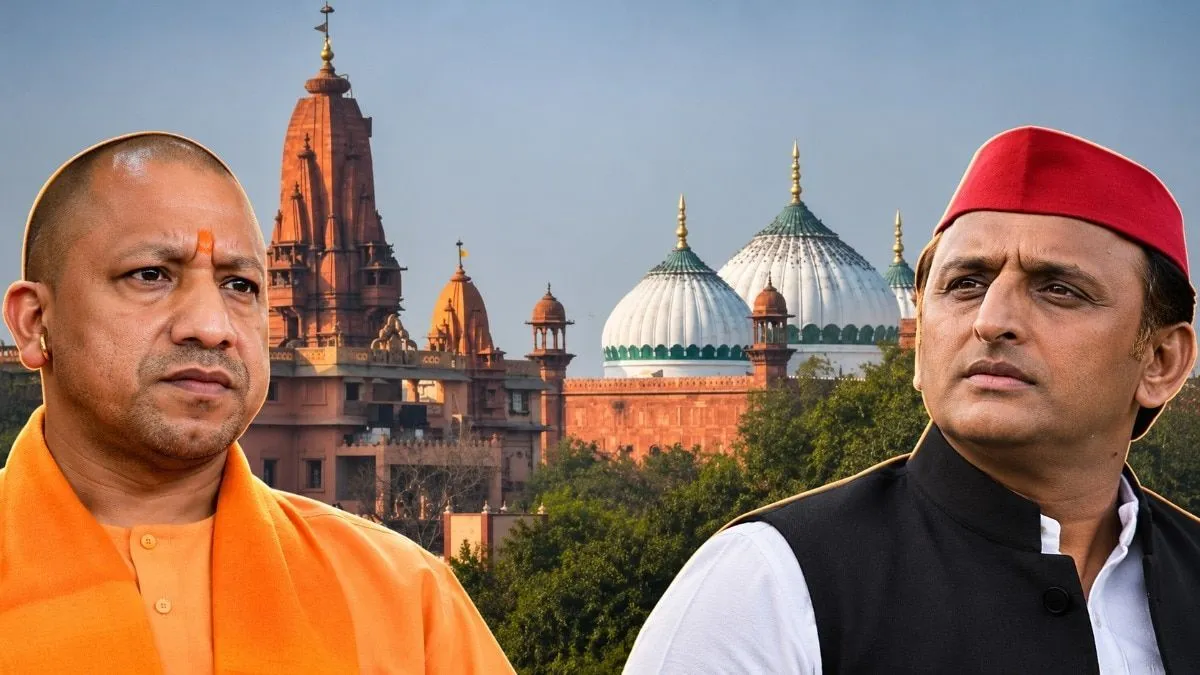
Just when Lord Ram's Ayodhya seemed set to have become the biggest battleground ahead of the 2027 Uttar Pradesh Assembly elections, Lord Krishna's Mathura entered the picture and grabbed the spotlight.
The BJP and Samajwadi Party had been sparring over Akhilesh Yadav's proposed visit to the Ram Mandir on December 12. The BJP invoked the 1990 firing on kar sevaks by the then Mulayam Singh Yadav government and demanded Akhilesh's apology before his promised Ayodhya visit. The Samajwadi Party chief tried to corner the BJP by raising the alleged donations theft at the Ram Temple in Ayodhya.
Even as that slugfest over Ayodhya continued, Akhilesh clubbed Vrindavan to his "temple darshan" plan, and the BJP announced a two-day strategy meeting in Mathura for November 16 and 17. This has brought the Krishna Janmabhoomi dispute to the centre of the political conversation before the crucial polls in India's largest state.
The turn from Ayodhya to Mathura was encapsulated in UP Deputy Chief Minister Keshav Prasad Maurya, as he invited Akhilesh Yadav to join kar seva for a grand Krishna temple in Mathura, adding, "Ayodhya hui humari, ab Mathura ki baari."
The BJP's two-day strategy meeting in Mathura was attended by party president Nitin Nabin, CM Yogi Adityanath, both deputy chief ministers and senior party functionaries. The meeting, aimed at preparing the BJP for its bid for a third consecutive term in UP, and the statements made by its leaders on its sidelines have brought Mathura and the demand for a grand Krishna Janmabhoomi temple to the centre of the political discourse ahead of the 2027 elections.
Mathura MP Hema Malini also backed the demand for a grand Krishna temple. Sources told Aaj Tak TV that the BJP had discussed a plan to resolve the Krishna Janmabhoomi dispute within six months of returning to power in 2027, amid mounting pressure from party cadres to take up the issue. However, no such commitment has been officially confirmed by the party.
The Krishna Janmabhoomi-Shahi Idgah dispute concerns ownership of 13.37 acres of land in Mathura, where the Shahi Idgah mosque stands adjacent to the Krishna Janmasthan temple, at the site believed to be Lord Krishna's birthplace.
Hindu petitioners have sought the mosque's removal and challenged a 1968 agreement between the temple management and the mosque trust that allowed both places of worship to coexist. The Mathura dispute has long been one of three major temple-mosque disputes associated with the Sangh Parivar and the BJP, alongside the Ram Janmabhoomi in Ayodhya and Kashi Vishwanath-Gyanvapi in Varanasi.
With the next hearing in the Krishna Janmabhoomi-Shahi Idgah dispute scheduled for November 20, the BJP's renewed temple pitch is set to keep Mathura in the spotlight. So, is the BJP preparing to make Mathura the next Ayodhya? Or is it just another Hindutva plank in its campaign against the Samajwadi Party's Yadav-centric coalition?
AYODHYA APPEARED TO BECOME POLITICAL BATTLEGROUND BEFORE 2027 POLLS
advertisement
The latest confrontation between the BJP and the Samajwadi Party (SP) over Ayodhya began after former SP MLA Pawan Pandey announced that Akhilesh Yadav and his wife, MP Dimple Yadav, would visit the Ram Mandir on December 12.
Akhilesh had promised in January 2024 to visit the temple with his family after its consecration on January 22. Nearly three years later, the proposed December visit would be his first to the Ram Mandir since its inauguration. However, the announcement of the planned visit didn't go well with the BJP.
The BJP responded by invoking the police firing on kar sevaks in Ayodhya in October and November 1990, when Akhilesh's father, Mulayam Singh Yadav, was Uttar Pradesh chief minister.
UP BJP president Pankaj Chaudhary challenged Akhilesh to visit the temple on December 6 (the day the Babri Masjid was demolished) instead and apologise for the firing. The SP has maintained that it supported resolving the Ayodhya dispute through dialogue or judicial proceedings even as UP CM Yogi Adityanath attacked Akhilesh and the SP.
The SP, meanwhile, countered the BJP by attacking it over the alleged theft and embezzlement of donations at the Ayodhya Ram Mandir.
advertisement
Days later, on November 11, Akhilesh expanded his proposed itinerary beyond Ayodhya to Vrindavan (near Mathura) and Kedareshwar, a replica of the Kedarnath shrine dedicated to Lord Shiva that is being built in his native district of Etawah and is expected to be inaugurated soon. Akhilesh also gave the SP's PDA slogan a new meaning. "Pehle Darshan, Phir Ashirwad," he said.
While the BJP and the SP appeared headed for a prolonged confrontation over Ayodhya, the spotlight shifted to Mathura within days.
BJP CHOSE MATHURA TO SOUND ITS POLL BUGLE
On Monday (November 16), the BJP began its two-day Chintan Baithak at the Pandit Deendayal Upadhyaya Gau Anusandhan Kendra in Parkham, Mathura.
The gathering brought together 54 senior leaders, including Yogi Adityanath, deputy chief ministers Keshav Prasad Maurya and Brajesh Pathak, UP BJP president Pankaj Chaudhary and national general secretary (organisation) BL Santhosh. BJP national president Nitin Nabin is scheduled to address the gathering on Tueday (November 17). But the location of the meeting is also very significant.
Mathura is central to Hindu beliefs as the birthplace of Lord Krishna. The Krishna Janmabhoomi-Shahi Idgah dispute concerns claims over the religious complex, where the Shahi Idgah mosque stands adjacent to the Krishna Janmasthan temple. The issue also carries significance for Akhilesh Yadav, whose party draws substantial support from the Yadav community, which traditionally reveres Lord Krishna and traces its lineage to the deity.
advertisement
By inviting Akhilesh to join kar seva for a grand Krishna temple, the BJP has brought the SP chief's religious and political identity into the debate.
"If Akhilesh Yadav wants to join us in kar seva, we will take him along too to build a grand temple of Lord Krishna," UP deputy CM Keshav Prasad Maurya said.
Maurya said the temple could be built through judicial proceedings or mutual discussions, and described Krishna Janmabhoomi as the biggest election issue.
Mathura MP Hema Malini echoed the sentiment. "We have started our meeting in Mathura, and we want construction of Shri Krishna Janmabhoomi in a proper manner, like the Ram temple has been constructed in Ayodhya," she told India Today TV.
Reporting from Mathura, Aaj Tak TV correspondent Piyush Mishra said the message emerging from the BJP's strategy meeting was clear. "Ayodhya is ours, now it is Mathura's turn. This means that the BJP's upcoming political narrative and election campaign will revolve around the construction of a grand temple at Shri Krishna Janmabhoomi," Mishra said on Tuesday.
advertisement
As of now, the Krishna Janmabhoomi-Shahi Idgah dispute remains before the courts, with the Allahabad High Court hearing multiple suits concerning the complex in Mathura. The next hearing is scheduled for November 20.
WHY BJP'S UP POLL RATH HAS TURNED TOWARDS MATHURA
Several factors could explain the BJP's renewed focus on Mathura, and the reported bid to construct a Krishna temple in the city ahead of the 2027 UP Assembly polls.
First could be the BJP's search for another powerful religious issue after Ayodhya. With the Ram Mandir consecrated in 2024, the BJP has a completed temple project to showcase. The Krishna Janmabhoomi-Shahi Idgah dispute, meanwhile, remains unresolved. The Mathura issue offers the BJP a chance to build on the mobilisation, like it had done around the Ram Mandir movement in Ayodhya. The shift towards Mathura would also help the BJP move the political conversation away from Ayodhya, where the SP has been targeting it over alleged theft of Ram Mandir donations.
Secondly, the Mathura pitch challenges Akhilesh Yadav's PDA politics. The SP has built its electoral strategy around Pichhda, Dalit and Alpsankhyak voters. By raising Krishna Janmabhoomi, the BJP could seek to appeal to Hindu religious identity across caste lines. By building a broader Hindu identity narrative around Mathura, the BJP could seek to counter the SP's Yadav-centric mobilisation and appeal to voters across caste lines.
Another factor is the Yadav connection to Lord Krishna. The Yadav community traditionally traces its ancestry to Krishna. Akhilesh is one of its most prominent leaders, and Yadav voters constitute a key support base of the SP. And, the Braj region, where Mathura is located, is also regarded by many Yadavs as their ancestral homeland. So, deputy CM Keshav Prasad Maurya's invitation to Akhilesh to join kar seva puts the SP chief in a politically sensitive position. The BJP has effectively invited him to take a stand on an issue with both religious and community significance.
A fourth factor could be the importance of western Uttar Pradesh. Mathura lies in the Braj region, which has a strong connection with Lord Krishna and a sizeable presence of Jats, Yadavs and other OBC communities. By raising the Krishna Janmabhoomi issue, the BJP could seek to appeal to the non-Yadav OBC communities and strengthen its presence in the region.
Taken together, these factors suggest that Mathura is emerging as a major issue for the BJP ahead of the 2027 UP polls. But this does not mean the party is moving away from Ayodhya. Rather, it is adding Krishna Janmabhoomi to its narrative, even as Akhilesh Yadav tries to challenge the BJP through his proposed visits to Ayodhya and Vrindavan.
- Ends