PM Modi’s messaging implies that the physical war in jungles may be entering its final chapter, but the political and ideological war against urban handlers is just getting started
In the lexicon of Prime Minister Narendra Modi’s political communication, catchphrases are never accidental, and repetitions are never lazy or casual.
When PM Modi first unleashed the term ‘Dimagi Naxal’ during his August 15 address from the ramparts of the Red Fort, mainstream political observers dissected the term and his speech; some showed opposition to such a branding, some felt offended, while some dismissed it as a standard Independence Day rhetoric. But the prime minister did not let the momentum around his coinage fade away. Instead, he defended it light-heartedly in a later address at Shri Ram College of Commerce in September, calling it a “homeopathic pill" designed to make hidden adversaries surface.
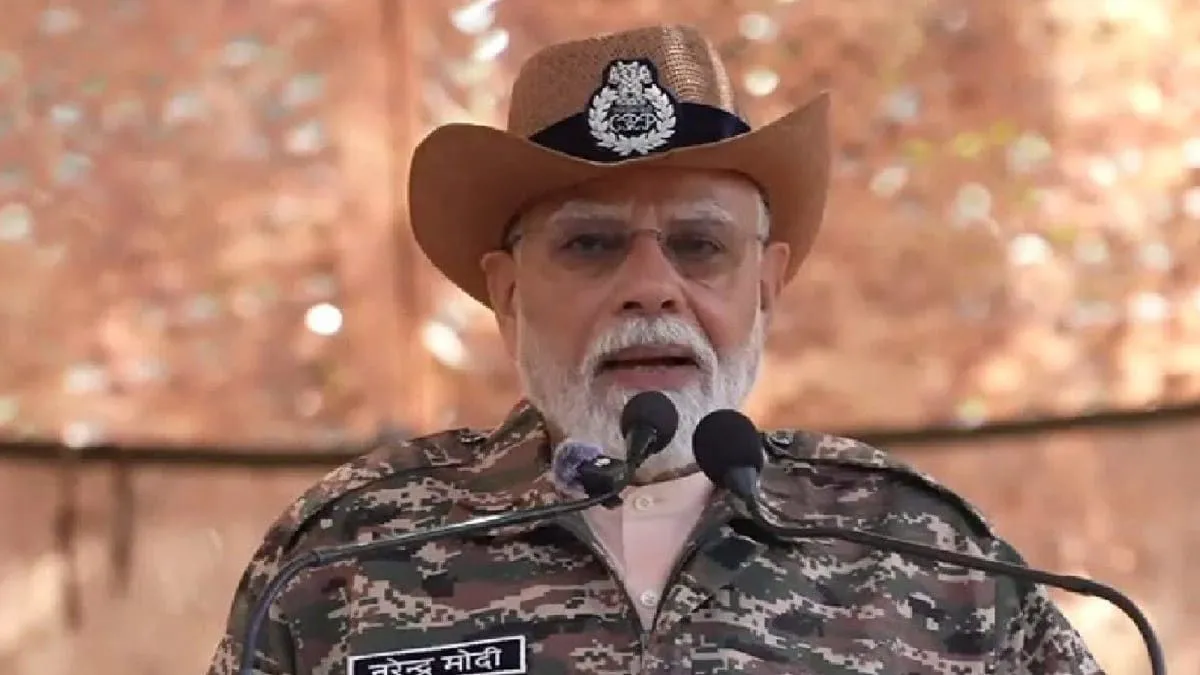
But his deliberate, razor-sharp reiteration of the term on Sunday at the CoBRA base in Chhattisgarh’s Bastar elevates it from a mere political punchline to a definitive state doctrine. His speech was meant to mark a moment of triumph for the near-eradication of armed Naxalism after decades of insurgency. Yet, tucked into his address to security personnel was another political message—one that may have a longer shelf life than the declaration of victory itself.
By taking an abstract intellectual concept coined in New Delhi and explicitly anchoring it to a real-world, battle-tested counter-insurgency camp, PM Modi has completed a strategic loop. He has connected the Red Fort to the Red Corridor. This second usage is a calculated messaging signal to the nation, implying that the physical war in the jungles may be entering its final chapter, but the political and ideological war against their urban handlers is just getting started.
This is clearly a loaded message for the party cadres, while one can even call it a signal for the law-enforcement agencies.
The Shift In The Theater Of War
For over a decade, PM Modi’s annual Diwali custom of visiting the frontlines meant high altitudes, freezing temperatures, or naval decks. His choice of the CoBRA Operations Base at Karanpur in Bastar for Diwali 2026 was not just about sharing festive sweets with security personnel. It was a carefully synchronised operational audit wrapped inside a powerful political messaging exercise. And, the timing is really crucial.
The security apparatus has effectively read the last rites of physical, weaponised Left-Wing Extremism (LWE) in central India. For the first time in nearly five decades, the home ministry can boast of a year where the CRPF lost no personnel on duty in LWE theatres.
But in politics, a vacuum is a dangerous thing.
The takeaway from PM Modi’s Bastar speech is how the BJP plans to utilise this hard-won security victory. Insiders reveal that the top leadership realised that while the AK-47s in Abujhmad in Chhattisgarh have fallen silent, the political utility of anti-extremist rhetoric remains potent.
By declaring that physical Naxalism has been heavily neutralised on the ground, the PM is systematically denying the Opposition any opportunity to question his track record on internal security. However, this also means that the boots-on-the-ground battle is won and the government is now entering the phase of intellectual clean-up.
PM Modi’s use of words like ‘identify and isolate’ in his reference to ‘Dimagi Naxals’ was particularly striking, as it suggested not merely countering an ideological position but singling out and excluding those perceived to be its proponents from the social and intellectual mainstream.
Electoral Subtext
Politically, this second strike sets up the battlefield for the upcoming crucial assembly elections and subsequent national narrative building.
By warning that these ‘Dimagi Naxals’ have now actively infiltrated mainstream political parties, civil organisations, and academic circles to instigate marginalised communities against the Constitution, PM Modi is providing his cadre with a fresh, highly potent vocabulary to brand political rivals.
This completely shifts the profile of the enemy. The adversary is no longer a hidden insurgent in camouflage deep in the woods; it is an ideological opponent operating out of urban centres, universities, and political war rooms.
By contrasting the silent, historical grief of local tribals with the alleged indifference of ‘palace-dwelling leaders’ (naamdaars), the prime minister has successfully transformed a regional security victory into a national ideological stick to beat the Opposition with.
The immediate, aggressive counter-attacks from the Congress camp, with the Leader of the Opposition (LoP) Rahul Gandhi challenging PM Modi to an open debate on national security, and senior leaders calling the prime minister “distraught and desperate", prove that the jibe has landed exactly where the BJP intended.
New Vocabulary For Old Contest
Consider the emergence of the Cockroach Janta Party (CJP), which began as an internet-born and social media-driven satirical intervention, but quickly acquired traction among young people angered by examination irregularities, unemployment and the handling of student grievances. Its protests at Jantar Mantar, and its subsequent mobilisation around the Election Commission, demonstrated how quickly an apparently fringe digital initiative could become a recognisable political platform.
The emergence of Neha Bora, the All-India Students’ Association (AISA) president, as a prominent and powerful face of these protests adds another dimension. Her speeches and repeated participation in demonstrations have given the student Left a visibility that it has struggled to command through conventional electoral politics. The significance is not that these movements represent one coherent ideology. It is about the distress and pent-up grievances beginning to find a common political expression.
The protests have also travelled beyond Delhi. In Bengal, where the Trinamool Congress’s electoral decimation has created an unprecedented opposition vacuum, Left student organisations have attempted to reclaim political space through street mobilisation.
Students from Jadavpur, Presidency and other institutions took to the streets in October, connecting the Jantar Mantar protests against the Election Commission with local concerns over the electoral roll revision. The Left may be far from recovering its former electoral influence, but its ability to provide organisational muscle and a language of protest is becoming visible again.
The Politics Beyond Bastar
None of this makes every protester, student activist or critic an ideological Naxal. However, some of these movements are aligned with the Left. The CJP’s appeal, in particular, has drawn from a wider reservoir of youth frustration that cannot be reduced to traditional ideological categories.
That is precisely what makes the changing terminology worth examining. When a political expression moves from a speech to repeated public usage, it begins to shape how political disagreements are framed. The question is no longer confined to the threat posed by an armed insurgency. It extends to the interpretation of dissent, ideological disagreement and opposition mobilisation.
Bastar may well mark the end of one of India’s longest internal security battles. But, the prime minister’s words point towards another contest over ideas, political legitimacy and the ownership of public dissent. The armed Naxal may be receding from the forests but the politics of the ‘Dimagi Naxal’ is now entering a much larger arena.