This year's Diwali celebrations in Delhi-NCR come with a caveat. The Supreme Court has permitted the bursting of only certified green firecrackers for two days, subject to strict timings and location-specific restrictions, amid concerns over rising air pollution. With the court allowing only certified crackers, questions remain over whether the products being sold in the capital meet the prescribed standards. And if non-green fireworks are being sold in Delhi.
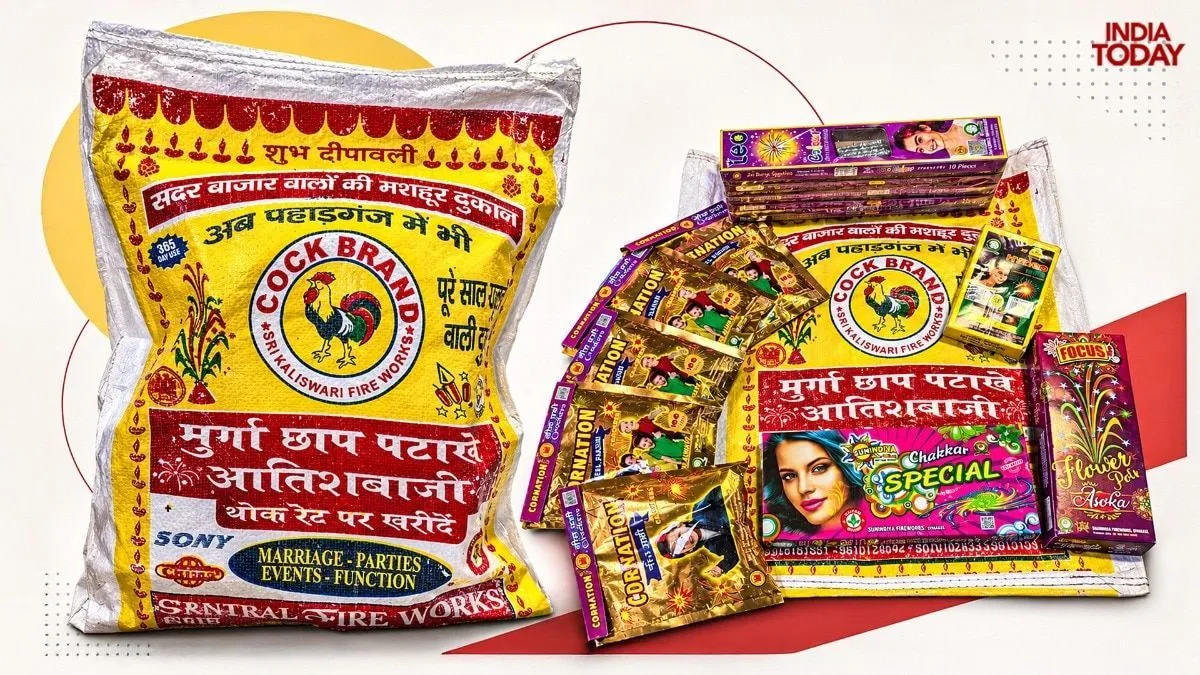
A ground check by India Today Digital at Sadar Bazar, one of Delhi's biggest wholesale markets, found several firecracker boxes carrying QR codes that failed to display mandatory certification details, raising questions about their green credentials. There was no official on the ground who would check and enforce the Supreme Court-mandated green cracker norm.
Scanning the QR code on several of the boxes returned basic manufacturer information, raising questions about whether the products were genuinely certified green firecrackers or were being passed off as such.
A QR code is supposed to be the key identifier for a legally certified green firecracker. The QR codes printed or pasted on the firecracker boxes at Sadar Bazar threw up information that did little to establish them as green.
Instead of displaying the mandatory certification-related particulars, including the company's name, product category, function, PESO licence number, NEERI Green Fireworks registration number and marketer's details, the scanned codes largely returned basic manufacturer information such as the company's name, address, telephone number and email ID. Much of this information was already printed on the packaging.
HOW ARE CRACKERS CERTIFIED GREEN CRACKERS?
The Petroleum and Explosives Safety Organisation (PESO), under the Ministry of Commerce and Industry, regulates the safety of explosives, including fireworks, and issues licences to manufacturers.
The Council of Scientific and Industrial Research (CSIR), through its National Environmental Engineering Research Institute (NEERI), tests and certifies green fireworks to ensure they meet prescribed environmental standards, particularly in reducing particulate emissions and noise pollution.
According to CSIR-NEERI, crackers must meet specific emission-reduction criteria to be categorised as green crackers.
Green crackers should achieve at least 30% lower particulate matter emissions compared with conventional crackers of the same category. Alternatively, they must reduce particulate matter emissions by at least 20% along with a minimum 10% reduction in gaseous emissions.
A valid green firecracker QR code should carry the relevant PESO licence and NEERI registration details, allowing buyers and enforcement agencies to verify its credentials.
The absence of these details on the scanned boxes raises serious questions about the authenticity of the products being sold and whether QR codes were being used to create an impression of regulatory compliance without providing verifiable green certification. For an unsuspecting customer, a QR code on a box could easily be mistaken for proof that the firecracker meets the prescribed green standards.
At crowded shops, customers buying multiple boxes of firecrackers are unlikely to scan every QR code before making a purchase. India Today Digital witnessed this on the ground, where the rush of buyers made it practically impossible for them to verify the certification of each box before paying.
QUESTIONABLE QR CODES, AND LITTLE VISIBLE ENFORCEMENT
The questionable QR codes were not the only concern. India Today Digital found traditional firecrackers being sold openly, with little visible scrutiny of whether the products met the prescribed green certification standards.
India Today Digital also approached a major firecracker seller from Sadar Bazar on November 3 and asked whether crackers would be available. The seller said the shop was closed due to the Supreme Court mandate but shared a WhatsApp number, saying that the entire range of firecrackers would be available through the number at any time.
India Today Digital also purchased some firecrackers to examine whether they carried the requisite certification and whether their QR codes could establish their green credentials.
What was particularly striking, however, was the complete absence of enforcement. During India Today Digital's visit, no police personnel or other authorities were visibly checking the shops or inspecting the firecrackers being sold. This was particularly concerning given that the sales were taking place barely 500 metres from Sadar Bazar police station.
The sales were continuing even as Delhi's air quality deteriorated sharply. On the intervening night of November 4 and 5, the city's AQI crossed 600, placing it in the severe pollution category. While several factors contribute to the capital's air pollution, the restrictions on firecrackers are intended to prevent an additional pollution burden during the festive period.
Bursting of firecrackers is a tradition long associated with Diwali, and a complete ban on firecrackers in 2024 hadn't gone down well with a large section of the population in Delhi NCR.
The cracker market at Sadar Bazar was bustling with Diwali shoppers on Wednesday night buying firecrackers, but there was little visible indication that anyone was checking whether the products being sold complied with the prescribed standards.
GREEN FIRECRACKERS: WHAT THE SUPREME COURT HAS ALLOWED
The Supreme Court has permitted the use of certified green firecrackers in Delhi-NCR for two days during Diwali celebrations, on November 7 and 8. The permission is limited to two daily windows: 6 am to 7 am and 8 pm to 10 pm.
A bench of Justices MM Sundresh and Prasanna B Varale, in its order on November 2, acknowledged the religious and cultural significance of bursting firecrackers during Diwali but underlined the environmental and public-health consequences of unrestricted celebrations. The court pointed out that fireworks contribute to air and noise pollution and generate solid waste, with children, senior citizens and persons with disabilities particularly vulnerable to their effects.
The Supreme Court also made it clear that the permission did not extend to every location. Firecrackers cannot be burst within 300 metres of hospitals, nursing homes, primary and district health centres, old-age homes and educational institutions, besides notified silence zones. Such areas are to be designated and marked as no-cracker zones.
The court's position was that celebrating the festival cannot come at the cost of worsening environmental conditions and public health. It also noted that the use of fireworks became part of Diwali celebrations much later, following the introduction of gunpowder, while traditional references to the festival included the lighting of lamps.
Paintings dating back to the 16th and 17th centuries suggest fireworks being part of Diwali celebrations. It was, however, in the 19th century that the first fireworks factory was opened in India.
The Supreme Court permission is specifically for certified green firecrackers and cannot be treated as a blanket approval for the sale or use of all fireworks. This makes the authenticity of the products being sold, and the ability of enforcement agencies to verify their certification, particularly important.
The findings from Sadar Bazar raise a fundamental question, that if the QR codes on firecracker boxes do not establish that the products are certified green fireworks, how are customers expected to distinguish permitted crackers from those that are not? And if sellers can continue operating through the night without visible inspections, who is ensuring that the restrictions are being followed?
- Ends