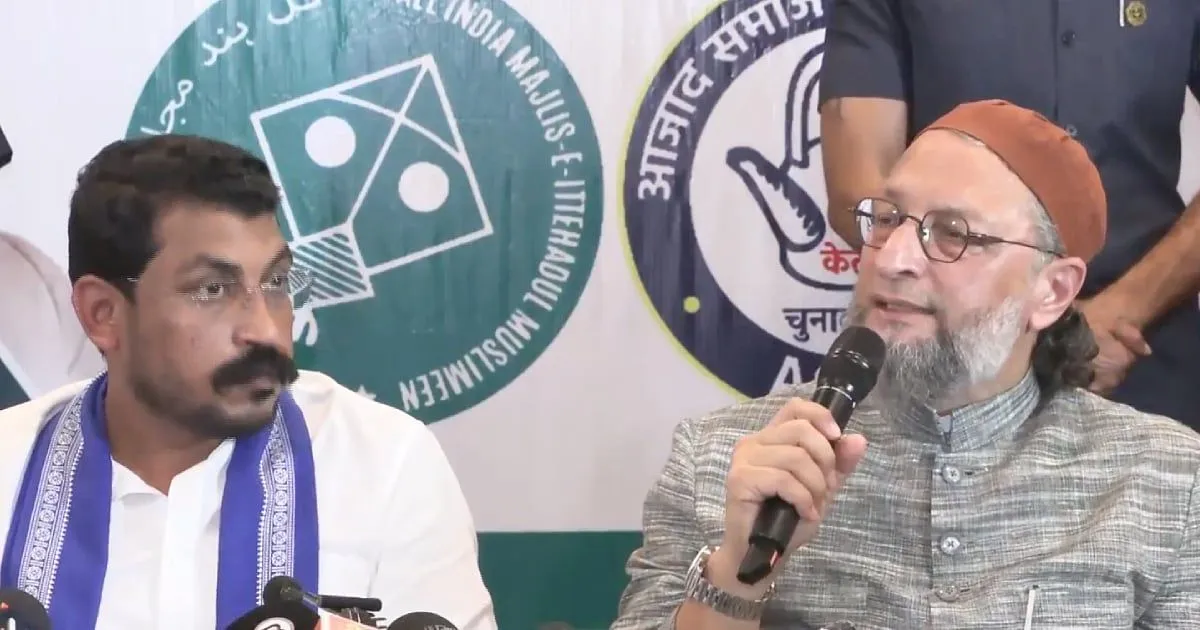
LUCKNOW: Adding a new dimension to the political landscape in poll-bound Uttar Pradesh, the Asaduddin Owaisi-led AIMIM and the Chandrashekhar Azad-led Azad Samaj Party (ASP) announced an alliance here on Thursday.
Naming the alliance as Samajik Parivartan Morcha, both the leaders, eyeing the Muslim-Dalit votes, which together make 40 per cent of the total population of UP, decided to field candidates on all 403 seats, with Azad as the chief ministerial candidate.
Describing the front as a potent political formation to help BJP's ouster in UP, Owaisi and Azad said that they were open to other political forces joining them if they wanted to stop the BJP from getting another stint in the state.
Interacting with the media, Owaisi claimed that his community had so far been used only as a vote bank by political parties, but now “Abdul would get an equal status.”
"We tried to join a larger alliance, but we were treated as weak partners," said Azad, adding that this attitude of major political parties compelled them to join hands and offer a new political formulation.
Targeting UP CM Yogi Adityanath, Owaisi questioned the figure of 1.27 crore Hindus, who, as per Yogi, were deleted from the voters' list during SIR.
Owaisi also demanded Yogi to release a country-wise list showing how many of those removed were Bangladeshis, Pakistanis, or other non-Indian citizens.
Taking a poetic dig at SP chief Akhilesh Yadav over his proposed visit to the Ram temple on December 12, the AIMIM chief recited a couplet by poet Ameer Minai: "Sarakti Jaye hai Naqab Aahista, Aahista …." (Your veil is slowly slipping away, and your true face is gradually coming out).
Responding to Akhilesh Yadav's remark that those helping the BJP had been provided security, Owaisi said that even if his security was withdrawn the next day, it would not affect his outspokenness. He said he remained confident and committed to achieving his goal.
Taking a further dig at Akhilesh, Owaisi said: "Akhilesh Yadav is a former Chief Minister of UP and, Inshallah, he will remain a former Chief Minister."
Referring to the "unsuccessful alliances" of 2014, 2017, 2019, and 2022, Azad said he had tried to build a bigger alliance by learning from past experiences. However, he alleged that people driven by ego and ambition did not respect others' time or dignity.
The Nagina MP claimed that the 'Social Change Front' would bring a change in power in the 2027 Assembly elections. He alleged that opposition leaders who claimed to support the PDA (Pichhda, Dalit, Alpsankhyak) community did not speak out against incidents affecting them.
Meanwhile, reactions from multiple political leaders poured in after the announcement of the formation of the new front. State Cabinet Minister Om Prakash Rajbhar stated that a alliance between AIMIM chief Asaduddin Owaisi and Azad Samaj Party leader Chandrashekhar Azad would significantly disrupt the state's political landscape and specifically impact Samajwadi Party (SP) chief Akhilesh Yadav.
Meanwhile, several political leaders reacted to the announcement of the new alliance. State Cabinet Minister Om Prakash Rajbhar said the alliance between AIMIM chief Asaduddin Owaisi and Azad Samaj Party leader Chandrashekhar Azad would significantly alter the state's political landscape and particularly affect Samajwadi Party (SP) chief Akhilesh Yadav.
Speaking on the speculated political tie-up, Rajbhar said, "A major upheaval is coming in Uttar Pradesh politics, and it will prove to be an earthquake for Akhilesh Yadav."
Predicting a major shift in voter alignment before the upcoming polls, the minister claimed that traditional vote banks of the opposition would move away from them. "By the time elections arrive, Muslims will leave the Samajwadi Party and Congress to stand with Asaduddin Owaisi, while the Dalit community will stand with Chandrashekhar Azad," Rajbhar said, adding that as a result, no opposition party would remain in a position to challenge the ruling alliance.
Notably, Muslims make up around 19 per cent of Uttar Pradesh's population, while Dalits account for 21 per cent. Together, the two communities represent around 40 per cent of the state's population, making their support an important factor for any alliance.
As per political experts, the alliance could directly affect the voter bases of the Samajwadi Party (SP) and the Bahujan Samaj Party (BSP). The SP's support base largely comprises Muslims and Yadavs, while the BSP draws much of its support from Dalit voters. The Owaisi-Chandrashekhar alliance could make inroads into both vote bases. This could further divide opposition votes and potentially benefit the BJP.
In the 2022 Assembly elections, AIMIM had fielded candidates in 96 constituencies, collectively securing less than one per cent of the total vote share in the state. However, the party affected the prospects of several SP candidates who lost by narrow margins, as the votes secured by AIMIM candidates in those constituencies exceeded the respective victory margins. This was the case in several constituencies, benefiting the ruling BJP.
Owaisi is working to strengthen his party's support base in Muslim-dominated areas, while Chandrashekhar is trying to expand his influence in Dalit politics. Both parties are particularly eyeing constituencies in western Uttar Pradesh and the Rohilkhand region, where Muslim and Dalit voters could play a decisive role. Around 41 Assembly constituencies are said to have a combined Muslim and Dalit voter share of more than 50%. Both leaders hope that a common electoral platform will help them put up a strong show in those constituencies.
Political observers believe that while Akhilesh Yadav is seeking to consolidate backward classes, Dalits and minority voters under his PDA (Pichhde, Dalit, Alpsankhyak) formula, the alliance between Owaisi and Chandrashekhar could pose a challenge to his strategy.
Similarly, the BSP’s core support base has traditionally been Dalit voters. Chandrashekhar’s presence could lead to a split in this vote bank. "A division of Dalit and Muslim votes could weaken the unity of opposition voters. In such a scenario, the BJP could gain an advantage in several constituencies," says JP Shukla, a political commentator.
SP's Ayodhya MP Awdhesh Prasad rejected the idea of any damage to his party's prospects in the upcoming polls because of the Owaisi-Azad alliance. However, the party's national spokesman, Udaiveer Singh, said: "Certainly, it is election time, so all parties are forming alliances according to their convenience and understanding. They are welcome for having formed their own alliance. We are also in our own alliance, and our objective is to uproot and throw out the Bharatiya Janata Party government. So, certainly, the people of the state have to decide who is fighting against the Bharatiya Janata Party in what manner at such a time..."
Another SP leader, Ashutosh Verma, said, "This is the beauty of democracy that anyone can contest election anywhere inside the country. Anyone can stitch any alliance anywhere. This alliance has also come up. Let's see what happens with it. The SP is the main opposition in UP and our main goal is to form government."
Reacting to the development, the working president of the Uttar Pradesh Congress Committee (UPCC), Imran Masood, said: "In a democracy, everyone is free. Those forming alliances can do so, and whatever happens, we'll see how we respond. These things don't carry much weight in politics..."