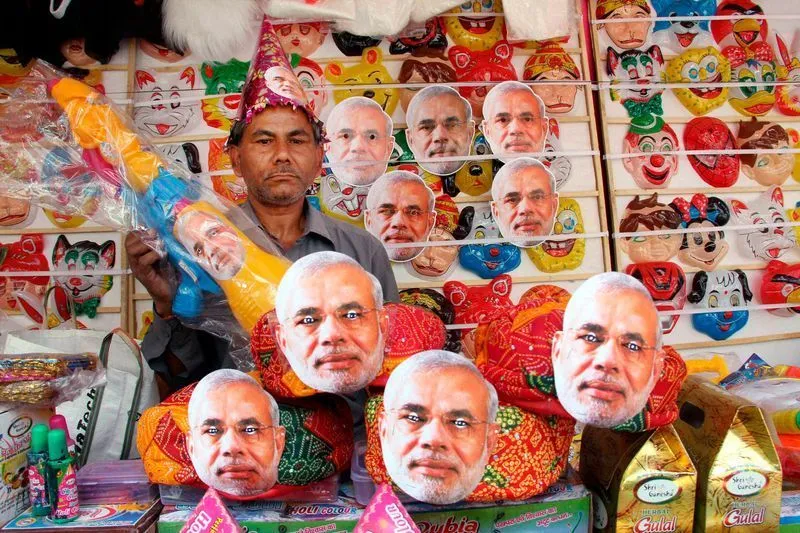
Prime Minister Narendra Modi bears a grudge against the media. No, not because the media is largely mediocre, biased or lacks integrity. Modi probably cherishes these vices. He is upset with the media because it doesn’t sell what he calls ‘The India Story’, the fact that India now fixes deadlines and achieves targets. “Deadlines are important. Our deadline for Viksit Bharat is 2047,” he said, addressing the media at the Bharatiya Janata Party (BJP) headquarter on the occasion of Diwali Milan.
What the prime minister had in mind about ‘The India Story’ is the rapid development, unthinkable before his ascent to power, that the country witnessed in the last 12 years. If the prime minister wants the nation to take the ‘2047 deadline’ seriously, he needs to explain what was the deadline for ushering in acchhe din? He so passionately appealed to the people to give him five years – 60 months – to allow him to transform the miserable existence into acchhe din. He promised to solve every problem – price rise, unemployment, women’s safety, foreign policy. Should his failure to deliver be part of ‘The India Story’ the media needs to sell?
What was the deadline for doubling the farmers’ incomes? 2022? What was the deadline for bringing back black money? First 100 days after assuming power in 2014 May? What was the deadline for showing red eyes to the Chinese? Didn’t Modi promise to end corruption, to purge Parliament of tainted people and stop political vendetta by central agencies? Should the media tell the citizens Modi tore up his own promises and threw them into the dustbin? Should these dark chapters be part of ‘The India Story’? Should ‘The India Story’ include chapters on diminishing freedoms, growing hatred and divisions in society, and institutional decay?
Is the Opposition part of ‘The India Story’ – splits in their parties, defections of MLAs & MPs, and harassment by government agencies? Shouldn’t ‘The India Story’ reflect what the Leader of Opposition Rahul Gandhi is saying – about US control, Chinese encroachment, Modi’s timidity and surveillance culture? Should ‘The India Story’ include nuggets about the prime minister not taking questions, refusing debates and blocking investigations into charges of crony capitalism? About ministers having links with Epstein being protected, lobby firms being hired for normal political work and government’s machinations to put curbs on social media?
Or ‘The India Story’ must be carefully sanitised first, thorns separated from the roses, lies preserved and truth strangled, before being presented on a silver plate? Who will believe it if the media declares there is no job crisis in India? Who will accept prices are under control after buying petrol and diesel at Rs 100 a litre? Who will celebrate the Vishwaguru falsehood after looking at Modi’s pusillanimity against the United States and China?
‘The India Story’ isn’t about expressways and Central Vista; it’s about people’s miseries and struggles, about fear and hopelessness among minorities, about losing friends in the global community and falling behind China in the development race. ‘The Modi Story’ indeed reflects success and comforts of power. ‘The India Story’ is still melancholic.
'Who would have thought...'
The prime minister has the habit of hyping up his own achievements and previous governments’ failures. He has gone so far in the past as to declare that nothing happened before his arrival because his predecessors neither had vision nor commitment. He used to say, “People wondered where did we born – India, what kind of a place is that.”
Though Modi curbed this tendency after widespread criticism, he still talks in hyperbole, advertising his false perception that other prime ministers didn’t possess the capability and foresight to put India on the path of development.
Speaking at the same Diwali Milan function for the media, he said, “Kisne socha tha ki Bharat chandrama ki dakshini dhruv par utar kar itihas rachega (Who would have thought India will make history by landing near the lunar south pole)?”
The prime minister should have known these missions weren't accomplished all of a sudden through a turnkey project. These are the outcomes of decades of planning and hard work. It all started with the first Prime Minister Jawaharlal Nehru setting up the Indian National Committee for Space Research (INCOSPAR) in 1962 which was later developed into India Space Research Organisation (ISRO) in 1969 during Indira Gandhi’s tenure. The concept for a lunar scientific mission was proposed in 1999 and the National Lunar Mission Task Force was set up a year later. The Chandrayaan-I mission was successfully conducted in 2008 and the Chandrayaan-III which Modi talked about happened in 2023.
Kisne socha hoga… this sense of bewilderment clouds facts because people were thinking right after the Independence and working on science & technology despite countless other responsibilities and priorities.
Modi also asked who would have thought India would make the world’s highest bridge over the Chenab in Jammu & Kashmir. The plan to link Kashmir Valley with the rail line was under consideration in the late 1970s and Chenab feasibility survey was conducted in 1997. The plan was approved in 2003 and contracts were awarded in 2008. The construction finally started in 2017.
Kisne socha hoga… rhetoric loses its bite against the force of facts. Modi repeated – kisne socha hoga – while claiming that India had become the second largest mobile phone manufacturer in the world. The prime minister would have thought better and deeper before making that boast because India doesn’t have a single credible mobile phone brand known the world over. India is only assembling phones by importing all the high-tech components, including chips, from China.
India needs a political leadership that can think, plan and execute a long-term scheme to push industrialisation and innovation. Condemning previous governments for slow growth, Modi proudly said at the same function, “People now demand high-speed express-ways.”
If the leader is happy with a comparison with Pakistan or Bangladesh, this thinking is not problematic. If India has to compete with developed nations, particularly China, Modi is clearly wallowing in intellectual backwater. India needs to dream bigger, not to fool itself by petty achievements. We don’t need this dialogue – kisne socha hoga. We need to ponder – kaun sochega (who will think)!
Power, not wealth
The Nehru-Gandhi family might have been in power for decades but there is no credible evidence to show they amassed a disproportionate amount of wealth during this period. Wild speculation about their financial clout remained afloat but the truth is that Rahul Gandhi doesn’t even own a house in Delhi. What Sonia Gandhi wrote in her book, Belonging, a journey of love, about Rajiv Gandhi’s financial plight before their marriage presents more evidence of their honesty and personal integrity.
Sonia Gandhi wrote, “With few exceptions, Indian students (studying in England) were chronically short of money. Rajiv would make up for it by taking up part-time jobs. In Cambridge, he worked selling ice cream, picking strawberries, and taking on night shifts in a bakery till five in the morning. That was how he was able to save for the odd (music) record, petrol, a book, or a movie ticket. I noticed that while I was happily having a meal on our outings together, he’d just sit with me and not order anything. ‘Why don’t you have something too? I’d ask. “I’m fine. I have eaten already,’ he’d reply. It was later that I came to know from one of his friends that he used to eat breakfast and after that nothing till the evening, when he’d have a small snack of baked beans on toast or fish and chips.”
Explaining how he took flying lessons to ensure a job before marriage, she wrote, “He continued to do odd jobs to pay for his flying lessons. In one of his letters he wrote, ‘I am sorry I have not written before but we (he and a friend) had got a job working on a building site as labourers. We had to work ten hours a day, and going and coming took another one-and-a-half hours a day, and by that time we were quite dead.”
Rajiv was not only the prime minister’s son, he came from Motilal Nehru’s family whose bungalows in Allahabad would have fetched them thousands of crore today. But the entire asset was donated to the nation. There is continuity in this story, indicating that Sonia Gandhi was not making up things.
Katherine Frank wrote in her celebrated work on Indira Gandhi, “For the first time in her life (after the defeat in 1977), at the age of 59, Indira found herself without a job, an income or a roof over her head. Nehru had left the family home, Anand Bhawan in Allahabad, to Indira in his will. But she had given Anand Bhawan to the nation in 1970. Even had it still been hers, Indira would not have been able to afford to run and maintain Anand Bhawan. Mohammed Yunus, their old family friend, came to the rescue and vacated his bungalow at 12 Willingdon Crescent for Indira.”
Sanjay K. Jha is a political commentator.