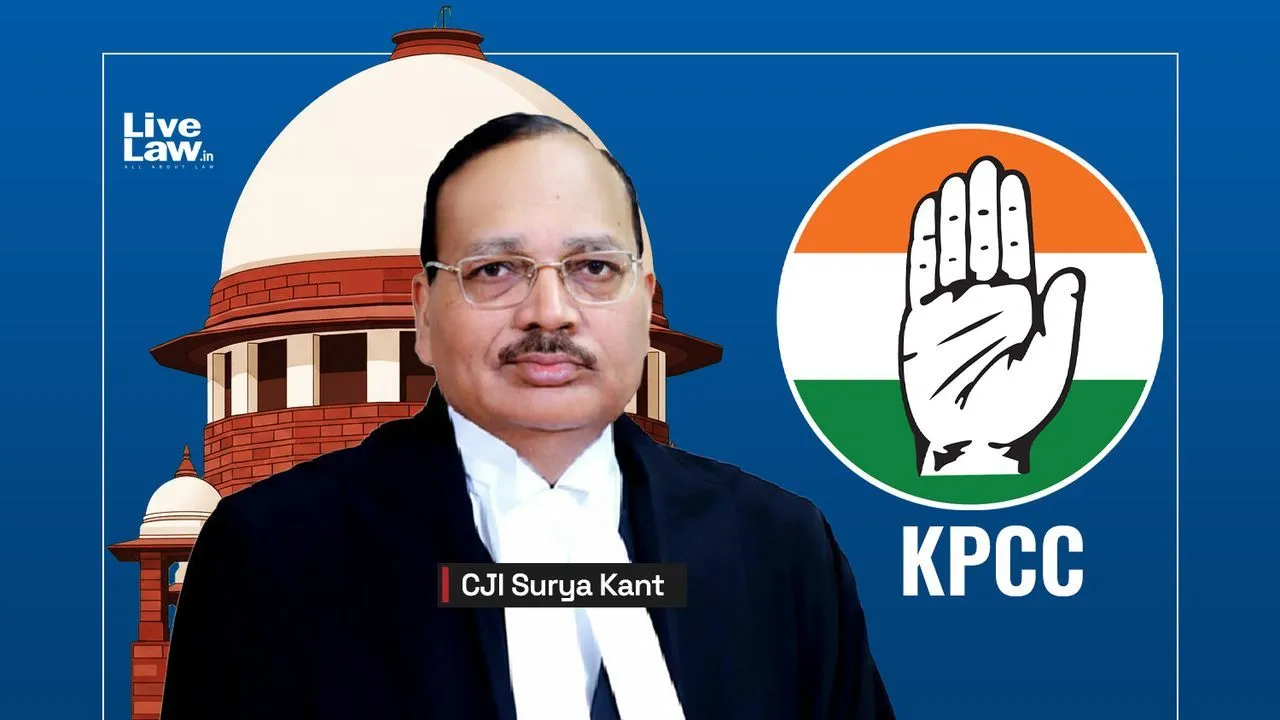
The Supreme Court on Friday issued notice to the office-bearers of the Kerala Pradesh Congress Committee (KPCC), including its President, seeking their response on why contempt proceedings should not be initiated against them over a now-deleted social media post directed at Chief Justice of India Surya Kant.
A bench of Justice Aravind Kumar and Justice Vipul M. Pancholi was hearing a writ petition filed by Advocate Vineet Jindal seeking suo motu action regarding the post published on the official X account of the Indian National Congress Kerala unit (@INCKerala).
During the hearing, counsel for the Kerala Congress committee submitted that the material was uploaded without the office-bearers' approval, was taken down, and that an unconditional apology had been issued. Justice Aravind Kumar observed that the court would examine “whether it has come from the pen or your heart.”
In its order, the bench underscored the supremacy of the Constitution and the independence of the judiciary. “The Constitution is supreme; no individual or political organisation stands above it. Independence of the judiciary is not a matter of political convenience,” the Court said. It noted that while judgments are always open to criticism, “freedom of expression cannot be a shield for intimidation or interference with the administration of justice.” The authority of the court, the bench added, rests on the rule of law and does not require political endorsement. Any attempt to undermine it “needs to be dealt with an iron hand.”
"Judicial restraint must never be mistaken for institutional weakness," the bench stated.
The Court directed that notice be issued to all office-bearers of the Kerala Pradesh Congress Committee (including the President and Secretary) to show cause why contempt proceedings should not be initiated under the Contempt of Courts Act, 1971. The bench exempted the office-bearers from personal appearance and indicated it would examine whether the material warrants exercise of powers under Article 129 of the Constitution.
The bench indicated that it might appoint Senior Advocates Arvind Datar and Siddharth Agarwal as amicus curiae to assist the court. The Attorney General was also requested to assist. The Court clarified that it had expressed no opinion on the merits of the matter at this stage.
The post, which appeared on October 12, 2026, read: “Dear Surya Kant, If law and order is not your domain, resign now. We will find your replacement who can handle it.” It was deleted after drawing widespread criticism. The KPCC has maintained that the post was uploaded by a party worker without the knowledge, consent or approval of the leadership, that the individual was stripped of responsibilities, and that an unconditional apology was subsequently tendered. Earlier, responding to a legal notice sent by a Supreme Court lawyer, KPCC President Sunny Joseph expressed apology for the post, and said that it was unauthorisedly posted.
Previously, the Supreme Court had issued contempt notices to journalist Nikhil Wagle and ShivSena MP Sanjay Raut on a petition brought by the Supreme Court Bar Association over their social media posts against the CJI in relation to the anti-CEC protests.
In today's order, the bench observed: "The present matter concerns certain remarks directed against the Hon'ble CJI attributed to the social media of a political organisation. The Constitution is supreme; no individual, no institution or political organisation stands above. Independence of the judiciary is not a matter of political convenience. It is a constitutional guarantee owed to the people of this Republic. Judgments are always open to criticism; however severe. The freedom of expression can't become a shield of intimidation or interference with the administration of justice. However high the position a person occupies, that person can't be allowed to pollute the stream of justice. Judicial restraint must never be taken as institutional weakness. Any attempt to undermine the authority of the court needs to be dealt with an iron hand.
The authority of the court neither requires political endorsement nor approval; it rests upon the Constitution and the rule of law. Where the administration of justice is established, the law must take its course irrespective of the identity or the interference of the person.