Earth Captures Temporary Mini-Moon 2026 QQ8, Expected to Orbit Until December 2026
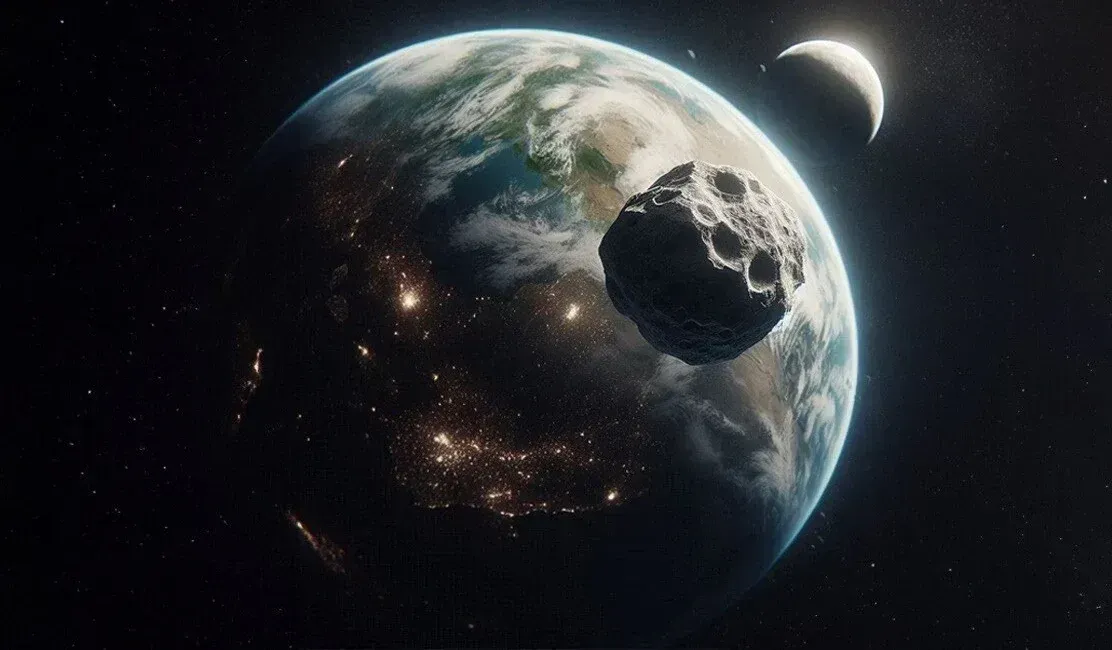
Earth has recently acquired a temporary celestial companion, an asteroid known as 2026 QQ8, which is currently in orbit around the planet. This small space rock, measuring approximately one metre in diameter, is believed to have been captured by Earth’s gravitational pull. The asteroid is expected to remain in this orbit until December 2026, at which point it will escape and continue its journey around the Sun.
The Minor Planet Center has reported that 2026 QQ8 was first discovered by astronomer Krisztin Srneczky on August 20, 2026. However, the asteroid is thought to have entered Earth’s gravitational influence much earlier, around late April of the same year. Observations indicate that it poses no threat to Earth, as its closest approach is estimated at 0.0038 astronomical units (AU), which is approximately 1.5 times the average distance between Earth and the Moon.
Initial discussions among astronomers centred around whether 2026 QQ8 was a natural asteroid or a fragment of human-made debris, potentially originating from an old rocket or satellite. Follow-up observations conducted with the University of Hawaii’s 2.2-metre telescope and the Lowell Discovery Telescope helped clarify its nature. The Minor Planet Center later confirmed that the object is indeed a natural asteroid.
Mechanism of Capture by Earth
Earth occasionally captures small asteroids that come close enough to be drawn into its gravitational field. In the case of 2026 QQ8, the asteroid crossed into Earth’s Hill sphere in April, a region where the planet’s gravity can dominate the motion of smaller objects against the Sun’s gravitational pull. This interaction allowed 2026 QQ8 to be temporarily captured.
The asteroid’s orbit around Earth is not circular but follows a looping trajectory, which is characteristic of such captures. By December 2026, it is anticipated that 2026 QQ8 will break free from Earth’s gravitational influence and continue its independent path through the Solar System. This behaviour is typical for temporary visitors of this nature.
Interestingly, 2026 QQ8 is not unfamiliar to Earth. Orbital calculations indicate that it passes relatively close to our planet approximately once every ten years. It made a close approach in 1965 but did not come near enough to be captured. The next predicted close encounter is slated for 2058, although astronomers do not expect it to become a mini-moon again during that event.
Historical Context of Temporary Visitors
Earth has had several temporary visitors in the past, including other small asteroids such as 2020 SO, 2020 CD3, and 2024 PT5. Additionally, there are quasi-moons like 2025 PN7, which appear to accompany Earth but actually orbit the Sun alongside the planet, rather than being gravitationally bound to it.
As of now, 2026 QQ8 stands as the latest temporary companion to Earth, highlighting the dynamic interactions between our planet and nearby celestial bodies. The study of such objects not only enhances our understanding of the Solar System but also provides insight into the nature of asteroids and their potential impacts on Earth.
In summary, the capture of 2026 QQ8 demonstrates the complex gravitational interactions that can occur in space. As scientists continue to monitor this mini-moon, they will gain further knowledge about its characteristics and behaviour, contributing to the broader field of planetary science.
Long or Short, get news the way you like. No ads. No redirections. Download Newspin and Stay Alert, The CSR Journal Mobile app, for fast, crisp, clean updates!
App Store – https://apps.apple.com/in/app/newspin/id6746449540
Google Play Store – https://play.google.com/store/apps/details?id=com.inventifweb.newspin&pcampaignid=web_share