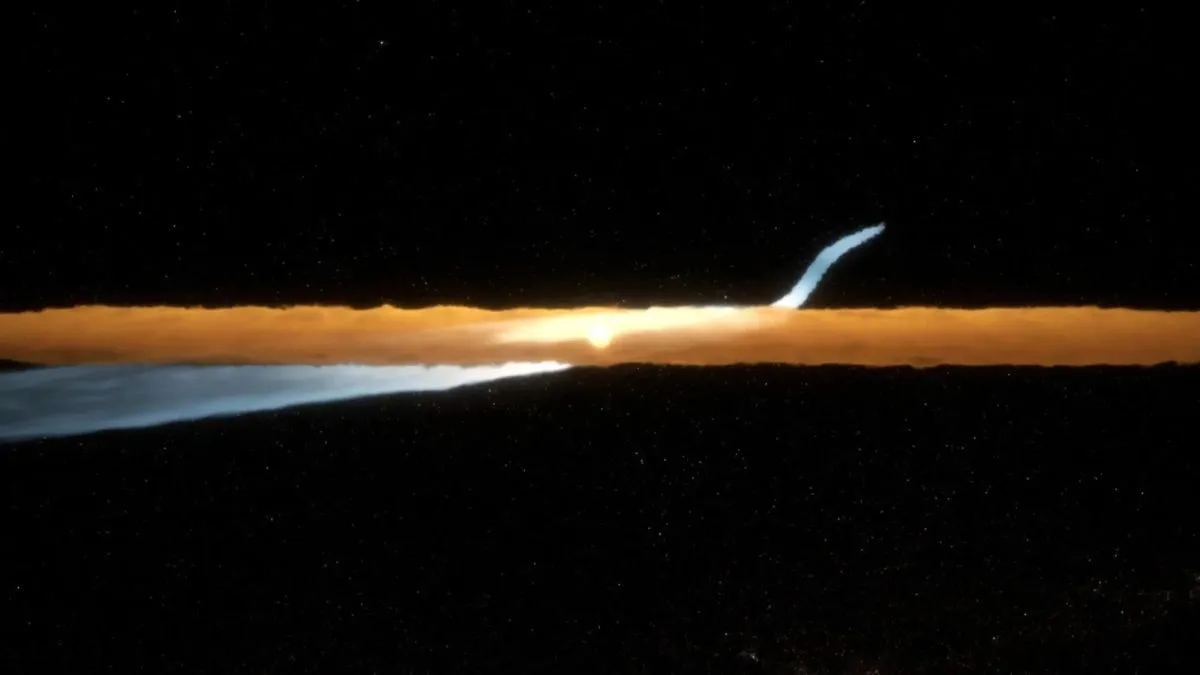
The Cat’s Tail was first detected by the James Webb Space Telescope (JWST) using infrared observations in 2024. However, astronomers had struggled to spot it in visible light, raising questions about its composition and origins.
“Oddly, this feature had previously only been seen with the James Webb Space Telescope, which detects infrared light, but remained invisible at shorter wavelengths, which has puzzled the community for a while,” Avsar told ScienceDaily.
What did Hubble reveal?
Using Hubble’s imaging instruments, the researchers detected the faint structure in visible light and combined their findings with observations spanning more than 14 years.
This allowed them to examine the cloud’s shape, location, and composition more closely.
The researchers suggest that the Cat’s Tail contains unusually dark, carbon-rich dust, which could explain why it was difficult to detect in visible light.
Their findings also support the possibility that the material originated from a collision involving large, icy planetary bodies.
“The Cat’s Tail is thought to be the aftermath of a collision between large bodies — think something like Pluto,” Avsar said in the same interview.
His comparison to Pluto refers to the possible size of the objects involved in the collision. Such dwarf-planet-sized bodies may have been common in the early solar system, when collisions between large objects helped shape the planets and debris belts we see today.
However, the collision itself was not directly observed, and its precise circumstances remain uncertain.
Also read: Can Hubble be saved? NASA invites companies to service telescope before 2031
What does this tell us about our solar system?
Beta Pictoris is a relatively young star surrounded by a disk of dust and debris left over from planetary formation.
Astronomers believe that similar conditions existed in our solar system billions of years ago, when planets and smaller celestial bodies were still forming.
One possible comparison is the Kuiper Belt, a region beyond Neptune that contains Pluto and numerous other icy objects.
During the solar system’s early history, this region may have contained hundreds of Pluto-sized bodies. Over time, the gravitational influence of the giant planets altered their orbits, scattering some objects and ejecting others.
The Cat’s Tail may offer a glimpse of these processes, providing researchers with an opportunity to investigate how collisions between large bodies generate debris and influence the evolution of young planetary systems, including our solar system.
(Edited by Maryam Hassan)