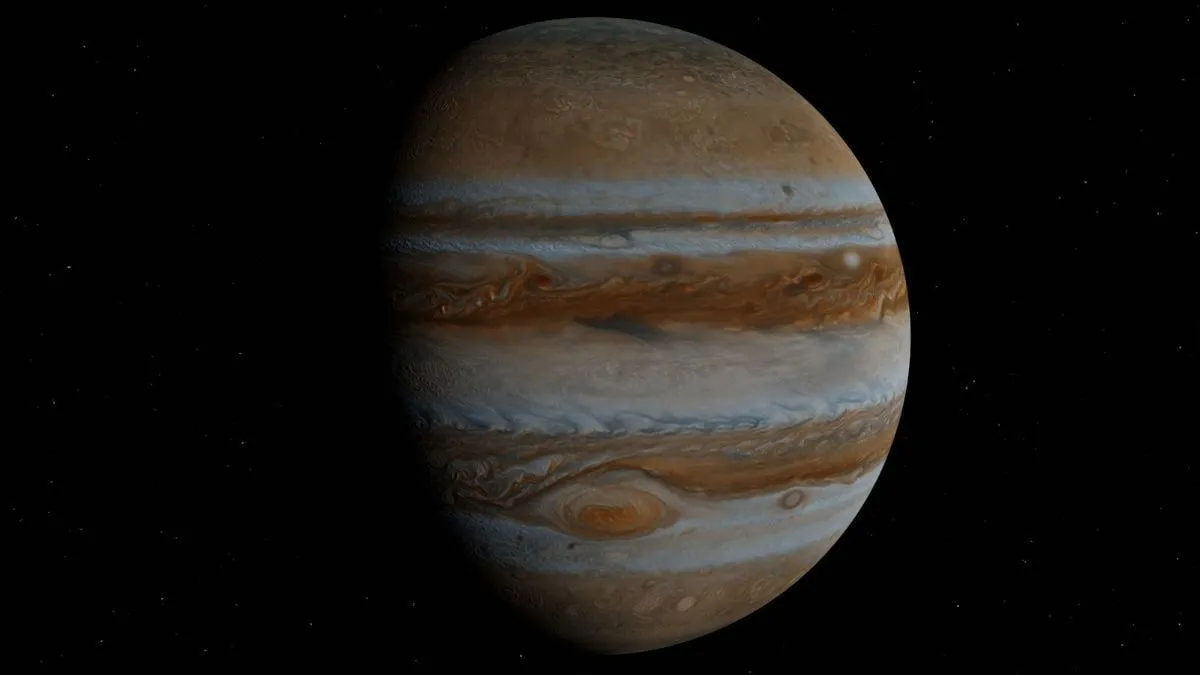
New Delhi: A hot gassy giant as large as Jupiter but nearly 1,000 light years away has suddenly disappeared from the sight of astronomers. They suspect that its orbit has slowly been changing and it will take nearly 30 to 50 years for telescopes to finally spot it again.
The study documenting the disappearance of this planet was published in the Astrophysical Journal Letters on 9 November, by researchers at the American Astronomical Society. This is the first known planet to have pulled a disappearing act on scientists.
Called TOI-2535, this “hot Jupiter” spins around its respective Sun taking only 8.25 days to complete one round. Over the past seven years, researchers have often caught it in transit when it briefly dims the light of its star as it crosses in front of it. However, its sudden disappearance hints that the planet’s orbit is being altered by another planet. The duo’s wobbling orbits make them vanish from view and out of alignment when Earthly telescopes.
“We think of the universe as resembling clockwork, where everything is regular, but that’s not true. If there are multiple planets in a system, they can affect each other’s orbits. We know of a few systems that are like this. This is the most extreme example we’ve seen because the two planets are interacting so strongly. The planet’s orbit is tilting so quickly that its transit disappeared while we were watching,” co-author Samuel Yee, a postdoctoral fellow at UCLA, said in a statement.
Also read: ‘Sugar-coated’ stem cells cut fractures in women with osteoporosis by 94%
Spotting planets far away
To spot such planets located far away in distant galaxies, scientists use the “transit method”. As a planet passes between the Earth and its host star it blocks a fraction of the star’s light. Telescopes can detect this dip in brightness and scientists can then use it to determine the planet’s location, size, and orbit.
“If the moon’s orbit around the Earth was perfectly aligned with the Earth’s orbit around the sun, we would see an eclipse every month. But because the moon’s orbit is tilted, eclipses are less common. The tilt of the moon’s orbit is a relic of its violent formation history, which resulted from a collision with the early Earth,” said co-author Erik Petigura, UCLA astrophysicist, in the statement.
Researchers are curious to understand how TOI-2535 migrated from its trajectory to enter a tilted orbit. This might help them figure out how planets like Jupiter, migrate closer to their stars instead of being farther away where their gases could cool off.
“Because TOI-2535 b has a close neighbor, it probably migrated by slowly spiraling in instead of getting flung in,” Yee added. “We may be seeing a formation channel that doesn’t happen very often but is very interesting.”