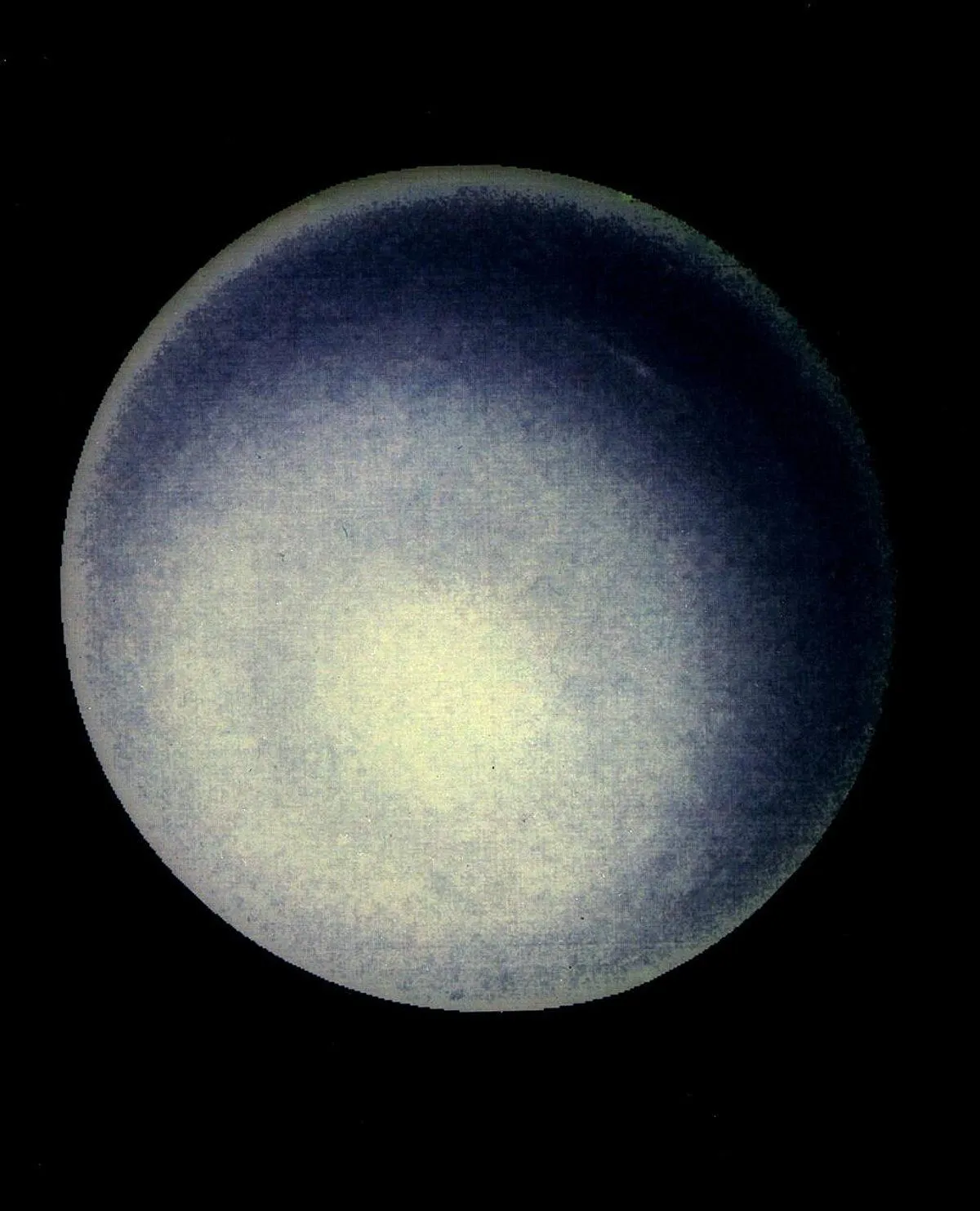
Scientists studying Uranus and Neptune may have found a new way to investigate the origins of the solar system’s two ice giants. A study led by the Southwest Research Institute (SwRI) suggests that measuring argon-40 in their atmospheres could provide clues about the conditions and locations in which the planets formed.
Published in The Planetary Science Journal, the research examined whether the isotope could help determine the amount of rocky material beneath the planets’ atmospheres. However, the team found that atmospheric argon-40 may reveal more about their formation environments than their rocky or icy interiors.
“Despite decades of research, we still have surprisingly little information about what lies beneath the atmospheres of Uranus and Neptune and their physical compositions,” said Dr Olivier Mousis, the study’s lead researcher and a planetary scientist at SwRI.
Argon-40 in the planets’ atmospheres could have two sources: material inherited from the protosolar nebula, the cloud of gas and dust that formed the solar system about 4.6 billion years ago, and radioactive decay of potassium-40 in rocky interiors.
To distinguish between these sources, Mousis and his team combined calculations of argon-40 production with a numerical model of the protosolar nebula. The model tracked the condensation, trapping and transport of primordial argon inside ice particles as the nebula evolved. These particles subsequently accumulated and contributed to the formation of Uranus and Neptune.
The team's calculations showed that primordial argon trapped inside ice particles in the protosolar nebula would far outweigh the argon produced by radioactive decay inside the planets. “Its contributions are more abundant than previously thought,” Mousis said.
The simulations also indicated that argon-rich planetary building materials may have accumulated near an argon frost line, where low temperatures caused the gas to condense into ice.
SwRI’s Solar System Science and Exploration Division vice president and study co-author Dr Robin Canup said chemical signatures preserved in planetary atmospheres could help reconstruct their formation histories. Future missions, including the proposed NASA Uranus Orbiter and Probe, could directly measure noble gases and isotopic ratios to investigate these questions further.