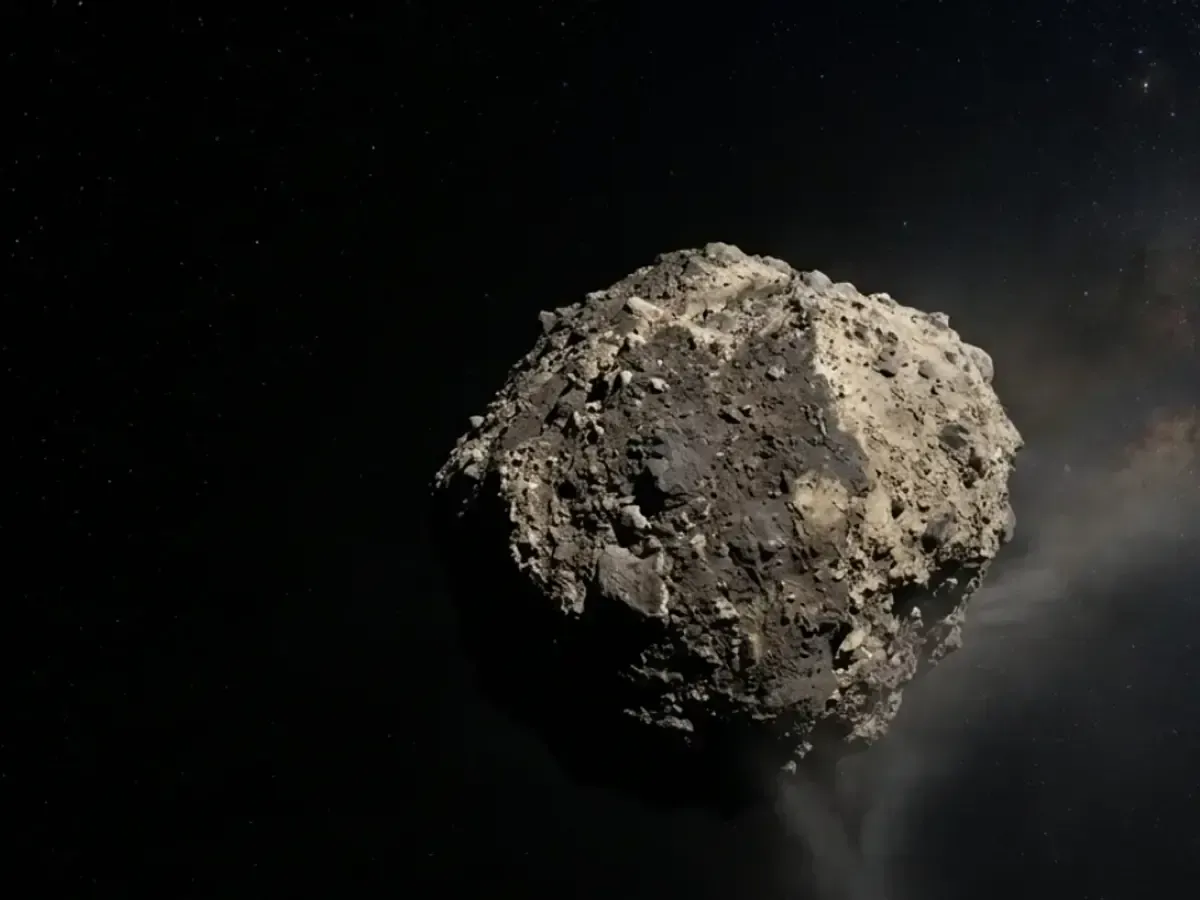
A new paper published in the journal Icarus details an asteroid that may or may not even be an asteroid. When an alternate possibility is considered- that of 1998 KY26 being a comet- more problems arise. The space rock defies standard gravitational expectations. While most asteroids move predictably based purely on gravity and solar radiation pressure, 1998 KY26 is accelerating perpendicular to its orbital plane. It is also rotating once every 5.35 minutes. Scientists have failed to explain this anomalous activity.
The bizarre movement has led astronomers to theorise that 1998 KY26 could be a comet. The path it has taken could well be because of the invisible outgassing of ice associated with dark comets. Such comets do not have a visible tail, hence the name. However, Korbin Hansen and Masatoshi Hirabayashi state in the new study that 1998 KY26 is too warm to be a comet and holds ice that can throttle it.
Also Read: Doomsday asteroid collisions, including the one in India, sowed seeds of life on Earth
Too warm to hold onto ice
For water ice to survive buried inside an asteroid, temperatures need to stay below minus 128 degrees Celsius. But the "temperature model results indicate that the water outgassing rate on 1998 KY26 would be too high to maintain buried ice, refining the understanding of the asteroid's composition." Even the coldest regions of KY26 have an average temperature of at least minus 61 degrees Celsius as it orbits around the Sun.
That is too warm for cometary ice to survive. The researchers calculated that at this temperature, even if water ice made up 1 per cent of KY26's mass, it would vanish in around 2,000 years. If the ice were sublimating and causing the asteroid's unusual acceleration, it would stay for just 62 years. It is not known for how long it has been on this orbit, meaning it could still have this ice left. But an earlier paper proposed that it originated in the asteroid belt, and if this is true, that ice might no longer be there. Another possibility for its unusual movement is that it is happening because of radiation pressure from the Sun.
Trending Stories
The mystery of this rock will be solved by Japan's Hayabusa2 spacecraft, which will reach asteroid KY26 in 2031. The original Hayabusa mission sent samples from Ryugu and recently performed a high-speed flyby of the 450-meter asteroid (98943) Torifune.