B612 Foundation's ADAM platform searched 11.5 billion archived observations in under five minutes, extending 2026 ED138's orbital record from four months to ten years and enabling what astronomers call the most significant outer solar system find since Eris.
The B612 Foundation's Asteroid Institute published its 2026 Annual Report on Tuesday, November 4, detailing a year that ended with the most significant outer-solar-system discovery in roughly two decades. The report describes how ADAM — the institute's Asteroid Discovery, Analysis, and Mapping cloud platform — now catalogues nearly 12 million astronomical observations, according to B612, and how one automated archival search played a central role in characterizing 2026 ED138, a trans-Neptunian object that could become the sixth official dwarf planet.
The finding did not arrive fully formed. The Vera C. Rubin Observatory in Chile, which began its full 10-year sky survey only four months ago, spotted ED138 during its commissioning period and produced roughly four months of observations. What transformed that into a decade-long orbital portrait was B612's ADAM::Precovery service, which retrieved more than 44 archival images of the object captured by the Dark Energy Camera (DECam) on the Víctor M. Blanco 4-meter Telescope at Cerro Tololo Inter-American Observatory in Chile — images taken as far back as February 2016, according to B612's annual report, before anyone knew the object existed.
The resulting observational record stretches 3,789 days. That extended arc is what makes the orbital solution reliable enough for astronomers to begin the classification process.
2026 ED138 sits roughly 46 astronomical units (AU) from the Sun — approximately 4.3 billion miles (6.9 billion km), well beyond Pluto's average orbital distance of about 40 AU. That places it squarely in the trans-Neptunian region, the broad band of icy objects orbiting beyond Neptune that includes the Kuiper Belt and the scattered disk.
Matthew Holman, a senior astrophysicist at the Center for Astrophysics | Harvard & Smithsonian and a member of the Rubin operations team, found the object on October 13, 2026, by scanning Rubin data using a search algorithm he co-developed with colleague Kevin Napier. When Holman and University of Washington astronomer Mario Jurić went to verify the detection, they confirmed 30 Rubin observations taken across 20 separate nights between March 4 and July 11, 2026.
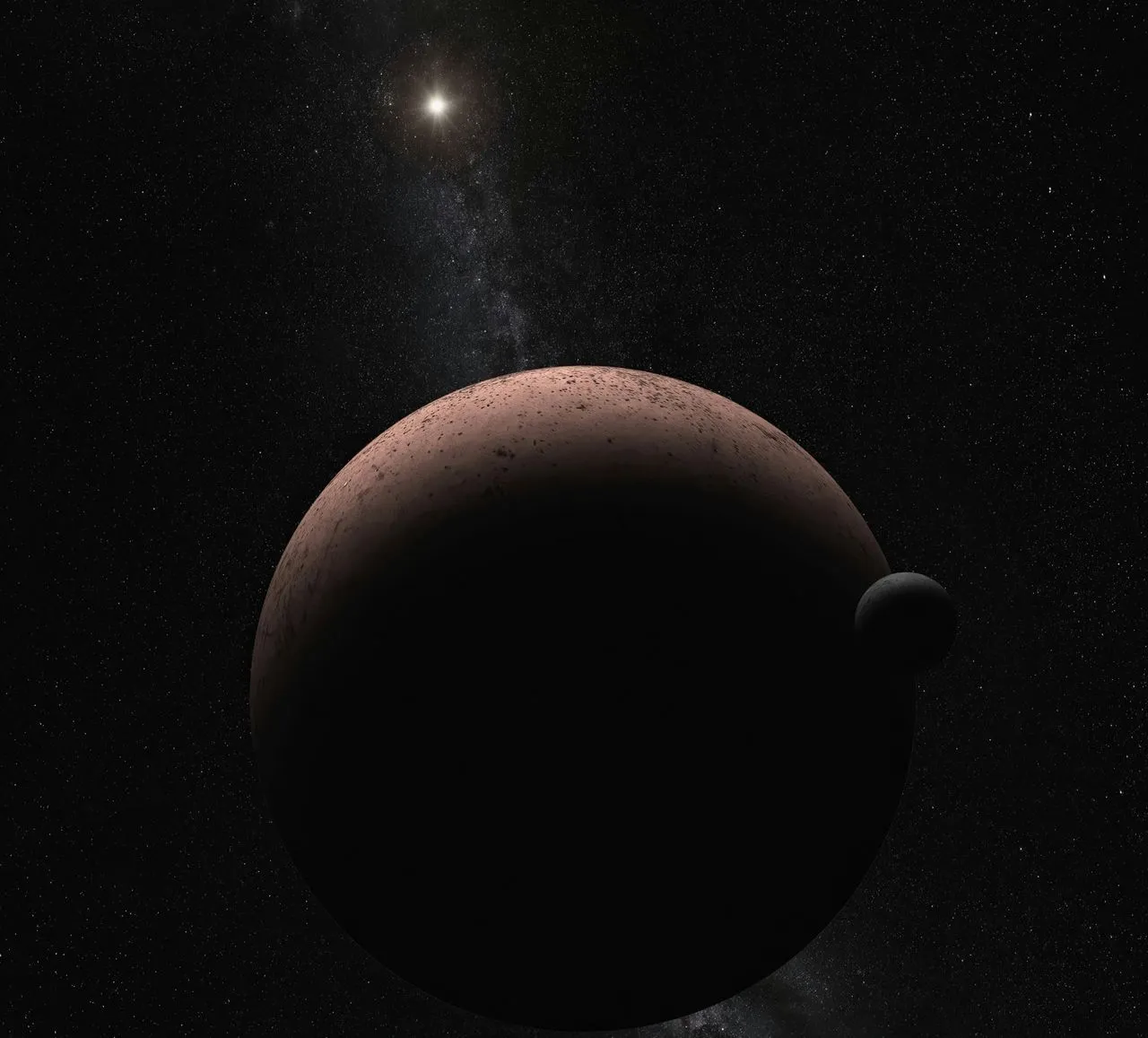
The object's initial measurements put its diameter somewhere between 600 and 1,500 kilometers (373 to 932 miles) — a range that reflects uncertainty in the object's albedo, the fraction of sunlight it reflects. The same apparent brightness could mean a large, dark body or a smaller, brighter one; until astronomers measure both visible and infrared light, they cannot collapse that range. At the upper end, ED138 would be comparable in size to Makemake, one of the five currently recognized dwarf planets. At the lower end, it would still count among the most intrinsically bright known trans-Neptunian objects.
What struck astronomers was the sheer rarity of the find. "Finding an object this big is something that happens maybe once in a generation," said Jurić. "It's the largest trans-Neptunian object found in about 20 years." The last comparably significant discovery was Eris, whose 2005 detection set off the reclassification debate that ended with Pluto being demoted to dwarf planet status in 2006.
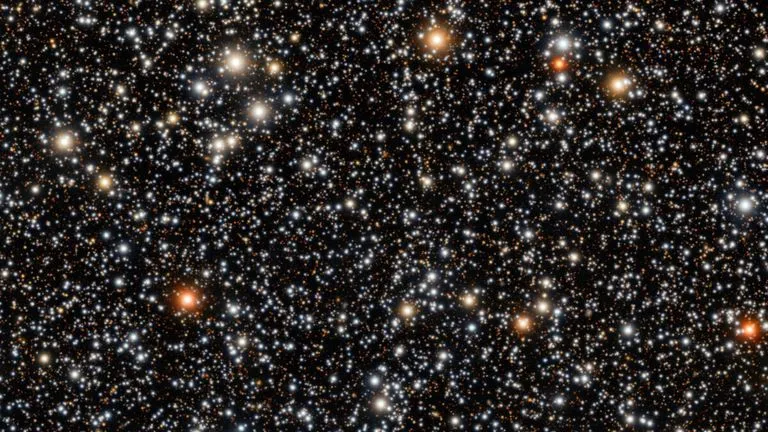
ED138's orbit is tilted nearly 25 degrees away from the plane of the solar system — a configuration that places it in the "hot-classical" category of trans-Neptunian objects. That inclination, combined with its southerly sky position near the dense stellar backdrop of the Milky Way, is why earlier surveys missed it. Rubin's wide-field camera — 3.2 gigapixels covering roughly 9.6 square degrees of sky per image, or about 50 full moons — was designed for exactly this kind of crowded-field challenge.
The Technology: How a Cloud Tool Reached Back a Decade
The discovery is an astronomical story, but the confirmation is a software story.
ADAM::Precovery does not look at the sky. It looks at previously collected images, searching for objects that were captured without anyone noticing. When Rubin or any other survey instrument detects a newly identified body, ADAM::Precovery takes the preliminary orbital solution — which at first carries a wide uncertainty band — and calculates the range of sky positions where the object might have appeared at any prior date, based on that orbit. It then queries the archive for any images covering that uncertainty region and flags candidate detections for human review.
The key technical advance in B612's August 2026 upgrade was replacing a fixed 10-arcsecond search radius around a predicted position with a search region shaped by the actual orbital uncertainty. That distinction matters enormously in practice. When an object has only a few weeks of observations, its uncertainty region can extend far beyond 10 arcseconds; a fixed-radius search would simply miss the candidates lying outside that circle. In a technical post demonstrating the upgrade, B612 showed that searching the full uncertainty region for the asteroid 2026 PG extended its observational arc from 4.64 days to 38.81 days — roughly eight times longer — by recovering detections that lay about 35.8 arcseconds from the nominal prediction. The old cutoff would have found nothing.
The scale of the system makes that work tractable. ADAM searches approximately 11.5 billion observations drawn from multiple sky surveys — including the Rubin Alert Stream, the ATLAS and Zwicky Transient Facility surveys, the NOIRLab Source Catalog, SkyMapper, and the Minor Planet Center's full observation database — in under five minutes, according to B612. That catalog lives on Google Cloud Storage, with attribution-status metadata handled through Google BigQuery. The computational infrastructure is what allows a single query triggered by a new Rubin detection to reach back a decade into DECam archives in roughly the time it takes to read this paragraph.
For 2026 ED138, that process produced an orbital fit spanning February 25, 2016, to July 11, 2026, based on 74 total observations. "If confirmed as a dwarf planet, ED138 would join a very small family of worlds," said Holman.
The Classification Question: What It Takes to Be a Dwarf Planet
The International Astronomical Union recognizes five dwarf planets: Ceres, in the asteroid belt; and Pluto, Eris, Makemake, and Haumea, all in the outer solar system. The last two additions — Makemake and Haumea — were both accepted in 2008. No new dwarf planets have been officially recognized since.
The IAU's 2006 definition requires three conditions: the body must orbit the Sun directly; it must have sufficient mass for its own gravity to pull it into a roughly spherical shape (a state called hydrostatic equilibrium); and unlike a true planet, it must not have gravitationally cleared the neighborhood around its orbit. The first and third conditions 2026 ED138 almost certainly satisfies — it orbits the Sun and shares the outer solar system with many other trans-Neptunian objects. The second condition is what must be confirmed.
That confirmation requires pinning down the object's albedo, which will determine whether the size falls into the range where self-gravity produces a sphere. The instrument best suited for that measurement in the outer solar system is the James Webb Space Telescope, which can capture both reflected visible light and thermal infrared emission — the combination needed to separate size from reflectivity. Those observations have not yet been completed.
"Scientists are nonetheless optimistic," said Kathy Turner, the Department of Energy program manager for the Rubin Observatory, who called Rubin "an incredible tool for investigating a wide range of astrophysical phenomena, from dark energy to the discovery of this dwarf planet candidate."
If 2026 ED138 ultimately joins the IAU's official list, its ranking among the known dwarf planets will depend on where within the 600–1,500 km (373–932 mile) range its actual diameter falls. At the upper end, it would likely rank among the three largest, behind Eris (~2,326 km / ~1,445 miles) and Pluto (~2,377 km / ~1,477 miles). At the lower end, it would fall below both Makemake (~1,430 km / ~889 miles) and Haumea (~1,560 km / ~969 miles along its longest axis).
What ADAM Can Now Do: Precovery Plus Ephemeris
The 2026 annual report frames 2026 ED138 as proof-of-concept for the ADAM platform's mature state. Over the past year, the Asteroid Institute grew ADAM to nearly 12 million astronomical observations, according to B612, and added major capabilities beyond precovery.
ADAM::Ephemeris, launched in May 2026, addresses the operational counterpart to precovery: not "where was this object in the past?" but "where should a telescope point to find it next?" Given a known or candidate orbit, the service predicts sky positions for future dates. Applications range from scheduling follow-up observations of newly discovered bodies to mission trajectory planning to assessing when an asteroid's next close Earth approach will be visible. ADAM::Ephemeris builds on the same orbit-determination infrastructure as the precovery service and is available through both the ADAM online platform and a programmatic API.
ADAM launched publicly in October 2025 as an open-access platform, running on Google Cloud and built around the institute's open-source adam-core library. The ambition behind the design is democratic access: astrodynamics computations that once required institutional supercomputing clusters are now available to researchers, mission planners, and graduate students through a web interface or API call.
The Opening Chapter of a Decade of Outer-Solar-System Discovery
The discovery of 2026 ED138 looks significant in isolation. In context, it may be the smallest story of the next ten years.
Rubin's full Legacy Survey of Space and Time began June 30, 2026 — four months ago. The object was found during commissioning data, before the full survey was underway. Astronomers project that over Rubin's 10-year run, the number of known trans-Neptunian objects could grow by a factor of 10 to 100, from roughly 5,900 currently known to potentially tens of thousands or more. The ~380 new TNOs that Rubin's commissioning-era data contributed to the Minor Planet Center in a single month in April 2026 gives a sense of the pace.
ADAM::Precovery was upgraded precisely to handle that volume. Each newly discovered TNO will trigger an automated search through billions of archived observations — looking for appearances in prior data that extend the orbital arc and sharpen the classification picture. For the objects large enough to qualify as dwarf planet candidates, that precovery step will be essential to building the arc length needed for a confident orbital solution.
The solar system's census of large worlds has been informally closed for 18 years. It is about to be reopened.
A Year of Institutional Recognition for Planetary Defense
Beyond the platform milestones, 2026 brought formal political and institutional recognition for the field.
The U.S. Senate unanimously passed a bipartisan resolution — S.Res.792, designating Asteroid Day, introduced by Arizona Senator and retired NASA astronaut Mark Kelly alongside Senators Jerry Moran (R-KS) and John Cornyn (R-TX) — formally recognizing June 30, 2026 as Asteroid Day. The date marks the anniversary of the June 30, 1908 Tunguska event over Siberia, the most powerful asteroid impact recorded in modern history, whose airburst flattened more than 2,000 square kilometers (approximately 772 square miles) of forest. The United Nations designated June 30 as International Asteroid Day in 2016; this Senate resolution marked the first time the U.S. legislature formally echoed that recognition.
The resolution also highlights the April 2029 close approach of asteroid Apophis — which will pass within approximately 32,000 kilometers (roughly 20,000 miles) of Earth, well inside the orbit of geosynchronous communication satellites — as a demonstration of why planetary tracking matters.
More than 740 Asteroid Day events took place worldwide in 2026, according to B612, with the flagship celebration held in Flagstaff, Arizona, at Lowell Observatory and Meteor Crater on June 26–27.
At the Flagstaff event, B612 awarded the annual Schweickart Prize to University of Edinburgh researchers Brian P. Murphy and Richard E. Cannon, recognized for a proposal to extend planetary defense to humanity's new frontiers in orbit and beyond. Their proposal calls for establishing an International Commission on Space Infrastructure Resilience (ICSIR) to investigate risks to orbital and lunar infrastructure and develop recommendations for the United Nations Committee on the Peaceful Uses of Outer Space — envisioning a permanent international coordinating body they term WARDEN (Warning-network for Asset Resilience from Dusts, Ejecta, and NEOs).
What Comes Next
The immediate scientific priority for 2026 ED138 is measuring its albedo — a task for JWST's infrared instruments. That measurement will determine whether the object's size places it firmly in the range where self-gravity produces a sphere, satisfying the second IAU criterion. Until that confirmation arrives, the object remains a candidate.
For B612, the discovery signals what a mature ADAM platform can do when coupled with the generation of survey infrastructure that Rubin represents. The platform was built, in the institute's own framing, for exactly this moment: a newly discovered object surfaces in Rubin's pipeline, and a decade-old archive image is waiting to be claimed.
The solar system still holds surprises. The question now is how quickly the tools to find them can keep pace.