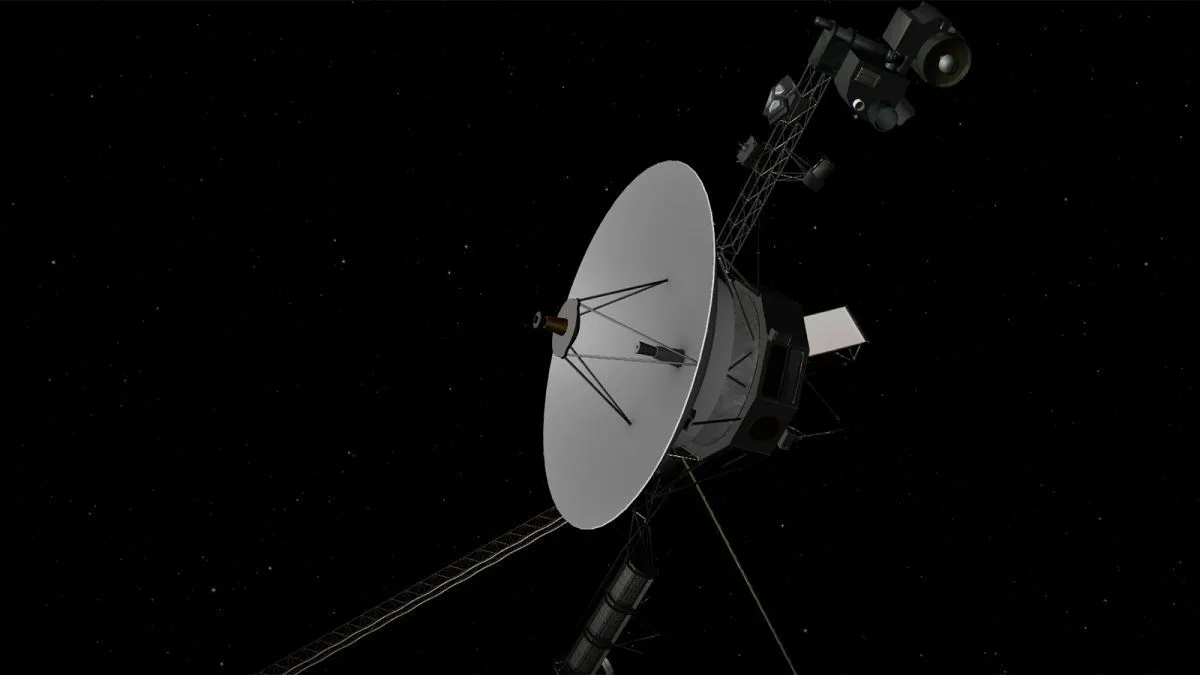
Voyager 1, the unmanned probe launched by the U.S. National Aeronautics and Space Administration (NASA) in 1977, will on Nov. 18 become the first human-made object to reach a distance of "one light-day" from Earth. That is the distance light travels in a single day—approximately 16 billion miles (about 25.9 billion km).
According to NASA and the scientific community, Voyager 1 will pass the point 16.09 billion miles (about 25.902 billion km) from Earth at around 5:16:07 a.m. U.S. Eastern Time on Nov. 18. That is the result of flying at roughly 37,000 mph (about 60,000 km/h) for 49 years and two months since its launch on Sept. 5, 1977—about 70 times the cruising speed of an international passenger jet.
Light takes 8 minutes and 20 seconds to travel the distance between the Sun and Earth. One light-day is 173 times farther than that. Voyager 1 earlier became the first human-made object to cross the heliopause—the boundary of the Sun's solar wind—and enter interstellar space in 2012.
One light-day is both a distance and a communications delay. A radio signal sent from Earth takes 24 hours to reach the probe, and the probe's reply takes another 24 hours to arrive back on Earth—two days round trip. "If you want to talk to Voyager, you send a message, go home, and wait two days to get an answer," said Suzanne Dodd, Voyager project manager at NASA's Jet Propulsion Laboratory (JPL).
NASA said the crossing will bring no special change to the probe's operations or its surrounding environment. It is, however, a symbolic milestone illustrating the vastness of the cosmos and the probe's durability over nearly half a century.
A chronology of Voyager 1's path and upcoming schedule is as follows.
Voyager 1 was originally designed with the possibility of contact with extraterrestrial intelligent life in mind. Attached to the exterior of its body is a "Golden Record" announcing humanity's existence. The 12-inch (30 cm) gold-plated copper disk carries greetings in 55 languages, 27 musical pieces, and 115 photographs. Greetings in Korean and Japanese are also included. The late Dr. Carl Sagan led its production.
The distance remaining to actual contact, however, defies imagination. Astronomers express interstellar distances in "light-years," the distance light travels in a year; one light-year is about 5.88 trillion miles (9.46 trillion km), or 365 times one light-day. On its current trajectory, Voyager 1 will in about 40,000 years pass near Gliese 445, a star about 17 light-years from Earth. No planets have yet been discovered in that star system, so the likelihood of life there is considered low.
The probe itself does not have much life left. Voyager 1 is too far from the Sun for solar power, so it relies on radioisotope thermoelectric generators (RTGs) that convert the decay heat of plutonium-238 into electricity. Its power output, 470W at launch, has fallen by 4W each year and now stands at about 240W. JPL had by 2016 sequentially switched off six of its ten science instruments, and it shut down the Cosmic Ray Subsystem (CRS) in February 2025 and the Low-Energy Charged Particle instrument (LECP) in April 2026. Only two instruments remain in operation: the Plasma Wave Subsystem (PWS) and the magnetometer (MAG).
The power situation grew more urgent this year. In September 2026, JPL completed a months-long power-saving retrofit dubbed the "Big Bang." Because the spacecraft's heat distribution must be maintained, the approach involved switching off three devices at once and replacing them with three low-power devices. The same retrofit was first carried out on Voyager 2 in August 2026. NASA said that without this work, it would have had to shut down one more of Voyager 1's science instruments as early as the summer of 2027. Thanks to the retrofit, the two remaining instruments can operate longer than originally expected.
On Oct. 18–19, communications with Earth were also lost for about 48 hours. NASA's Deep Space Network (DSN) failed to pick up signals in two scheduled contacts 24 hours apart, and the signal reappeared on Oct. 20. JPL believes that one group of thrusters went offline and the spacecraft automatically switched to backup thrusters, and that its onboard computer placed itself into a safe state and stopped communicating. The exact cause is still under investigation. The probe is reported to have about 10 years' worth of hydrazine propellant remaining.
Voyager 1's twin probe, Voyager 2, is flying a different trajectory and is projected to become the second object to reach one light-day, in November 2035 according to NASA. Voyager 2 achieved close observations of Uranus and Neptune in addition to Jupiter and Saturn.
The current status of the two probes is summarized below. One AU is the distance from Earth to the Sun (about 93 million miles, or 150 million km).
ItemVoyager 1Voyager 2Launch dateSept. 5, 1977Aug. 20, 1977Escape velocity from solar system3.6 AU per year3.3 AU per yearHeliopause crossingAugust 2012November 2018Science instruments in operationMAG, PWS (2)CRS, MAG, PWS (3)One light-day reachedNov. 18, 2026Projected November 2035
Voyager 2's CRS is scheduled to be shut down in the future depending on its power situation.