To estimate the Milky Way's mass, astronomers need to track the movements of stars and smaller satellite galaxies under its gravitational pull. The faster these objects travel at a given distance, the more mass is needed to hold them in place. For some time, these measurements have shown that most of our galaxy's mass can't be accounted for by the stars and gas we can see. However, they have also produced estimates that differ widely.
Through an extensive new analysis posted on the arXiv preprint server, the Dark Energy Spectroscopic Instrument (DESI) Collaboration has used its latest large-scale survey to make the most precise measurement yet. It places the galaxy's mass at 1.19 trillion times that of the sun, with an uncertainty of just about 11%.
Weighing a galaxy
Previous studies have approached the problem from several directions: observing stars in the galaxy's sparse outer "halo" (a vast region dominated by invisible dark matter), long streams of stars torn from smaller objects, and tightly packed star clusters and satellite galaxies.
However, recent models of how the galaxy's disk rotates have pointed to far lower masses than studies of more distant objects. Part of the problem is that earlier studies rarely tested several methods at once. They also rarely accounted for the realistic ways galaxies are disturbed by gravity, or for the limitations of large-scale surveys.
Surveys and simulations
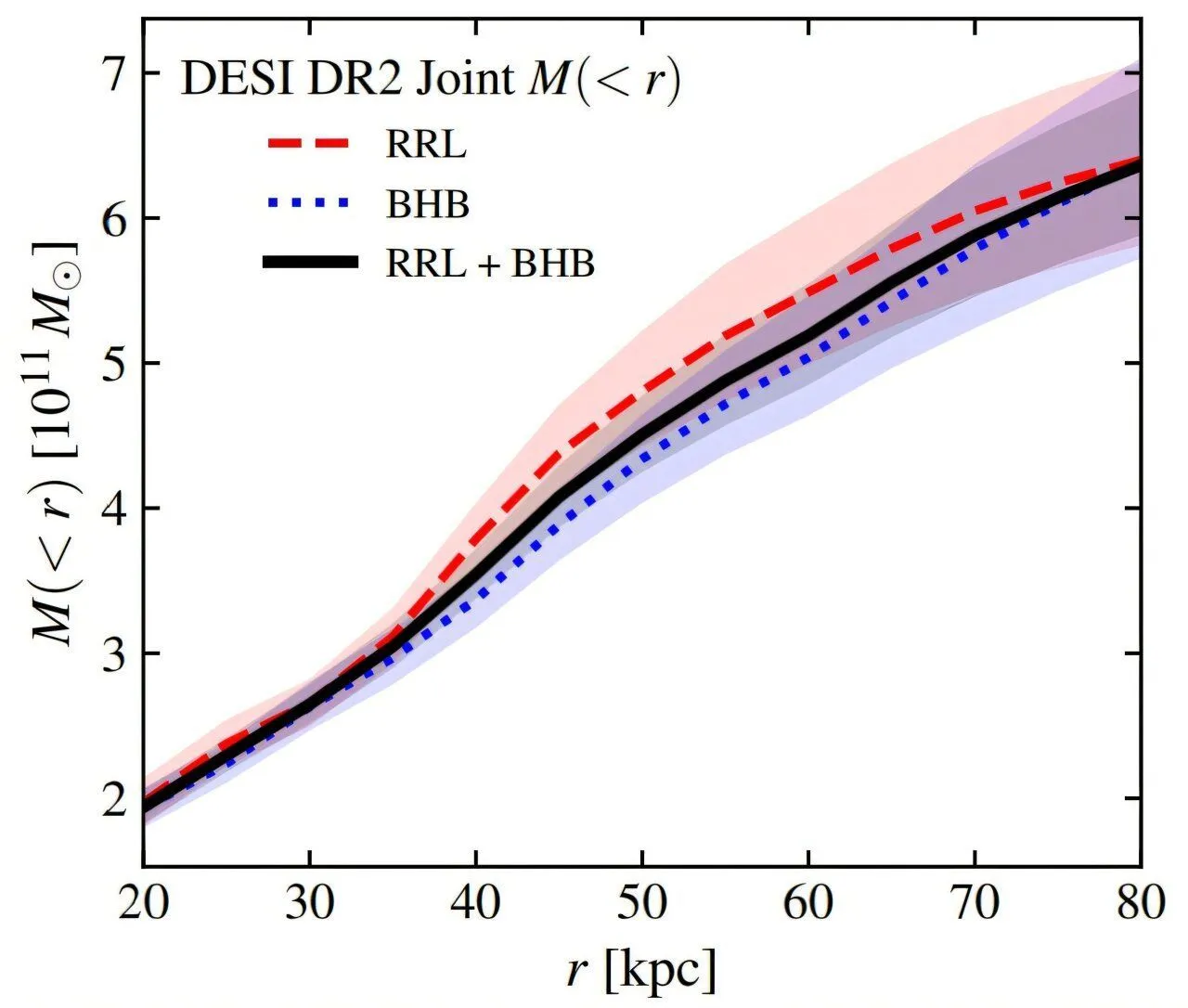
To tackle these issues, the DESI team carried out an exhaustive analysis of more than 10,000 distant stars recorded during DESI's first three years of observations, lying between roughly 30,000 and 310,000 light-years from the galactic center. The team combined this with measurements of the stars' motions across the sky from the Gaia space telescope. The stars belong to two distinct types of aging stars whose predictable brightness makes them useful distance markers.
The researchers applied four different modeling approaches to both populations. To calibrate and combine the results, they first tested each approach on mock surveys of six simulated galaxies, each viewed from four different vantage points. These mock surveys included realistic measurement errors and gaps in the survey's coverage of the sky, allowing the team to correct for biases in each method, including biases the methods share.
Highest precision to date
Altogether, their analysis put the Milky Way's total mass, including both dark and ordinary matter, at 1.19 trillion solar masses, with an uncertainty of about 11%. For material within 260,000 light-years of the galactic center, the uncertainty shrinks to about 8%. This relatively high result could hint at a massive, extended halo, though it doesn't fully resolve the debate with theories that argue against one.
The findings also shed new light on how our galaxy is structured, with all four methods assuming a perfectly round galaxy, settled into a steady state. The mock tests suggest that future models should instead allow for a less spherical, more gravitationally disturbed Milky Way.
With observations of even more distant stars and further measurements from Gaia, the team hopes to firm up estimates of the outer halo's mass. DESI's observations will soon be made public, opening the door to a new wave of independent analyses.
© 2026 Science X Network