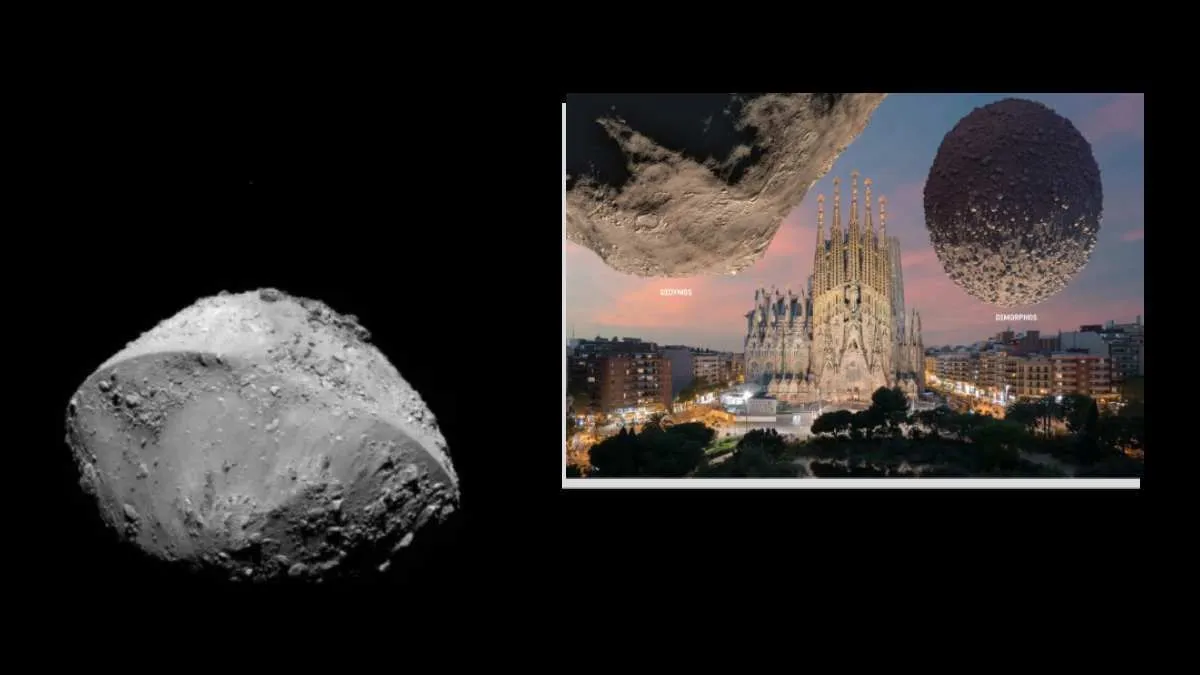
ESA's Hera spacecraft has sent back images of the Didymos asteroid taken through three different instruments, the agency stated in its 17 November updates. The larger body was photographed from just 28.5 km away. Its most obvious feature is a pronounced ridge running around the equator. Hera is Europe's first planetary defense mission, and it is surveying the pair of asteroids before a closer look at Dimorphos, the moonlet NASA's DART probe struck in 2022. The latest frames show what each onboard camera can pick up that the human eye cannot.
Hera's Three Instruments
The monochrome image of the asteroid body came from Hera’s Asteroid Framing Camera, which handles both navigation and science. The lenses in the cam resolve to about 2.7 m per pixel. Meanwhile, HyperScout H splits the surface into 25 color bands, running from visible red into the near-infrared. The Thermal Infrared Imager, the third camera, supplied and operated by JAXA, maps temperature instead. That tells scientists whether they are looking at solid or broken rock or loose material down to dust.
Dimorphos, 151 m across, is almost entirely in shadow in the visible images, with a single small speck lit by the Sun. In the thermal frame, the whole moonlet shows up.
The Ridge
Didymos is 780 m wide and spins once every 2.2 hours, fast for its size. Patrick Michel, Hera's Principal Investigator and a Director of Research at CNRS / Observatoire de la Côte d'Azur, said the spin may be pushing material toward the equator and helping build the ridge.
Debris by DART
On 26 September 2022, DART, a 580-kg spacecraft, hit Dimorphos at 6.1 km/s. The impact threw debris across 10,000 km of space and cut the moonlet's orbit by around 33 minutes, a far bigger deflection than simulations had predicted. Whether the hit left a crater or reshaped the body, and what Dimorphos is made of, remain open questions. Over the coming months Hera will examine the crash site and release two shoebox-sized CubeSats for a closer survey, with a landing planned later. Detailed images of both asteroids will be unveiled on 25 November.
See Also: Euclid Space Telescope Discovers Its First Comet Between Jupiter And Saturn; Here’s How It Was Spotted
Cover: ESA