Published November 18, 2026 1 Min Read Paper-3 Mains
The ultra-rare meson-to-muon decay is a particle physics process in which a meson transforms into muons, helping scientists test the Standard Model and search for possible new physics beyond it.
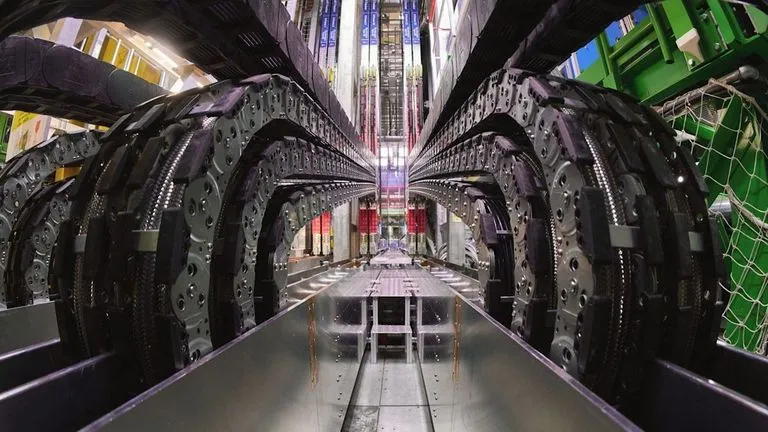
NEWS: CERN's LHCb experiment reported the first evidence of an ultra-rare decay of a neutral beauty meson (B⁰) into two muons.
ABOUT THE DECAY
B⁰ meson decays into a muon and an antimuon.
Expected frequency: Approximately 1 in 10 billion decays.
B⁰ meson consists of a down quark and a beauty (bottom) antiquark.
Meson: Subatomic particle made of one quark and one antiquark held together by the strong nuclear force.
Muon: Elementary particle similar to an electron but approximately 207 times heavier.
ABOUT CERN AND LHC
CERN: European Organisation for Nuclear Research, established in 1954.
India became an Associate Member of CERN in 2017.
LHC: World's largest particle accelerator.
Located near Geneva on the France–Switzerland border.
27-km underground circular accelerator.
SIGNIFICANCE
Measured decay rate: Approximately 1.14 in 10 billion.
Closely matches the prediction of the Standard Model of Particle Physics.
Helps constrain possibilities of unknown particles and new forces.
Provides insights into fundamental particle interactions.