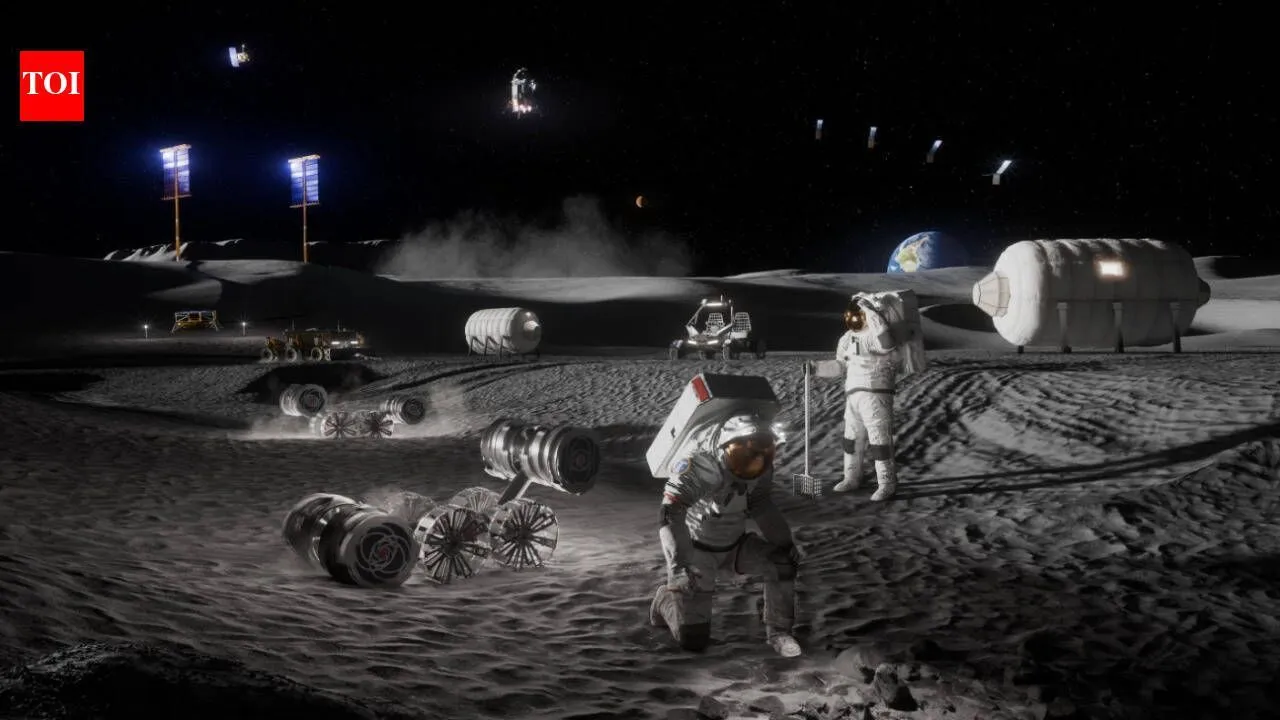
Artist’s concept depicting astronauts, habitats, rovers, power systems, and cargo operations supporting sustained human activities at the Moon Base near the lunar South Pole. (Image Credit: NASA)
NASA has now invited students from across America to help tackle problems around a long-term lunar base through its $1 million Moon Base Student Challenge. It was announced on November 8, 2026. The competition invites students from eligible US high schools and post-secondary institutions to develop innovative ideas for a future lunar base. This base shall provide astronauts a place where they could live, work and explore for extended periods. Registration is open until January 25, 2027, giving aspiring engineers, designers and problem-solvers a chance to contribute ideas to NASA's next chapter in space exploration. The announcement is more than an invitation to build impressive models. It is an opportunity to think about the practical realities of imagining life on the Moon. As NASA explains in its official announcement, students will help explore technologies needed to establish a sustained human presence near the lunar South Pole.
Six problems standing between the Moon and a human home
A lunar base needs far more than a place to sleep and a window with a spectacular view of Earth. Every essential service must be designed to operate in an unforgiving environment, often with limited resources and minimal human intervention. NASA's competition therefore focuses on six areas, each addressing a different piece of the lunar-living puzzle.1. Power generation and storage Electricity is the backbone of a lunar settlement. A lunar base will have to operate communications equipment, heating systems, life-support machinery and other scientific instruments. Due to the Moon's unique rotation cycle there are periods when it stays in the dark. This requires solutions regarding electricity generation, storage and distribution when sunlight is unavailable.2. Habitat construction As attractive as it sounds, habitat construction on the Moon has challenges that seem unthinkable on Earth. After all, how do you build a shelter in a world where transporting every kilogram of material from Earth is expensive? Students can explore ways to construct durable structures using lunar soil, known as regolith, alongside robotic construction and other innovative techniques. The goal is to make habitats that can protect astronauts without depending entirely on supplies shipped from home.3. Life-support systems On Earth, air and water are things we rarely think about until something goes wrong. But, beyond that, the unavailability makes them more valuable than a Kohinoor. Students need to focus on building concepts that could address oxygen supply, water processing, waste management and the maintenance of a stable living environment.4. Surface mobility Astronauts and robots living on the lunar base will need to move across the Moon's dusty, uneven terrain. Mobility will be required to transport equipment, conduct experiments and explore the surrounding landscape. Solutions around better rovers and autonomous vehicles could make these journeys safer and more efficient.5. Communication networks A settlement on the Moon needs reliable ways to exchange information not just between astronauts but also between vehicles, equipment and other facilities. Thus, students are encouraged to propose communication networks that remain reliable despite the Moon's harsh operating conditions.6. Astronaut safety Lunar dust can damage equipment, radiation in space poses health risks, and tiny micrometeorites can threaten exposed structures. Ideas involving protective materials, hazard monitoring, emergency procedures and safer equipment could help reduce those dangers. The competition's official rules and eligibility guide outline these six categories and the environmental conditions teams must consider.
The Moon is not an easy place to improvise
The challenge is not just building a home, it is to sustain it on the Moon where conditions are drastically different from those on Earth. According to the competition's technical guidelines, teams should account for extreme temperature swings, radiation, abrasive dust, low gravity and the challenges of operating in a vacuum. Their designs should also be lightweight, energy-efficient and reliable, with limited dependence on supplies from Earth. A brilliant habitat concept, for instance, will not be particularly useful if it requires constant repairs by astronauts or materials that cannot realistically reach the lunar surface.
Who can participate, and how does it work?
The competition is designed for eligible student teams in the United States, with separate divisions for high school and post-secondary students. Teams must have two to five student members along with an adult coach. Participants must meet the competition's institutional and individual eligibility requirements, so interested students should read the official rules before registering.
Join conversation
Share your thoughts in the comments
Be respectful · TOI community guidelines
The challenge follows multiple phases, taking teams from developing a concept to submitting more detailed proposals. Students can choose one of the above mentioned six technical categories and work on a solution suited to their interests, whether that means designing an energy-storage system, exploring lunar construction materials or developing technology to protect astronauts. The competition is intended to help participants build practical skills, work collaboratively and explore potential careers in the space industry. Registration takes place through NASA's STEM Gateway, and the Moon Base Student Challenge website provides the competition's rules, guidance and updates. The registration deadline is January 25, 2027. The next breakthrough in space technology might not begin in a high-security research laboratory. It might start with a group of students around a classroom table, a rough sketch of a habitat and a deceptively simple question: What would it take to call the Moon home?
End of Article