Dust is usually something you can brush off. The finest dust on Mars, however, isn’t like that. On small squares of spacesuit fabric carried by NASA’s Perseverance rover, dust fine enough to reach deep into human lungs has stayed attached through years of driving and drilling.
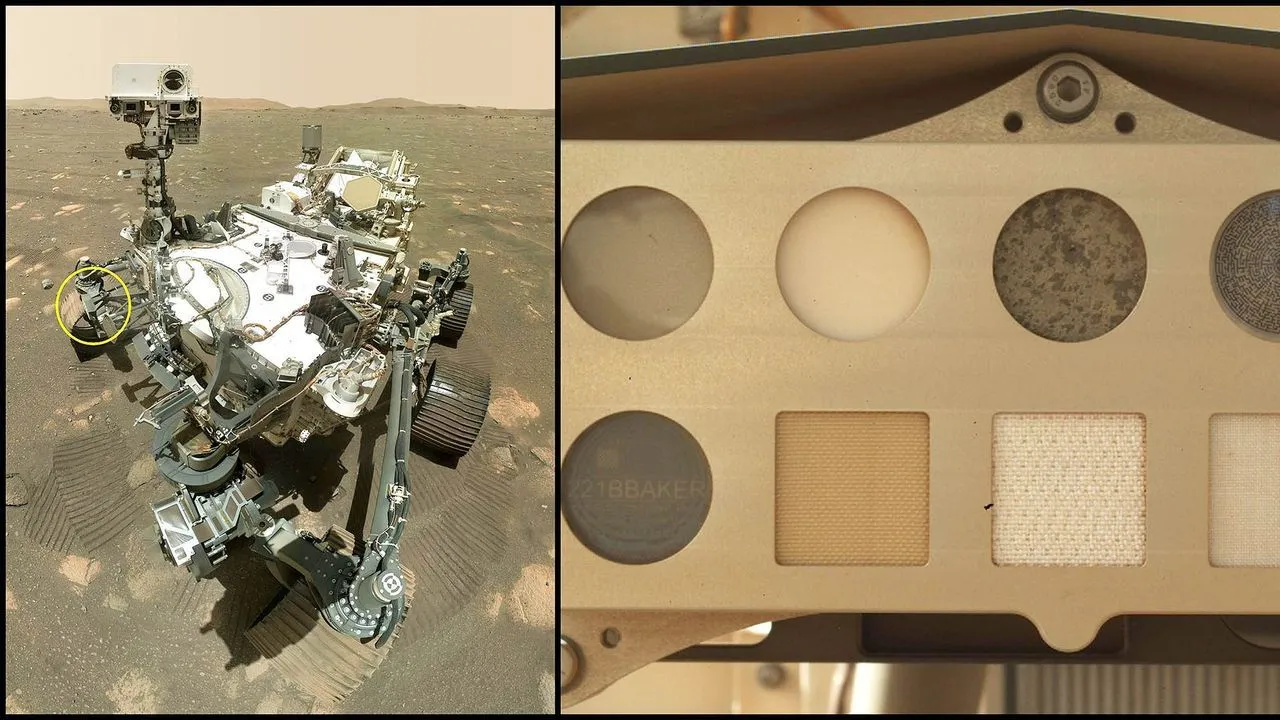
Perseverance measured that dust over 1,645 Martian days, more than four years on an Earth calendar. Its readings came from PIXL, an X-ray instrument on the end of the rover’s robotic arm.
Scott VanBommel, a Perseverance scientist at Washington University in St. Louis, is the paper’s lead author.
“The existence of Mars dust at these ultrafine sizes has been predicted for a long time, and PIXL gave us the chance to measure it directly on Mars,” he said.
Swatches collect Mars dust on the rover
None of this fabric is part of a suit. Five swatches of spacesuit material, each three-quarters of an inch (20 millimeters) square, are mounted on a small panel.
The rover uses that panel to check the settings of another instrument, called SHERLOC. NASA sent the swatches to see how spacesuit materials hold up on the Martian surface.
PIXL has its own test panel, with one sample of Teflon and one of glass made from basalt, a dark volcanic rock. Teflon contains no elements PIXL can detect directly. So any signal the instrument picked up from that sample had to come from dust resting on it.
On SHERLOC’s panel, the team also checked swatches of Teflon and Vectran, two materials used in spacesuits.
Tiny grains stayed attached
Earlier missions had measured Mars dust particles down to about 3 micrometers across. PIXL picked up two groups of even smaller ones.
Fine particles were less than 2.5 micrometers wide, and ultrafine particles were around 100 nanometers. A human hair is about 70 micrometers wide, so the ultrafine grains are roughly 700 times thinner than a hair.
Grain sizes varied from one surface to the next. Dust on PIXL’s Teflon and on SHERLOC’s Vectran swatch averaged about 2 micrometers.
On the basalt glass and SHERLOC’s Teflon swatch, some grains were as small as about 100 to 300 nanometers.
“The larger clumps, the Martian dust bunnies, get shaken off over time. But the smallest particles stay behind, and those are the ones that pose the greatest challenge for human support systems,” VanBommel said.
Static charge sorts the Mars dust
Static electricity appears to explain which grains cling to which surface. Dust grains become charged as they collide in the air, and different materials on the test panels attracted grains of different sizes.
Plastics like Teflon are common in the outer layers of spacesuits, and the results show they readily collect fine dust.
Some materials held less dust than others, which could guide the choice of materials and protective coatings for future suits and habitats.
Chemically, the dust matched what earlier missions had measured: rich in iron and sulfur. PIXL also found extra phosphorus and signs of calcium sulfate.
Mars dust brings different risks
During NASA’s Apollo missions, lunar dust scratched visors, degraded the outer layers of spacesuits, and damaged their seals. Some crew members reported symptoms similar to hay fever.
Mars dust is different. Wind keeps knocking the grains into each other, which rounds them off, so they’re less abrasive than grains on the Moon.
They carry more sulfur, chlorine, iron and silica than lunar dust does. Regional and global dust storms can keep them circulating through the atmosphere.
On Earth, airborne particles smaller than 2.5 micrometers are tied to a range of health problems, because they can get deep into the lungs and enter the bloodstream.
Studies have shown that ultrafine particles, those no larger than 100 nanometers, can travel from the nose to the brain along the nerve that carries smell.
Martian dust is mostly silicate minerals, and it carries reactive chemicals. Those include perchlorates, which can disrupt the thyroid, and reactive iron, which damages cells. Scientists think the health risk depends on how much dust a person takes in and for how long.
Testing fixes on the Moon
Perseverance measured dust stuck to small samples, not dust floating in the air of a crew’s living space. Researchers still don’t know how much of that dust would get indoors, or how much a person would breathe there.
NASA can use the results as it refines indoor dust limits for astronauts and works out ways to clean gear.
Some designs could keep dust out. A suitport lets an astronaut climb into a suit attached to the outside of a habitat. Airlocks with two chambers could also cut how much dust reaches living quarters.
NASA is already testing some fixes on the Moon. In March 2025, an Electrodynamic Dust Shield developed at Kennedy Space Center in Florida landed on the Moon aboard Firefly Aerospace’s Blue Ghost Mission 1. It used electric fields to clear lunar soil from glass and radiator surfaces.
At Johnson Space Center in Houston, engineers use vacuum chambers and imitation Moon soil to test spacesuit parts and a handheld dust-removal tool ahead of Artemis missions.
Those lunar tests are the proving ground for gear that future crews will eventually need on Mars.
The full study was published in the journal Proceedings of the National Academy of Sciences.
—–
Like what you read? Subscribe to our newsletter for engaging articles, exclusive content, and the latest updates.
Check us out on EarthSnap, a free app brought to you by Eric Ralls and Earth.com.
—–