What if one of the most intriguing discoveries on Mars happened entirely by accident? That is precisely what happened when NASA's Curiosity rover rolled over an ordinary-looking rock on the Red Planet and crushed it open, revealing an unexpected yellow surprise inside.
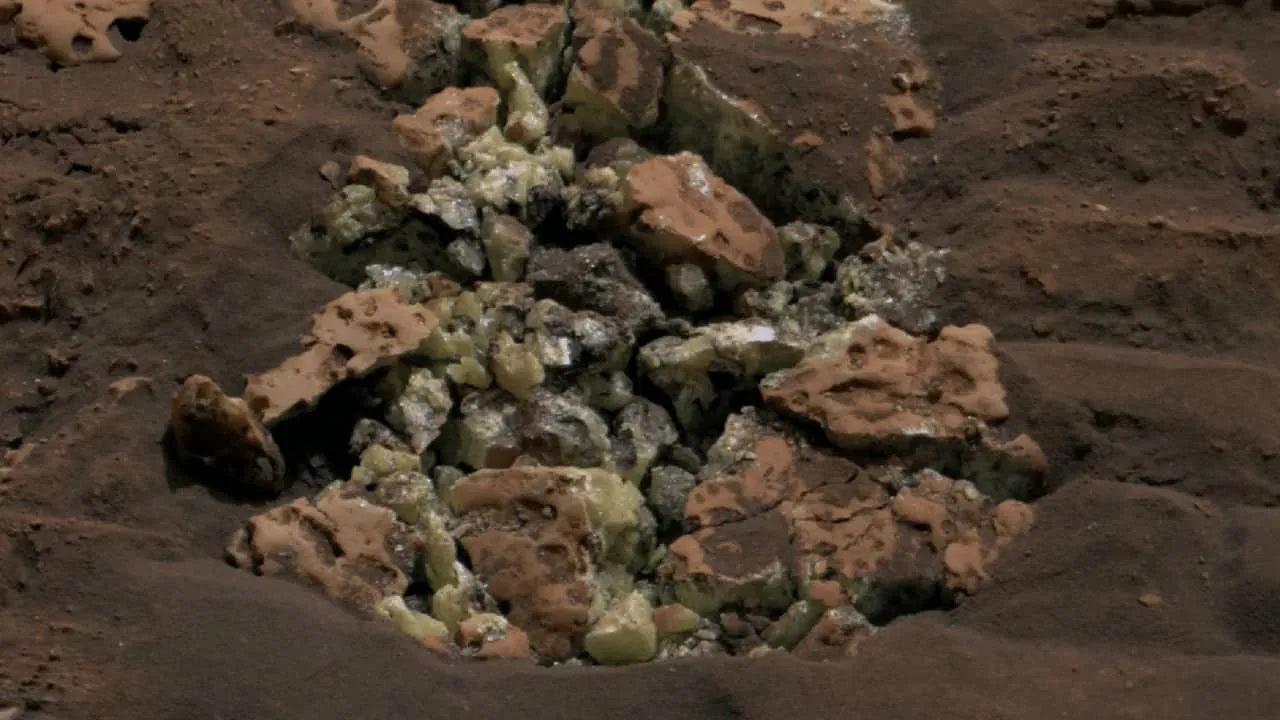
In May 2024, the rover was exploring the Gediz Vallis Channel in Mars' Gale Crater when its 899-kg body accidentally cracked a rock beneath its wheels. What emerged was a collection of pale yellow crystals that left scientists surprised.
Upon analysing the material, researchers identified it as elemental sulphur, also known as pure sulphur. It marked the first time this form of sulphur had been discovered on Mars.
While sulphur-based minerals are not unusual on the Red Planet, finding sulphur in its pure elemental form was an entirely different matter. Even more intriguing was the fact that the surrounding landscape appeared to contain several similar rocks.
"Finding a field of stones made of pure sulfur is like finding an oasis in the desert," Curiosity project scientist Ashwin Vasavada of NASA's Jet Propulsion Laboratory said following the discovery.
Now, more than two years after that accidental find, scientists are beginning to piece together how these unusual yellow deposits may have formed and what they reveal about Mars' ancient geological history.
What exactly did NASA's rover discover?
Sulphur is an important chemical element found in several minerals on Earth and Mars. However, there is a significant difference between sulphates and elemental sulphur.
Sulphates are compounds containing sulphur and oxygen, and they are relatively common on Mars. They can form when mineral-rich water evaporates, leaving deposits behind.
The material uncovered by Curiosity, however, was pure elemental sulphur, consisting of sulphur atoms rather than sulphur combined with oxygen.
NASA scientists found that the yellow crystals were scattered across a region of the Gediz Vallis Channel. The discovery was particularly puzzling because the geological conditions required to produce large deposits of pure sulphur were not readily apparent in the area.
The rover's accidental encounter had therefore uncovered more than an unusual mineral. It had raised a bigger question: How did so much pure sulphur end up on this part of Mars?
Two new studies offer clues to the mystery
Two studies published in 2026 are now helping researchers explore possible explanations for the mysterious sulphur deposits.
The first study, published in the journal *Science* in June 2026, examined Curiosity's observations and chemical analysis of the sulphur-rich rocks.
Researchers found that the pure sulphur deposits extended across approximately 2,100 square metres. Their analysis also suggested that the rocks were relatively fragile, supporting the possibility that they had formed in the area where Curiosity discovered them rather than being transported there from elsewhere.
One possible explanation involves ancient volcanic activity.
According to the researchers, gases released by volcanic activity could have become trapped beneath the Martian surface as they cooled, potentially within ice-like structures known as clathrates.
Over billions of years, erosion may have carved out the Gediz Vallis Channel, reducing pressure on these underground gas deposits and allowing the gases to escape. Subsequent chemical reactions could then have produced elemental sulphur.
Based on the geological evidence, researchers estimate that these deposits may have formed between 3.1 billion and 2.8 billion years ago.
A second study, published in Geophysical Research Letters in July 2026, explored another possible explanation.
Led by researchers at Cornell University, the team investigated whether pure sulphur could form through chemical reactions involving water, without requiring high temperatures or biological activity.
In laboratory experiments, researchers mixed dissolved sulphide with chlorate in acidic water at room temperature. The reaction produced tiny yellow crystals of elemental sulphur.
The experiments showed that the concentration of chlorate played an important role in determining the resulting material. Lower concentrations favoured the formation of pure sulphur, while higher concentrations produced more sulphate.
The researchers suggested that similar chemical reactions could potentially have taken place on ancient Mars over much longer periods, contributing to the formation of larger sulphur deposits.
Importantly, the two studies offer possible mechanisms rather than a definitive explanation of how the deposits formed.
Does the discovery mean there could be life on Mars?
Sulphur is an essential element for life as we know it. On Earth, living organisms use sulphur in several biological processes, including the production of amino acids needed to build proteins.
Its discovery on Mars therefore adds to scientists' understanding of the chemical ingredients that may have been available on the planet in its distant past.
However, finding pure sulphur does not mean that NASA has discovered evidence of life on Mars.
In fact, the second study demonstrates that elemental sulphur can form through non-biological chemical reactions. The presence of the mineral, therefore, cannot be taken as proof of microbial activity.
Nevertheless, the discovery is scientifically significant because it offers another piece of the puzzle surrounding Mars' ancient environment, including its geological activity, chemistry and history of water.