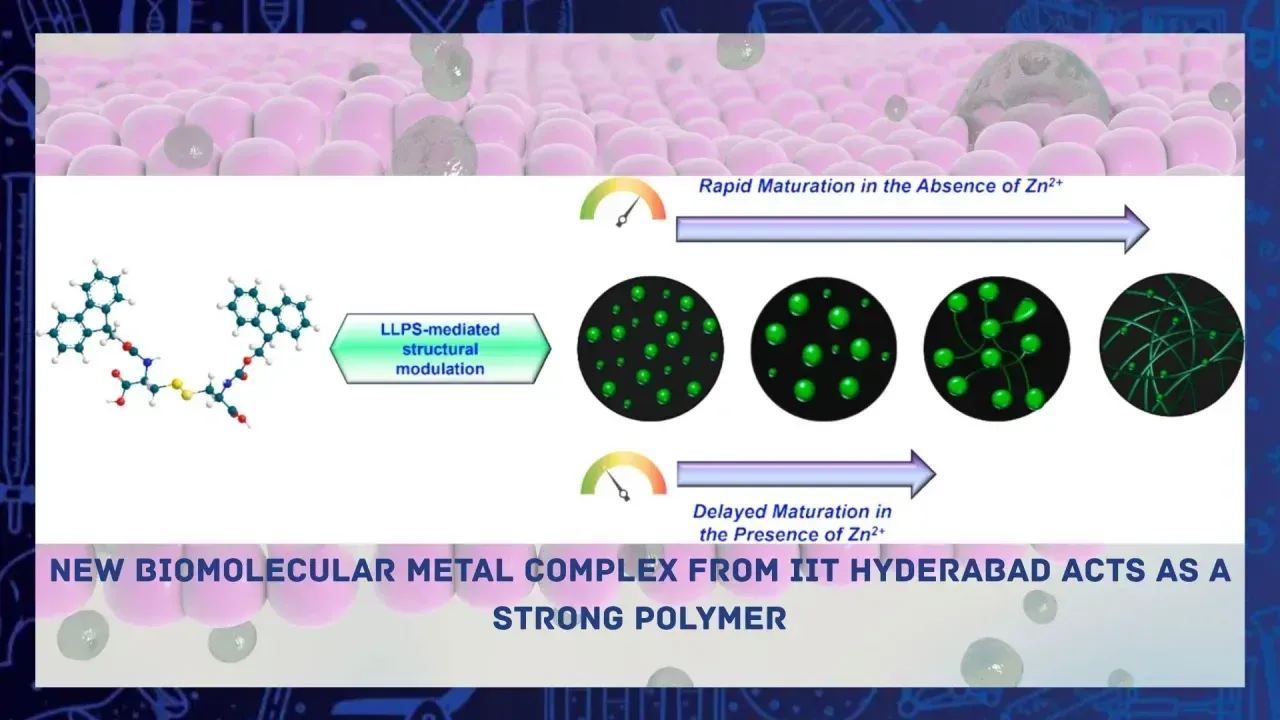
Liquid-liquid phase separation (LLPS) is a process in which biomolecules coexist in two distinct phases. For example, proteins can separate from solution as liquid droplets. Such droplets often harden into fibres over time. Many cellular compartments are known to form due to LLPS. However, outside the cellular environment, these droplets are not stable as they harden. Researchers at the Indian Institute of Technology Hyderabad (IIT Hyderabad) have now shown that a zinc ion can slow this transformation using a synthetic system.
Researchers used N, N′-difluorenylmethoxycarbonyl-l-cystine (DFC) as an example for an LLPS droplet. The fluoromethoxy groups at both ends of the molecule act as stickers that stack together, and the cystine provides the necessary space between the stacks. It resembles a sticker space model of a disordered protein. When zinc was added at a ratio of 2:1 (DFC:zinc), the droplet took 48 hrs to form a hardened gel. Whereas, in control experiments without zinc, it took less than 24 hrs. The authors performed similar experiments with copper, iron, gold, and silver ions, and other DFC-to-zinc ratios and none of these formed hydrogels
The team analysed the reason behind the stability using microscopy. Droplets of DFC alone lost their shape by 4 hours and showed fibrous structures by 24 hours. DFC/zinc droplets, by contrast, remained smooth and spherical even after 24 hours. To test molecular movement inside the droplet, they used photobleaching to induce light-driven chemical damage. When the molecules are active, the bleached area is replaced by new molecules due to Brownian motion. In DFC/zinc complex droplets, only 70% recovery was observed at 30 minutes after photobleaching.
Another property of LLPS droplets is the ability to take up other molecules. When tested, it was observed that DFC/zinc droplets took up secondary metabolites such as thioflavin T and rhodamine T. The authors tested droplet stability using a hydrazone reaction. Hydrazone is a very stable product formed between a carbon and a nitrogen molecule (methyl and imine group). DFC/zinc droplets showed about 2.5-fold higher absorbance, indicating high stability and an apolar environment similar to micelles.
Using computational modelling, the authors have explained the theory behind the stability. According to density functional theory, a zinc atom placed between the carbonyl groups of two DFC molecules has a binding energy of −28.9 kcal/mol. The authors suggest this binding is stable but still reversible. In contrast, other ions, such as copper, bind too strongly, and silver complexes bind too weakly.
Additionally, modelling the stability of the hydrogel showed significant stability with the introduction of zinc ions. From 245 Pascal for DFC, its strength shifted to 1695 Pascal in the presence of zinc. Between two glass slides, the DFC gel held 400 g of weight, while the DFC/zinc gel held 1.6 kg. The authors confirm that the complex's stability is due to denser, more evenly distributed fibres that cross-link with zinc molecules.
The researchers believe the long-lived DFC/zinc droplets could be used to develop novel biopolymers and study LLPS structures.