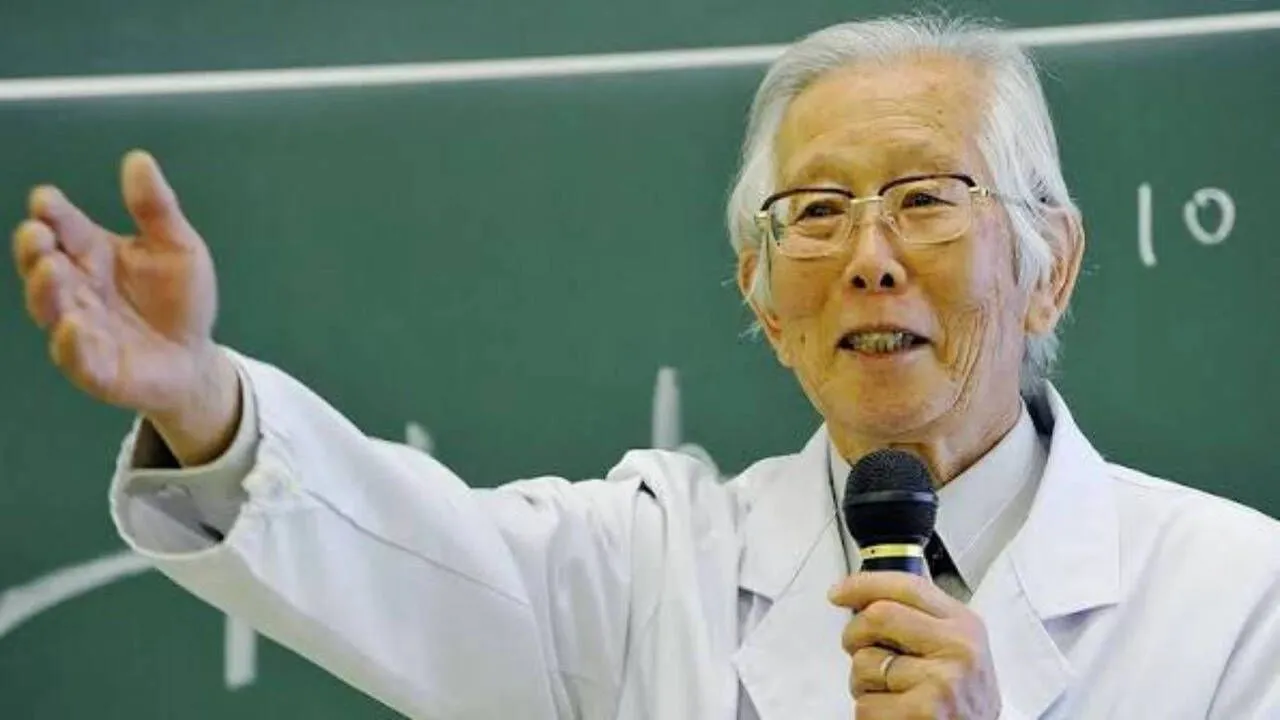
What if plastic could conduct electricity just like metal? Japanese chemist Hideki Shirakawa helped turn this once-unlikely idea into reality. His accidental discovery of a special form of polyacetylene in 1967 opened a new field of research in conductive polymers.
The Nobel Prize-winning scientist died on August 24, 2026, at the age of 90.
Plastic is generally known as an insulator. It is commonly used to cover wires because it stops electricity from flowing through them. However, Japanese chemist Hideki Shirakawa challenged this held scientific understanding and helped create a new class of materials that could carry electricity.
Shirakawa, who shared the 2000 Nobel Prize in Chemistry died on August 24,2026 at the age of 90.
His death was confirmed by the University of Tsukuba in Japan, where he had worked as a researcher and professor.
His research changed the way scientists thought about polymers and created possibilities in materials science. His work also played a role in the development of technologies used in displays, solar cells and flexible electronic devices.
Hideki Shirakawa was born in Tokyo, Japan in 1936. He developed an interest in science during childhood when experimenting with natural materials and electronic equipment.
He studied chemical engineering at the Tokyo Institute of Technology called the Institute of Science Tokyo and earned a degree in engineering in 1966 focusing on how organic molecules link together to form long chains known as polymers.
After finishing the doctorate he joined the institution as a research associate and started investigating polyacetylene, a polymer produced from acetylene molecules. The experiments eventually led to one of the most important discoveries in modern materials chemistry.
Shirakawa’s breakthrough began with a laboratory error in 1967. He was trying to create polyacetylene, a material that usually comes out as a powder. During an experiment a visiting South Korean researcher, Hyung Chick Pyun mistakenly added a catalyst about one thousand times the amount that was needed.
Instead of the expected powder the mixture produced a thin uneven film on the surface of the solution. This film had a metallic look.
Then brushing the strange result off as a failed experiment Shirakawa chose to investigate it further.
He later devised a way to produce films of polyacetylene that shine like metal. This unexpected result became the foundation for study of how polymers conduct electricity.
The discovery of polyacetylene was a step forward. It was through more experiments that people really understood how this material could conduct electricity.
Shirakaku later joined forces with scientists Alan MacDiarmid and Alan Heeger at the University of Pennsylvania. Together they worked on making polyacetylene to carry electric current. They found that adding amounts of certain chemicals to polyacetylene made a huge difference.
This change is called doping. Doping works by adding substances that help create charges that can move easily through the material. The team saw a jump in conductivity.
About 10 million times higher after the chemical treatment.
This was a shock to the world; for the time people believed that plastics could only block electricity. They were insulators but this discovery proved that wrong. Plastics could under the conditions carry electricity just like metals.
In 2000 Hideki Shirakawa, Alan MacDiarmid and Alan Heeger jointly received the Nobel Prize in Chemistry for their discovery and development of polymers.
The Royal Swedish Academy of Sciences recognised their work for showing that plastics could be made conductive through chemical modification.
The discovery established a direction in materials science and encouraged researchers to explore the use of organic materials in electronic devices.
Conductive polymers combine some of the advantages of plastics with the ability to carry electrical current. Unlike many traditional metal-based materials, they can be lightweight, flexible and suitable for specialised electronic applications.
Their research and development have contributed to several technological fields such as the following:
Although Shirakawa's original polyacetylene is not directly used in all these products, his discovery helped establish the wider field of conductive polymers.
Shirakawa's discovery showed that scientific breakthroughs do not always start with planned experiments. Sometimes an unexpected result can raise questions that lead to a brand area of research.
His work changed the way we understand plastics. It also showed that materials that were once thought to be non‑conductive can actually have electrical properties. This contribution keeps influencing research, in chemistry, electronics, energy and materials science.
For generations of students and researchers Shirakawa's journey gives a scientific lesson. Curiosity, careful observation and the willingness to investigate a result can change the course of science.