Market Mastery
Webinar by Vishal Malkan
Find the weak links
in your portfolio by Vishal Malkan
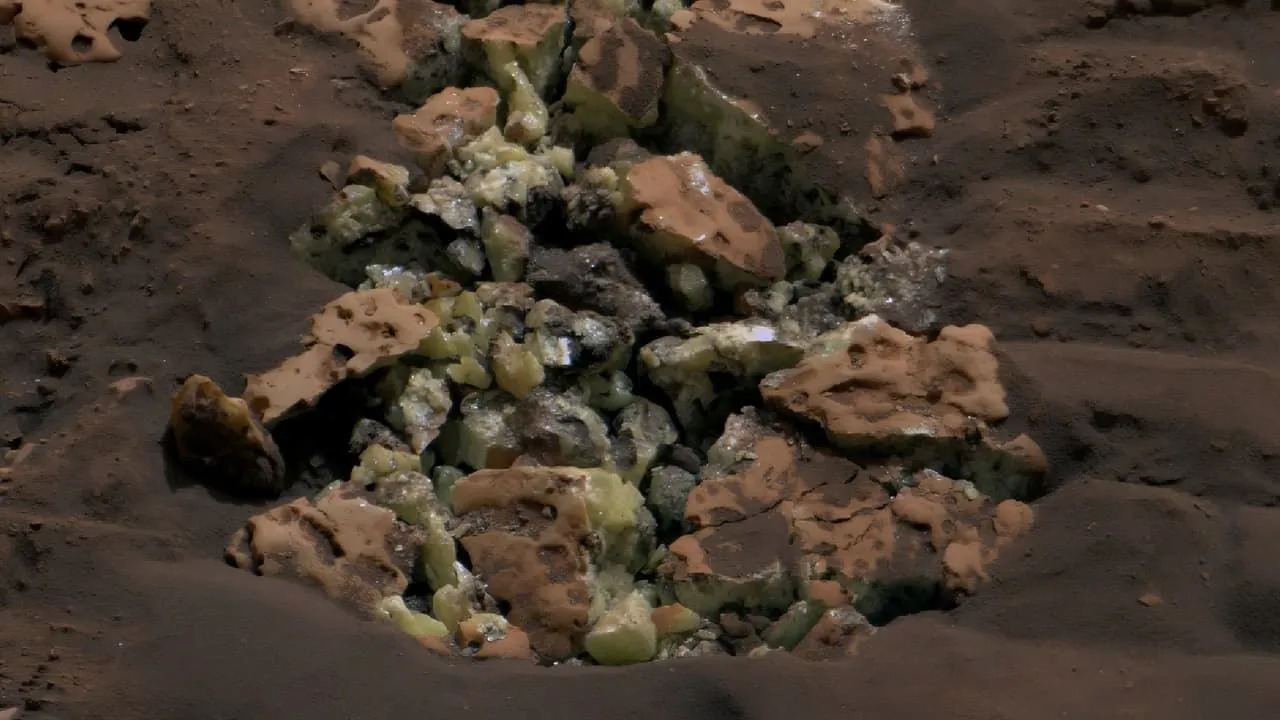
NASA's Curiosity rover has uncovered an unexpected geological mystery on Mars after identifying a field of rocks made entirely of pure elemental sulphur, a mineral never previously detected in its natural form on the Red Planet. The discovery, made inside the Gediz Vallis Channel on Mount Sharp, covers an area of approximately 2,100 square metres.
The finding has left scientists searching for an explanation because the geological conditions required to produce elemental sulphur were not expected in this region of Mars.
How did NASA Curiosity make the discovery?
The discovery happened accidentally on May 30, 2024, when Curiosity drove over an ordinary-looking rock and crushed it beneath its wheels. The broken surface revealed bright yellow crystals hidden inside.
Scientists subsequently used an instrument on the rover's robotic arm to analyse the material and confirmed that it was pure elemental sulphur. Unlike sulphate minerals previously identified on Mars, elemental sulphur consists entirely of sulphur atoms rather than sulphur chemically bonded with oxygen.
Where were the Sulphur deposits found?
The unusual rocks were discovered in the Gediz Vallis Channel, a geological formation that runs down Mount Sharp, which rises approximately 5 kilometres above the floor of Gale Crater.
Curiosity encountered a field of unusually bright, decimetre-sized rocks covering around 2,100 square metres. Scientists believe these fragments either formed at the location or travelled only a short distance before settling there.
The discovery provides another clue to the complex geological history of the region.
Why is pure sulphur so unusual on Mars?
On Earth, elemental sulphur commonly forms through volcanic activity, hydrothermal processes and certain chemical reactions involving sulphur compounds. However, scientists have not identified convincing evidence of these processes near the Martian deposits.
Researchers are investigating whether ancient underground fluids, volcanic gases or chemical reactions could have created the unusual material. Its precise origin remains unknown.
Does the discovery indicate life on Mars?
Sulphur is an important element for biological processes on Earth and plays a role in several microbial metabolisms. However, finding pure sulphur does not establish that life ever existed on Mars.
NASA Curiosity's broader mission is to investigate whether ancient Mars had environmental conditions capable of supporting microbial life. The unexpected discovery offers scientists another opportunity to understand the planet's ancient water activity, chemistry and geological evolution.