The history of Indian palaeontology contains an unusual connection between a poet and a geologist, brought together by the discovery of a dinosaur in central India. In 1961, the birth centenary of Rabindranath Tagore was being observed across the country. In that same year, a team of Indian and British palaeontologists was engaged in excavating a large collection of dinosaur fossils in the Pranhita-Godavari Valley.
advertisement
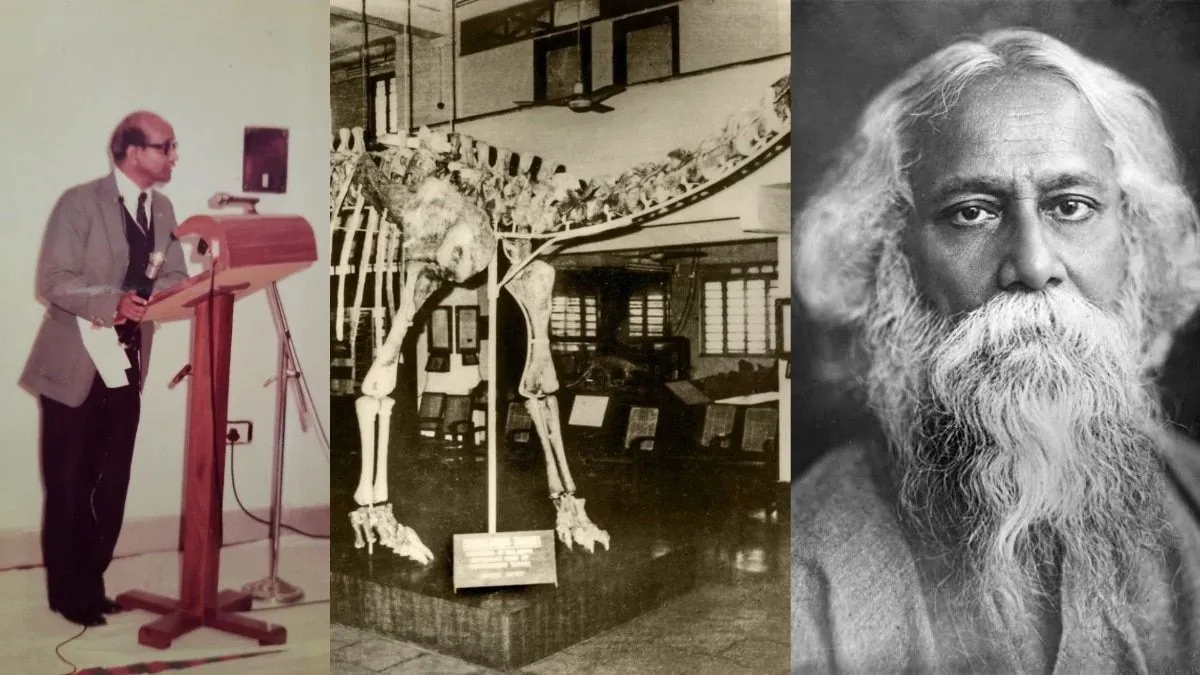
In honour of the poet's centenary, the newly identified dinosaur was given the name Barapasaurus tagorei. Among those involved in the expedition was a young Indian palaeontologist, Sohan Lal Jain, whose subsequent work would earn him a distinction of his own: a dinosaur genus, Jainosaurus, would eventually bear his name.
The story had begun three years earlier, in 1958, when geologists first discovered dinosaur bones near Pochampalli, in the Gadchiroli district of present-day Maharashtra, close to the Telangana border.
The discovery led to systematic excavations in 1960–61 by the Geological Studies Unit of the Indian Statistical Institute, Calcutta, working with researchers from University College London.
The expedition, associated with the British palaeontologist Pamela Robinson, brought together a team whose work would establish one of India's important early Jurassic dinosaur discoveries.
Approximately 300 bones were recovered from a single fossil deposit, representing at least six individual sauropods.
advertisement
The bones belonged to large, plant-eating dinosaurs whose remains had been preserved in the sediments of the Lower Jurassic Kota Formation.
The expedition, led by Pamela Lamplugh Robinson of University College London and supported by a grant from the Royal Society of London, included the Indian palaeontologist Sohan Lal Jain.
In 1961, the birth centenary year of Rabindranath Tagore, the Indian Statistical Institute's Scientific Council approved the name Barapasaurus tagorei in honour of the poet.
The generic name, meaning 'big-legged lizard', referred to the animal's remarkably large thigh bone, which measured approximately 1.7 metres in length.
Estimated to have measured between twelve and fourteen metres in length, Barapasaurus lived approximately 190 million years ago, during the Early Jurassic period. Its extensive fossil remains make it one of the better-documented early sauropods.
The mounted skeleton is preserved in the Geological Museum of the Indian Statistical Institute, Kolkata.
The dinosaur was formally described in 1975 by SL Jain whose name later was used to name another dinosaur, TS Kutty, TK Roy Chowdhury, and Sankar Chatterjee in the Proceedings of the Royal Society of London.
For Sohan Lal Jain, however, the discovery of Barapasaurus marked only the beginning of a long association with the study of India's prehistoric past.
advertisement
He continued his research at the Indian Statistical Institute for 33 years, studying fossil vertebrates, particularly the sauropods of central India.
Among his contributions was research on the braincase of a sauropod recovered from the Lameta Formation near Jabalpur. The braincase, being part of the skull that enclosed the animal's brain, offered evidence for the identification and classification of these animals.
In 1995, palaeontologists Adrian Hunt, Martin Lockley, Spencer Lucas and Christian Meyer proposed the genus Jainosaurus in recognition of Jain's contribution to the study of Mesozoic vertebrates.
The name was assigned to material previously classified under Antarctosaurus septentrionalis. Thus, the scientist who had helped bring one of India's early Jurassic dinosaurs into the scientific record had a dinosaur genus named in his honour.
There is an additional point of interest in Jain's work.
In 1997, he and Saswati Bandyopadhyay described another Indian sauropod from the Late Cretaceous deposits of central India, naming it Titanosaurus colberti in honour of the American palaeontologist Edwin H. Colbert.
In 2003, subsequent taxonomic work by Jeffrey Wilson and Paul Upchurch established it as a separate genus, Isisaurus. The new name commemorated the Indian Statistical Institute, where the fossil collection was housed and studied.
advertisement
The two names therefore preserve two separate moments in the history of Indian palaeontology: one commemorates a poet whose birth centenary was being observed, and the other honours a scientist whose work helped establish India's fossil record.
The history also reminds us that palaeontology is not merely the business of discovering bones. It is the patient work of excavation, comparison, description and, sometimes, the revision of conclusions reached by earlier investigators. In this instance, the names have endured, even as scientific classifications have changed.
And so, in a museum in Kolkata, the remains of Barapasaurus tagorei stand as a record of a discovery made in central India. The scientist associated with that discovery, Sohan Lal Jain, has his own place in the history of the creatures he studied: Jainosaurus bears his name.
- Ends
The history of Indian palaeontology contains an unusual connection between a poet and a geologist, brought together by the discovery of a dinosaur in central India. In 1961, the birth centenary of Rabindranath Tagore was being observed across the country. In that same year, a team of Indian and British palaeontologists was engaged in excavating a large collection of dinosaur fossils in the Pranhita-Godavari Valley.
In honour of the poet's centenary, the newly identified dinosaur was given the name Barapasaurus tagorei. Among those involved in the expedition was a young Indian palaeontologist, Sohan Lal Jain, whose subsequent work would earn him a distinction of his own: a dinosaur genus, Jainosaurus, would eventually bear his name.
The story had begun three years earlier, in 1958, when geologists first discovered dinosaur bones near Pochampalli, in the Gadchiroli district of present-day Maharashtra, close to the Telangana border.
The discovery led to systematic excavations in 1960–61 by the Geological Studies Unit of the Indian Statistical Institute, Calcutta, working with researchers from University College London.
The expedition, associated with the British palaeontologist Pamela Robinson, brought together a team whose work would establish one of India's important early Jurassic dinosaur discoveries.
Approximately 300 bones were recovered from a single fossil deposit, representing at least six individual sauropods.
The bones belonged to large, plant-eating dinosaurs whose remains had been preserved in the sediments of the Lower Jurassic Kota Formation.
The expedition, led by Pamela Lamplugh Robinson of University College London and supported by a grant from the Royal Society of London, included the Indian palaeontologist Sohan Lal Jain.
In 1961, the birth centenary year of Rabindranath Tagore, the Indian Statistical Institute's Scientific Council approved the name Barapasaurus tagorei in honour of the poet.
The generic name, meaning 'big-legged lizard', referred to the animal's remarkably large thigh bone, which measured approximately 1.7 metres in length.
Estimated to have measured between twelve and fourteen metres in length, Barapasaurus lived approximately 190 million years ago, during the Early Jurassic period. Its extensive fossil remains make it one of the better-documented early sauropods.
The mounted skeleton is preserved in the Geological Museum of the Indian Statistical Institute, Kolkata.
The dinosaur was formally described in 1975 by SL Jain whose name later was used to name another dinosaur, TS Kutty, TK Roy Chowdhury, and Sankar Chatterjee in the Proceedings of the Royal Society of London.
For Sohan Lal Jain, however, the discovery of Barapasaurus marked only the beginning of a long association with the study of India's prehistoric past.
He continued his research at the Indian Statistical Institute for 33 years, studying fossil vertebrates, particularly the sauropods of central India.
Among his contributions was research on the braincase of a sauropod recovered from the Lameta Formation near Jabalpur. The braincase, being part of the skull that enclosed the animal's brain, offered evidence for the identification and classification of these animals.
In 1995, palaeontologists Adrian Hunt, Martin Lockley, Spencer Lucas and Christian Meyer proposed the genus Jainosaurus in recognition of Jain's contribution to the study of Mesozoic vertebrates.
The name was assigned to material previously classified under Antarctosaurus septentrionalis. Thus, the scientist who had helped bring one of India's early Jurassic dinosaurs into the scientific record had a dinosaur genus named in his honour.
There is an additional point of interest in Jain's work.
In 1997, he and Saswati Bandyopadhyay described another Indian sauropod from the Late Cretaceous deposits of central India, naming it Titanosaurus colberti in honour of the American palaeontologist Edwin H. Colbert.
In 2003, subsequent taxonomic work by Jeffrey Wilson and Paul Upchurch established it as a separate genus, Isisaurus. The new name commemorated the Indian Statistical Institute, where the fossil collection was housed and studied.
The two names therefore preserve two separate moments in the history of Indian palaeontology: one commemorates a poet whose birth centenary was being observed, and the other honours a scientist whose work helped establish India's fossil record.
The history also reminds us that palaeontology is not merely the business of discovering bones. It is the patient work of excavation, comparison, description and, sometimes, the revision of conclusions reached by earlier investigators. In this instance, the names have endured, even as scientific classifications have changed.
And so, in a museum in Kolkata, the remains of Barapasaurus tagorei stand as a record of a discovery made in central India. The scientist associated with that discovery, Sohan Lal Jain, has his own place in the history of the creatures he studied: Jainosaurus bears his name.
- Ends