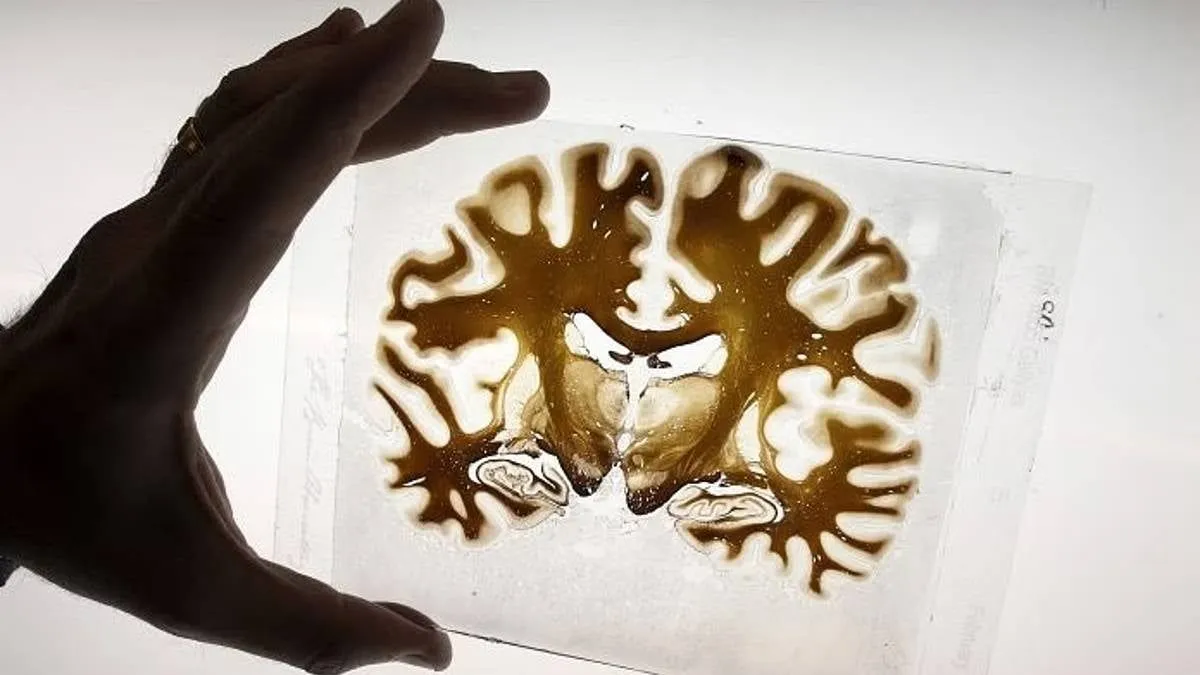
New Delhi: The human brain is wired in a curious way: the right hemisphere controls most movements on the left side of the body, while the left hemisphere controls the right. This arrangement, known as contralateral organisation, is also found in several sensory pathways across vertebrates. A new study proposes that the explanation may lie in the evolutionary history of vision, which could have established a pattern that later brain circuits inherited.
Published in Frontiers in Neuroanatomy, the study, titled ‘Why is the right side of the brain responsible for the left side of the body? The evolutionary history of a puzzling trait’, was authored by neuroscientists Daniel Delie Wang and Martin Wessendorf of the University of Minnesota.
How the brain’s cross-wiring works
The arrangement is particularly evident in vision. Light entering the eyes is projected onto the retina, where the image is reversed. Nerve fibres carrying information about the right visual field cross at a structure called the optic chiasm and travel toward the left side of the brain. Information from the left visual field follows the opposite route.
The researchers examined how this arrangement appears across vertebrate species, alongside pathways responsible for touch, pain, hearing and movement.
They identified several other crossed pathways, including the spinothalamic tract, which carries information about pain and temperature, and the corticospinal tract, which helps control voluntary movement. In humans, the latter is particularly important for fine motor skills, including precise finger movements.
The researchers suggest that the visual system was the first major sensory pathway to develop this crossed organisation. Other sensory and motor circuits subsequently adopted similar arrangements.
An evolutionary inheritance
Wang and Wessendorf propose that the ancient visual system established an organisational template in the brain. As other neural pathways evolved, they may have followed this existing arrangement rather than developing entirely new connections.
In their accompanying explanation published by Frontiers, the researchers write: “Since evolution is conservative in its innovations – it often retains and builds upon existing structures, pathways, and mechanisms rather than inventing new ones”.
They add that “the organization of the visual system (and in particular, the optic tectum) may have defined the organizational principles required of the sensory and motor pathways that evolved later”.
The optic tectum is an ancient midbrain structure involved in processing visual information and coordinating responses to stimuli. In mammals, its counterpart is called the superior colliculus.
The researchers suggest that this arrangement could date back to early vertebrates, potentially including jawless fish that lived during the Cambrian period, between approximately 538 and 486 million years ago.
Also read: New scorpion species discovered in Similipal, first record of its genus in Odisha
A hypothesis, not a settled explanation
The paper is a review and evolutionary hypothesis, rather than an experimental demonstration of how the cross-wiring first developed. Its authors acknowledge that the precise origins remain uncertain. They suggest that examining fossilised skulls of ancient jawless fish could offer a way to test aspects of their proposal.
The research offers a possible explanation for why the brain retained an arrangement that might otherwise seem unnecessarily complicated: later neural systems may have developed around connections that were already in place.
(Edited by Ratan Priya)