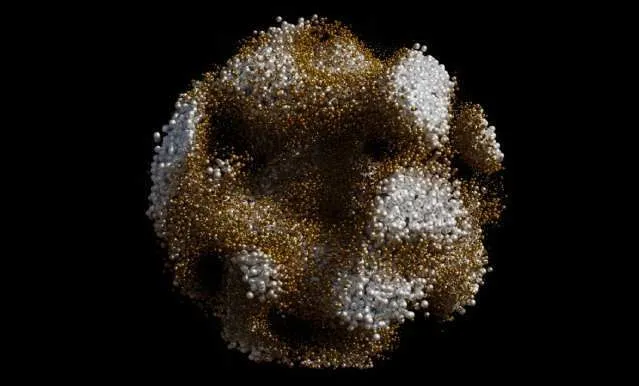
The Zeptoverse is a world of distances around a billionth of a trillionth of a meter, about 100 billion times smaller than an atom. Physicists believe new particles and forces could be hiding there, unbeknownst to any probe.
The decay LHCb found, Bd to mu mu, is predicted to happen about once in every 10 billion beauty particle decays. Its sibling, Bs to mu mu, occurs roughly three times in a billion, so the new one is about 30 times rarer.
Physicists have chased this decay for more than 40 years, and the hunt reportedly began in 1984. A 2015 joint LHCb and CMS analysis claimed first evidence, but updates using data up to 2018 did not confirm it.
The new data from 2024 and 2025 reached 3.0 standard deviations. Combined with 2011 to 2018 data, it rose to 3.2. Three standard deviations means a 0.3% chance the result is a fluke. A formal discovery needs five.
The 2024 LHCb upgrade collects data at five times the rate of 2010 to 2018. Machine learning helped pick the muons out of a huge background. The analysis team numbered about 19 people, with physicists from the UK, Germany, Italy, Spain, and the Netherlands.
The team measured the decay’s branching fraction at about 1.26 in 10 billion in the new data alone, with a statistical uncertainty of roughly 0.5 in 10 billion. The result matches Standard Model predictions and has not yet been peer-reviewed.
Images: LHcB, illustrative: Pexels—1, 2, 3, 4, 5 & 6