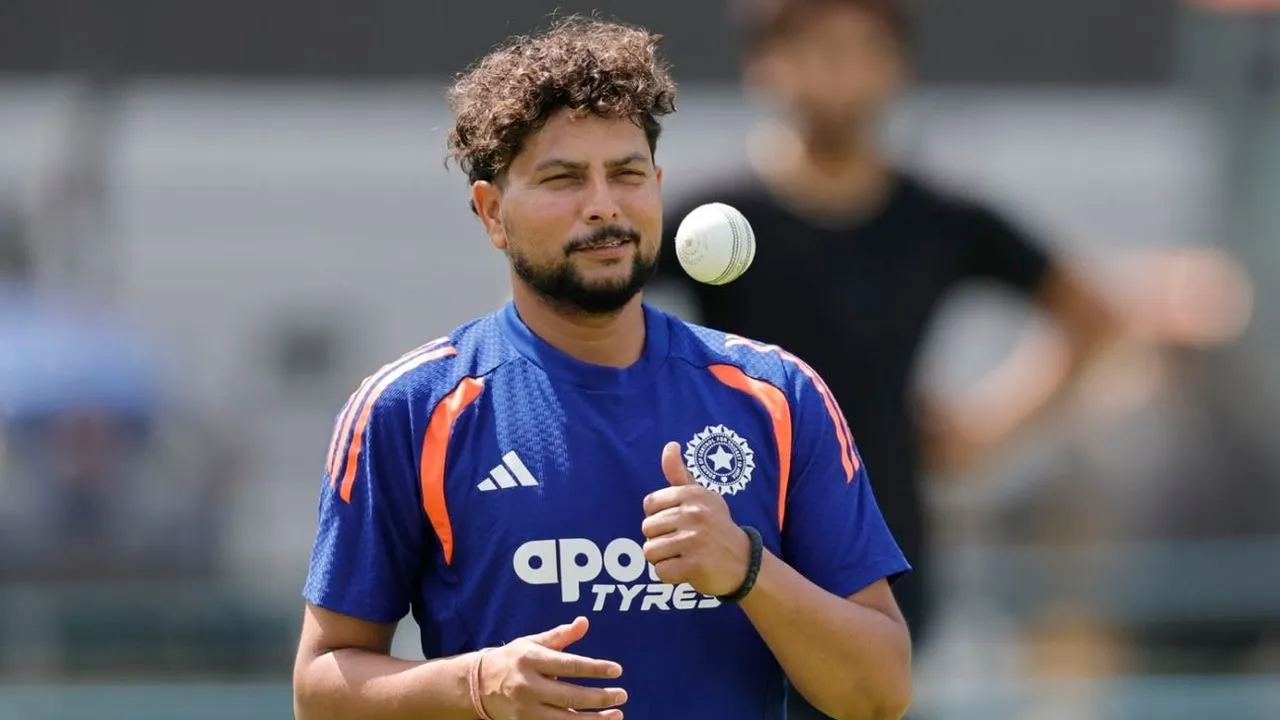
Kuldeep Yadav was taken for 73 runs in eight overs in the Mount Maunganui ODI, his first competitive game in a month, and was dropped from the Test team the day after
Karthik Krishnaswamy
Published: Nov 14, 2026, 10:42 AM (3 hrs ago)
We are well past the age of the three-format international cricketer - partly because of the shrinking skill overlaps, and partly because the calendar is so crowded. And yet, at the start of their tour of New Zealand, one player was part of India's squads in all three formats.
That player, Kuldeep Yadav, is now about to fly back home, released from the Test squad after playing none of the five T20Is and only one of the first four ODIs.
How do you go so quickly from all-format player to bit-part, one-format player?
The timing of India's announcement that Gurnoor Brar would replace Kuldeep in the Test squad was brutal. It came the morning after Kuldeep, in his first competitive game in more than a month, went for 73 runs in eight wicketless overs in the fourth ODI in Mount Maunganui. They probably didn't intend it that way, but it felt like India had judged him to be surplus to requirements after one game.
Related
Kuldeep, and fallacy of bits-and-pieces allrounders
Brar replaces Kuldeep in India's Test squad
At the post-match press conference on Friday, India head coach Gautam Gambhir was asked about the challenge Kuldeep faced to maintain his rhythm as a wristspinner while playing as sporadically as he has done.
This was Gambhir's reply: "Look, game time will always be limited [as a spinner] when you travel overseas. But whatever opportunities you get, you try and make the most of it. It's not that he hasn't got enough game time. He played three ODIs against West Indies [at home in October]. And then when you are travelling [to] a place like New Zealand, and when you know the dimensions [of the grounds] and you know the conditions, sometimes you go with three seamers and you go with four seamers as well [as India did in the first three ODIs], and that is exactly what we did.
"So, I think this debate about less game time, getting into rhythm - I think when you are playing international cricket, you should try and be in that rhythm most of the time. And whatever opportunities you get, you should try and make the most of it. It's the same for batters as well. Because you can't keep thinking that he hasn't got enough opportunities."
It's not unfair for a coach to expect their players to be at peak readiness to come into the XI at short notice and perform. But other coaches may have chosen to communicate this privately to their player while shielding them in their public utterances. They might have chosen any of these standard press-conference lines:
"Yes, it can be hard on a player to come in after a long break and immediately find his groove."
"Kuldeep bowled well even if his figures don't reflect it."
"He's a champion bowler, and he's just had one bad game."
Gambhir didn't say any of those things. And it's not that he can't be protective of his players; he's often extremely protective of particularly the younger players in his charge. That's a good thing, and it's even understandable that he might hold a senior player like Kuldeep to higher standards.
Kuldeep certainly wasn't at his best on Friday. It wasn't a case of bowling decently but happening to get hit - which can happen at international level. He wasn't at his best in terms of lines and lengths, and it didn't help his case that Axar Patel, India's other spinner, bowled an immaculate length and returned figures of 10-0-39-2 on a day when New Zealand scored 333.
"Kuldeep, he's a confidence bowler too, so I knew if I stayed still and didn't offer too much, he'd gain in confidence, so I thought I could hit with the wind and I could bring out my sweeps, and thankfully, that worked yesterday"
Will Young on his approach against Kuldeep in Mount Maunganui
New Zealand also went hard at Kuldeep, with Will Young stepping out to the first ball he faced from him and launching him for a straight six. He used the sweep and reverse sweep at every chance as well, and seemed determined to not let Kuldeep settle into a length.
"Axar was hitting a really nice length," Young, who scored 125 off 108 balls, said in a media interaction on Saturday. "The wicket was holding a little bit from just back of a length, so I found him difficult to find my timing [against].
"Kuldeep, he's a confidence bowler too, so I knew if I stayed still and didn't offer too much, he'd gain in confidence, so I thought I could hit with the wind and I could bring out my sweeps, and thankfully, that worked yesterday."
The other side of Kuldeep being a confidence bowler, left unsaid by Young, also seemed to be at play. When the batters came after him, Kuldeep looked rattled.
This is certainly not the case when he's bowling at his best. Perhaps his greatest ODI comeback after taking stick early on came against the same opposition in a 2023 World Cup game in Dharamsala. In that game, Daryl Mitchell had gone after him and left him with figures of 0 for 48 after five overs. Kuldeep played a big part in India hauling New Zealand back, and eventually winning that game, rebounding with 2 for 25, including the wicket of Mitchell, in his last five overs.
But it isn't a coincidence that Kuldeep has endured some of his most difficult days against New Zealand. They are the only team against whom he has a six-plus economy rate in ODIs. And right through his career - right since his first match against them, in Mumbai in 2017 - New Zealand's batters have gone after him in a brilliantly calculated manner.
New Zealand have used the sweep and all its variants against Kuldeep more often than any other team in ODIs, and to deadly effect. They have scored 223 runs off 144 balls while playing these shots, while only losing two wickets.
Australia have scored quicker against Kuldeep with variants of the sweep - at a strike rate of 185.92, as compared to New Zealand's 154.86 - but they have been less safe, averaging 50.20 to New Zealand's 111.50.
The same story extends to stepping down the track. Australia have stepped out far more often to Kuldeep than any other batting team, but their 129 forays out of the crease have only brought them 149 runs while costing them nine wickets. New Zealand have stepped out 48 times and scored 96 runs, including 11 sixes, while only losing three wickets.
In short, New Zealand were the worst team for Kuldeep to be playing his first competitive game against in more than a month.
Now Kuldeep would be the first to put his hand up and say he didn't bowl as well as he could have in Mount Maunganui on Friday, but it was still only one bad game. He had been India's best bowler by far in their last ODI series, playing all three games against West Indies on some of the most brutally flat pitches in 50-overs history, and taking seven wickets at 23.85 while going at less than a-run-a-ball. It was a series where West Indies lost one match after posting 405, and won another while chasing 352.
This had been Kuldeep's first series since enduring a tough Test tour of Sri Lanka, where he had looked the least threatening of India's three spinners in Galle, and missed out on the second Test in Colombo. In that West Indies series, he had shown the effects of playing regular competitive cricket: after the disappointments of Sri Lanka, he had gone to England and played three County Championship games in the space of 17 days in September. Kuldeep's alignment at the crease had seemed off-kilter in Sri Lanka; it seemed to be back where it needed to be when he bowled against West Indies, and he seemed to have recovered his ability to change his pace and trajectory constantly without losing his length.
That series could have been a springboard to more regular cricket for Kuldeep, and more opportunities to stay in his groove. Instead, he has found himself in this odd situation in New Zealand: a virtual non-playing member of all three squads, now released from one.
You can understand the point of view of India's management. It's natural that teams will pick squads that cover every base when they go on a long tour. A wristspinner of Kuldeep's gifts makes it to every squad on merit. And you don't know what conditions you will get before you reach each venue.
But it wasn't hard to foresee the way this tour would go for Kuldeep. Where previous India managements have erred on the side of adventure with Kuldeep, and trusted his skills to have an effect across conditions, this one has been notably averse to picking him. Last year, they kept him on the bench for the duration of a five-Test series in England, in a warm, dry summer with flat pitches that might have given him plenty of chances of influencing games, particularly in the second innings.
And so, given how India under Gambhir have tended to use Kuldeep, it might have been prudent for the selectors to perhaps not pick him in the T20I squad - and certainly not in the Test squad when it was clear from the outset that conditions in New Zealand almost never allow teams to pick more than one spinner.
India are almost certain to play a 4-1 combination in the Tests in Wellington and Christchurch, with one spinner in Ravindra Jadeja - and Washington Sundar as his back-up - and either four outright seamers or three plus the allrounder Nitish Kumar Reddy. It was always unlikely Kuldeep would get any game time in the Tests.
If they had rested Kuldeep from the T20Is, the selectors could have allowed him to play a couple of Ranji Trophy games for Uttar Pradesh, bowl long spells, and stay in the rhythm he had shown during the West Indies ODIs.
Now, with the Ranji Trophy taking a mid-season break, it is the Syed Mushtaq Ali Trophy T20s that Kuldeep will get to play, now that he has been released from the Test squad. India may well have made the right call in this specific case, but they couldn't have chosen a worse way to do it.
Karthik Krishnaswamy is an assistant editor at Cricinfo