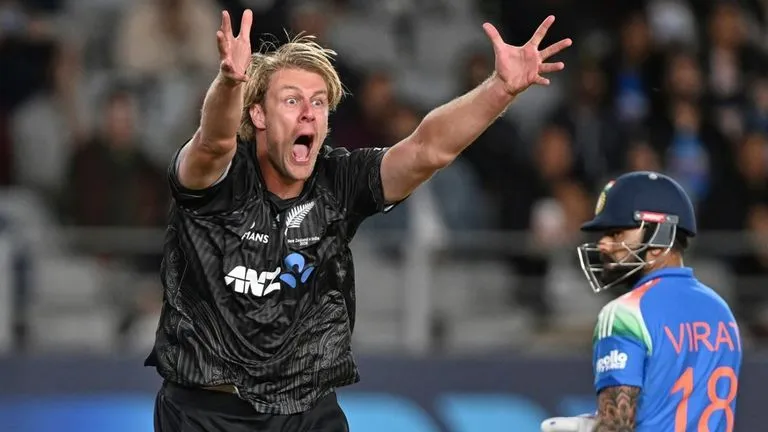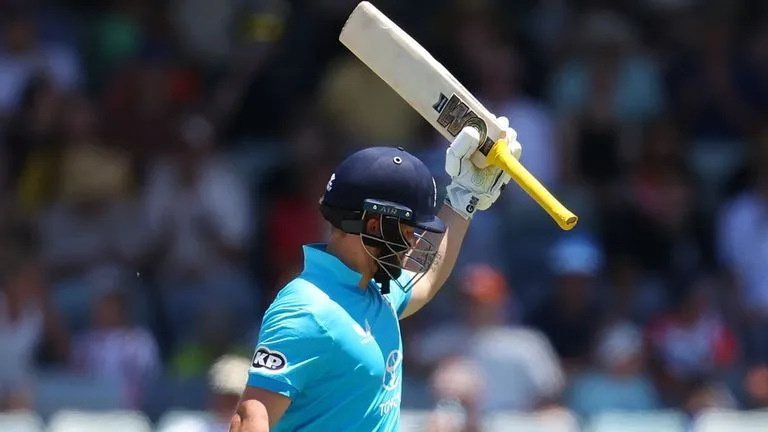
There’s a distinct fluidity and verve to Shreyas Iyer’s batting that can sometimes circumvent a difficult pitch. In Wellington, six balls into his innings, Iyer did one of those things: all wrists, barely a shift of the feet, a fierce swing of the bat to carve the ball over cover for six. It came against Jacob Duffy, on a high after prising out Shubman Gill and Virat Kohli with nagging seam.
For the next 38 balls after that shot, most of Iyer’s fluency was buried in the texture of a pitch that offered all of pace, seam and lift to bowlers. He fell to an ungainly dismissal, punched by his old irritant, the short ball.
Gill called the surface “tricky” and “challenging”, Santner repeated the t-word. “There’s no hiding it,” he added. It turned India’s short chase into hard work. That Iyer stroke took India to 27/2: at that point, the double strikes still looked like recoverable setbacks, for the target was just 135.
Next over, Rohit Sharma was teased with a bouncer by Jamieson and thwacked it for six over midwicket. For him, a short ball appears to almost stall and travel in slow-motion, until the bat meets it and resets its velocity. With little room to play, Jamieson’s idea would have emerged from India’s own ploy earlier in the game.
Much of New Zealand’s middle-order had been engulfed by pace and skiddy bounce, ignited by the tall frame of Gurnoor Brar. New Zealand had their own beanpole in Jamieson.
Maybe, it was too early. And Rohit wasn’t the batter to bother it with. The short-ball effect didn’t return until after.
Rain from earlier had left enough moisture to assist seam, and it made the surface slightly two-paced. Gill and Kohli had fallen to each of those facets, and Rohit did too. Trying to force a shot, he was bitten by late movement.
It gave New Zealand a firmer standing in the game. At 39/3, Iyer and Axar Patel had to deal with the next phase. That’s when the hosts decided to re-plant their strategy.
Axar’s first ball sharply lifted past him and nearly took along a glove to a diving Glenn Phillips. The next two overs brought one run. The next real scoring shot came from Axar’s cheeky ramp, absorbing Nathan Smith’s pace and steering it over the keeper. Ironically, the same shot brought his downfall too.
In an attempt to repeat it against Matthew Fisher, Axar meekly fell to New Zealand’s plan. It took the ball exactly to Duffy, placed for the stroke at third man.
Axar’s dismissal was his own undoing at a time when the run-rate wasn’t a challenge. When Naman Dhir also fell to a short ball, caught at the boundary by a fielder placed exactly for his pull, it further sucked India into the hosts’ plan.
Dhir might have had the image of Iyer’s dismissal from a few overs ago. Surprised by a Jamieson bumper, he turned into an awkwardly tangled figure. The dismissal will reignite a topic he admittedly hates: the short ball, the perceived difficulties from which, have “triggered” him in the past.
The scratchiness had lingered. Duffy dealt something similar to Iyer earlier in the innings with a ball directed at his face. Then, Iyer had borrowed just enough from elementary gymnastics to arch out of danger, falling flat on his back.
Iyer, unlike Axar and Dhir, was at the mercy of a vicious ball. Either way, the strategy tested India’s approach against that length, which nearly opened the game before another bout of showers crushed the hosts’ hopes.
New Zealand’s batters themselves had been snarled by it. Five of their batters fell to the short ball. Their false-shot percentage was higher than India’s, and it impeded their run-flow in the middle overs.
Across both teams, only two batters had a false-shot percentage in single-digits against short balls. Tom Latham, who hit three off nine against those, not drawing any false shots. The other was KL Rahul, whose percentage stood at 6.6.
Rohit (37.50) and Rahul (28.57) had the highest boundary percentages against short lengths, counter-attacking the threat better than anyone else. Together, they fetched 39 off 22 balls against the most fruitful bowling length of the game.
Rahul had a lot more control. It showed best across a two-ball sequence against Nathan Smith. The first one rose up to his helmet, but Rahul deftly rolled his wrists over it, getting no dangerous elevation, but four runs. Next ball, he sized up the relatively lower bounce early, and put force underneath it, crunching it for six behind square.
No other batter hit as many boundaries off short balls. Rahul took 24 off 14 from them. Looking back, that surge nudged India past the DLS par score before the match-ending showers emerged.
“He’s obviously class, right?”, Jamieson said after the game, drawing the inference after having bowled at him in every practice at Delhi (Capitals) for two months. “Like, he's so good and such a rock-solid player at that number six he was today.”
The short ball troubled both sides, but India managed to crawl out of quicksand. New Zealand went into a shell against those. India over-compensated at times, but the early runs from Rohit, and the calculated attack from Rahul at the end ensured even their scratchy pursuit had enough fuel to take them over the line.