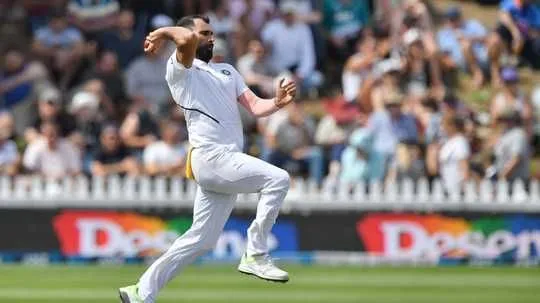
It took all of 17 balls, and it neatly typified Mohammed Shami's Test career. For 13 years, Shami showed he was all heart and fire with a red ball in his hand, and on that fourth evening in Johannesburg in 2018, he laid it bare in warp speed. South Africa were 157/5 in the final session on Day 4, still in control of their chase of 241. Then they went face-to-face with one of the finest old-ball proponents in the format, and crashed and burned their way to a 63-run defeat. Shami sent down yorkers at pace and dismantled the lower-order for a consolatory Indian win.
South Africa have been at the receiving end of his exploits far too often. Three years later, he snared a first-innings fifer in India's Boxing Day Test win in Centurion: baffling three of South Africa's top-five, and then picking three more wickets in the second.
In between these two, came an absolute fourth-innings demolition. At the peak of his powers as Test captain, Virat Kohli had a menacing henchman in Shami. For a skipper who wanted to give the opposition hell all the time, Shami became his hell-raiser. In Visakhapatnam, Shami returned second-innings figures of 10.5-2-35-5. The numbers barely conveyed the despair he left the touring South Africans in. For that, there was a frame of Faf du Plessis standing in disbelief after shouldering arms to a length ball that seamed back in and knocked over his stumps. Shami did that a lot to batters: turning seemingly calculative decisions into catastrophic misjudgements.
Exactly 13 years since he first played Tests for India, Shami called time on his Test career. When a cricketer retires, the measuring tape inevitably comes out. How good was he among his peers? How did he fare at home, and away? How good was he for his era? Numbers are dissected, comparisons drawn and impact debated. By almost every measure, Shami's career makes for a compelling reading, while also having a nagging feeling of 'what if' to it.
A red ball out of Shami's hand came with endless possibilities. It could uncannily seam in or out even when the pitch wasn't necessarily responsive. Reverse swing was one of the stronger bows in his quiver, while he could also bend a new, shiny ball to his whims. But, age and condition of the ball notwithstanding, there was one secret to most of his success: an upright seam, held with the languid grace of an Olympic swimmer gliding towards gold. Zoom in and slow down his deliveries for a closer look at that seam position, and you'd be left wondering if you're looking at an AI-generated output: too good, too perfect, too straight to be real.
For all of the aggression he packed into his bowling, Shami wasn't much of a sledger. There are tales about how ex-India coach Ravi Shastri fired him up over a meal and how he channelled that on the pitch. Yet, none of that fury spilled over to the opposition. Shami always came across as a civilised bruiser. He'd send stumps on a cartwheel, even break them in two, and celebrate big, but never in the batter's face.
Shami leaves the format with 229 wickets in 64 Tests at an average of 27.71. At home, that average dropped by five further points. Among bowlers with 75 wickets or more, only Kuldeep Yadav and Waqar Younis have a better strike rate in Asia than his 41.8.
Shami stretched every sinew of his body through long spells in the most testing conditions. And away from home, where the ball often danced more readily to his tunes, he became an integral part of India's growing belief that they could become a force. His best figures - 6/56 - came on a lively surface in Perth in India's successful tour of 2018-19. Though India lost that Test, Shami once again showed why he could impact matches with his second-innings prowess. There, his short balls and good length deliveries at pace did the trick for him.
The agonising 'what if' began at the 2023 World Cup and lingered through the years that followed. Shami played through pain and took injections to manage a heel and Achilles injury, yet remained central to India's march to the final, finishing as the tournament's leading wicket-taker with 24 scalps in seven matches. Surgery followed in February 2024, but the beginning of the end came later that year when knee swelling during rehabilitation ruled him out of the Border-Gavaskar Trophy in Australia.
Shami returned to red-ball cricket for Bengal in late 2024 and earned his international comeback in the Champions Trophy 2025, ending a 14-month absence. But a return to Test cricket remained elusive. Home series and away tours have followed but the selectors have been reluctant to go back to him with the fear of recurring injury leaving India short and vulnerable.
Shami regained fitness and remained hopeful, but on November 6, he chose to complete the full circle by announcing his retirement on the same date he had made his Test debut 13 years earlier. Only five Indian fast bowlers have played more Tests than Shami, and yet his feels like a career cut cruelly short. For a bowler of his quality and appetite, a tally of 80-plus Tests and 250-plus wickets would have felt far more fitting.
Shami's legacy perhaps lies in the way he changed India's relationship with fast bowling. He isn't the first fast bowler to enthral, and certainly won't be the last. But the search for a true successor, someone who can combine the perfection of seam presentation with the control, reverse swing and sheer persistence that Test cricket demands, will take time, effort and a fair bit of luck.
Shami's time in whites is over, and the red ball is no longer his responsibility. But every time, in the heat of a gripping Test, the old ball begins to reverse under fading light, or a delivery seams away just enough to create an opportunity out of nothing, memories of the magic Shami could conjure will come flooding back.