India opener may not be coping so well to the reality of being a one-format international cricketer
Karthik Krishnaswamy
Published: Nov 16, 2026, 3:32 AM (3 hrs ago)
3:16
Is India's powerplay batting a cause for concern?
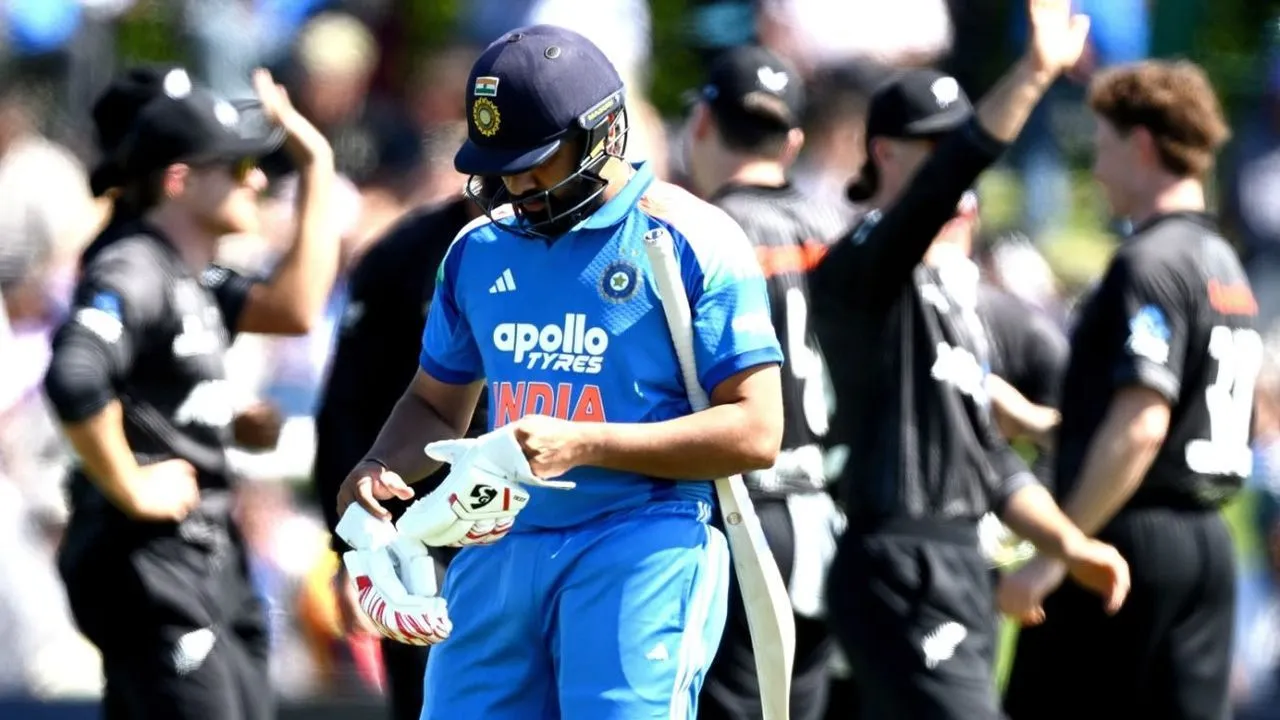
Thirty runs in four innings at an average of 7.5. Those are the batting outcomes of Rohit Sharma's last tour of New Zealand. Only once has he played this many innings in an ODI series and averaged less.
That series took place 14 years ago in Sri Lanka. The best years of Rohit's career were all in front of him. On Sunday, when he played his final ball of this New Zealand tour, flicking too early at Matthew Fisher and popping a catch to midwicket, Rohit was 39 years and 199 days old. When India play their opening game of next year's World Cup against Australia in Cape Town, Rohit will be 40 years and 180 days old.
If he's playing that tournament, he will have spent more than two years being a one-format international cricketer.
If. It felt like a big if five months ago when India's selectors told Rohit they were planning to move on from him. It felt like a smaller if when Rohit scored 138 in his very next innings, at Lord's. And he filled his boots in India's next ODI series, reeling off scores of 32, 101 and 92 against West Indies.
One bad series shouldn't take away from all that. Particularly a bad series on the green, seaming, bouncy and often two-paced pitches of an unseasonally wet early summer. And Rohit's overall record over the last year-and-a-bit is unimpeachable on the surface: since the end of last year's Champions Trophy, he has 982 runs at an average of 46.76 and a strike rate of 98.89.
On the surface.
You don't have to dig too deep to see signs of concern, however. Add, for instance, the context of how his top-order colleagues have done. The other two members of India's first-choice top three, Shubman Gill and Virat Kohli, average 75.00 and 63.37 respectively, and have struck at 112.84 and 114.18. This New Zealand tour apart, India have played the bulk of their ODIs on belters.
It wouldn't be a worry if Rohit simply averaged less than his top-order colleagues. It's the fact that he's also been scoring at a slower tempo, particularly because this is a batter who had previously led the way globally as an unstoppable first-powerplay force.
From the start of the 2023 World Cup to the end of the 2025 Champions Trophy, Rohit had been the world's fastest-scoring batter in the first 10 overs of ODIs (minimum 200 balls faced), striking at 133.68 in this phase and hitting a six roughly every 14 balls. Incredibly, he also averaged 62.5 in this phase, so he wasn't just going after the bowling at every opportunity but doing it with a high degree of certainty.
Since his match-winning 76 in the Champions Trophy final, Rohit has been a far more subdued starter. Across 22 ODI innings, he's struck at 86.25 in the first ten overs, and hit a six every 30 balls. He still has a more than decent first-powerplay average - 48.11 - but these are numbers of a pretty good ODI opener, not those of the elite one he has been for so much of his career.
And the issue extends to the underlying numbers. It's not as if Rohit has gone back to his earlier mode as an ODI operator, of cautious starts and ominously gathering momentum. It's that he seems to have become a less certain starter on the whole. It isn't just his powerplay strike rate that's dropped since the Champions Trophy but his control percentage in this phase too - from 78.79 in that World-Cup-to-Champions-Trophy mini-cycle to 75.30. And when he's been in control, he's gone at just a run a ball, compared to 152.26 in the earlier period.
Related
Arshdeep and Co help India defend 209 for 3-1 series win
Santner: 'It was a very close series that could have gone either way'
Iyer: 'We had the belief even though we didn't get that many runs'
What a short! Arshdeep becomes most rounded version of himself
There can be many reasons for this: age and slowing reflexes, possibly, and perhaps more pertinently the long gaps between ODI series that leave Rohit with no easy way to stay in batting rhythm. Kohli, who's also now a one-format international player, seems to have coped better with this than Rohit has so far.
And this was evident even three days before the first ODI, when the two of them took turns at an open net in the middle of Eden Park's outer oval, against a combination of throwdowns and three India fast bowlers - Gurnoor Brar, Anshul Kamboj and Auqib Nabi. Kohli was occasionally troubled by balls that seamed or kicked, but otherwise batted as if he was his only real opponent, going after every ball and in the process miscuing a few.
Rohit exuded an entirely different energy. He defended far more often, and edged or was beaten more frequently. It didn't seem like there was much to read from this at the time; the history of cricket is replete with batters who struggled in the nets only to light up matches and series with incandescent strokeplay.
There was little of that from Rohit in New Zealand, however. But this was still Rohit Sharma, and the moment of that open net came from his bat: a lazily effortless flick - time and the majesty of that shot have erased the identity of the bowler - that sailed over the boundary and onto Sandringham Road. For the fans who watched with faces pressed to the fence, there will always be this moment to treasure from Rohit's final tour of this country.
Karthik Krishnaswamy is an assistant editor at Cricinfo