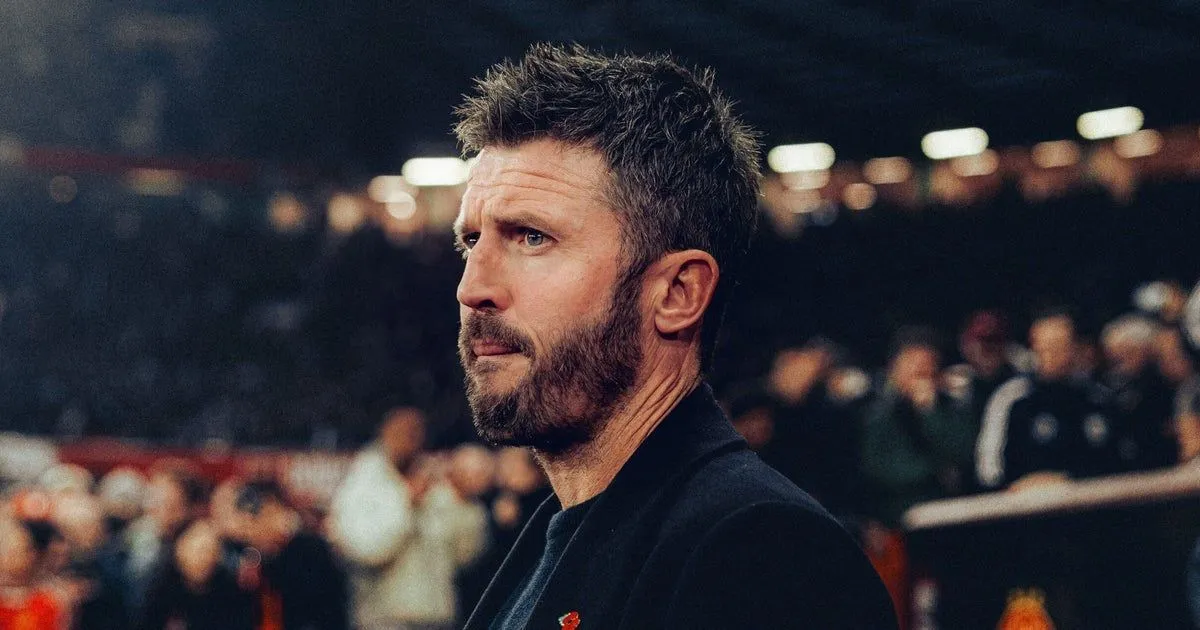
It took only 172 days for Michael Carrick to go from standing in sunshine in front of Manchester United fans at Brighton & Hove Albion’s Amex Stadium, applauding a 3-0 win that gave his team the best record in the Premier League in the period following his interim appointment in January, to driving out of a gloomy Carrington having been relieved of his duties.
The sudden spiral was not what those in charge wanted and heaps more scrutiny on the regime led by Sir Jim Ratcliffe, which has now overseen three mid-season changes in the dugout in three years. The handling of Carrick’s exit has also invited criticism.
The Athletic has spoken to multiple sources, all talking anonymously to protect relationships, to tell the story of how Carrick’s reign unravelled, detailing:
The Monaco meeting that delayed delivery of the news
Carrick’s passionate speech at Ferguson dinner
Questions over pre-season fitness plan
Goretzka considered as Tielemans alternative
More wanted from summer recruitment
Set-piece damage of losing Casemiro
This week, Carrick twice took training while knowing his fate, but without any member of the hierarchy communicating the club’s decision to him. Carrick has been around long enough at the sharp end of the football industry to know there is rarely a smooth farewell, but it would be understandable if this final act felt undignified to him.
Several people close to United, including current and former players, thought it was an unedifying look for the club to send him out to lead sessions while working on Mauricio Pochettino as his replacement in a way that quickly became public. “Zero class,” was one such take.
United are frustrated that private conversations about securing Carrick’s successor were leaked, and said plans for players not on international duty to still come into Carrington were made a month in advance.
Others connected to the matter point out that this kind of thing does happen, ironically to Pochettino himself. In November 2019, during another international break, Pochettino continued to coach for 10 days after his final Tottenham Hotspur game — a 1-1 draw against Sheffield United — until he was sacked by Daniel Levy, with Jose Mourinho replacing him.
Just like Carrick’s departure now, the Amazon behind-the-scenes documentary cameras were rolling for Pochettino’s parting seven years ago.
The mood over those couple of days as Carrick took training has been described as muted, with everybody knowing what was coming but not speaking it out loud.
Carrick was finally told of his dismissal by chief executive Omar Berrada on Thursday, his third day in a row at United’s training ground as the axe hovered. Berrada wanted to do it face-to-face once ratified at ownership level. Carrick, having arrived at 7.50am, drove out at 10.15am.
A complicating factor, delaying confirmation of United’s call, was the biannual INEOS CEO summit, which had long been in the diary for Tuesday of this week. Berrada and director of football Jason Wilcox, as well as Michael Sansoni, United’s director of data who is growing in influence, were due to fly to Monaco to present on long-term matters that are business-adjacent, rather than about football results.
Ratcliffe regards the meeting as hugely important and inflexible to events at the football club. The whole concept prompted several people connected with United to accuse those in charge of having mixed priorities, given the urgency of matters in Manchester.
Wilcox had wanted more from training and set pieces and, like Berrada, felt a change was required.
Ultimately, Ratcliffe and the Glazers finalised the decision, and the process of securing Pochettino was officially enacted with contact made to U.S. Soccer, Pochettino’s employers.
On Wednesday evening, United’s executives flew from Nice to Manchester on a private jet belonging to an airline that, by quirk, uses the callsign “Dark Knight”. Pochettino may need superhero qualities to succeed amid such turbulent circumstances.
One of Carrick’s final addresses as Manchester United head coach was to a room of 100 people connected to Sir Alex Ferguson, for a dinner to mark 40 years since he was appointed by the club. Taking place the night before Carrick oversaw his side’s 4-4 draw with Aston Villa, the 45-year-old stood in the Heritage Suite of Old Trafford, in front of former team-mates from days when United used to dominate England and challenge in Europe, and spoke for 20 minutes about Ferguson and the expectations at the club. He appeared in his element, with the audience willing listeners.
Carrick told the story of his full debut as a United player, which came in August 2006 at Watford’s Vicarage Road. He said he watched on, taken aback, as Ryan Giggs and Ferguson engaged in fierce rows during the game and afterwards, despite Giggs scoring the winner in a 2-1 victory. United were top of the league, having won three from three. For Carrick, who had come from Tottenham Hotspur that summer in an £18.6million ($25m at today’s rates) transfer, it was an eye-opening introduction to the standards at United.
United won the title that season and went on to lift five in total in Carrick’s first seven years, finishing runners-up by one point and on goal difference in the other two campaigns. He also won the Champions League, FA Cup, two League Cups, Europa League, and a Club World Cup, which is why his name continued to be sung even as United fell into the Premier League relegation places this season.
Fans were grateful, too, for the way Carrick guided United to Champions League qualification last season, and even amid turmoil in recent weeks, they’ve admired him handling his job with dignity.
Berrada and Wilcox were also in attendance for Ferguson’s tribute meal, before watching the Villa game from the directors’ box. Berrada celebrated wildly at Patrick Dorgu’s 96th-minute equaliser, but that goal was not enough to save Carrick.
Carrick’s decision to position himself among his players during their lap of applause to supporters was a conscious one, following on from the boos that greeted them once he went down the tunnel in the wake of the 3-0 defeat by Bournemouth on October 25. United’s hierarchy were said to feel that separation was not right, and in any case Carrick agreed, telling his team he shared responsibility with them when holding a group meeting at Carrington two days later.
The writing appeared on the wall after the Bournemouth defeat, as Carrick’s position was considered by the decision-makers. But they chose to give him and the players a chance to turn results around, which essentially amounted to the next three games, against Chelsea, Roma and Villa.
United figures told people a fortnight ago that Carrick is a good man, had not lost the players, cares for the club, and that nobody had been lined up.
Carrick’s address with his players in the build-up to Chelsea generated a positive reaction among them, and the first half at Stamford Bridge on October 31 was a testament to that, but ultimately the results failed to turn and United slipped into the relegation places.
Carrick signed autographs for waiting supporters as he left Old Trafford following the Villa game, but by Monday morning word at the club began to emerge that he had made that walk in charge of the team for the last time. United insisted nothing was officially decided, but the outcome had become clear.
For those who watched Carrick enjoying himself inside that suite at Old Trafford on Saturday evening, the thought of him effectively losing his job the next night at the same stadium is jarring.
There was, of course, an irony to the Ferguson dinner, in that the Scot’s arrival only came about in November 1986 because United were in the relegation places under predecessor Ron Atkinson, the last time the team were so low in the table in a campaign beyond August.
To those who believed Carrick could see United through this position, the example of Mikel Arteta struck a chord. That might seem a wishful comparison given Arteta is a Premier League champion, but his record to start at Arsenal was similar to Carrick’s, whose tenure lasted 32 games. Arteta got 19 wins, seven draws and six defeats in the same period at Arsenal, having been Pep Guardiola’s assistant at Manchester City before that. Carrick’s results read: 15 wins, eight draws, nine defeats.
But United are focused on the short-term situation, too, and felt compelled to make a change with United in 18th.
Coaches Steve Holland, Jonathan Woodgate, Jonny Evans, Travis Binnion and Craig Mawson are all gone, too. There had been a thought Binnion may stay on given he was at United, overseeing under-21 operations, when Carrick arrived and is regarded as a talented coach, having led first-team sessions. Goalkeeping coach Mawson had also been at United before Carrick’s appointment.
Four fit players not called up for internationals — Harry Maguire, Kobbie Mainoo, Mason Mount and Matthijs de Ligt — trained on Thursday in an under-21s/18s session led by Adam Lawrence, who coaches that age group. Players are off until Tuesday, so a decision will need to be made on who takes training next week before Pochettino’s expected arrival.
Undoubtedly, after the best record of any Premier League boss from January to May, Carrick’s troubles started in the summer. Two issues afflicted United: signings and stamina. The 4-2 loss to Milan in Wroclaw in the final pre-season friendly was a warning, in that United seemed sluggish and susceptible to the technical qualities of Ruben Amorim’s side.
Fitness work tapered as pre-season went on, with players joining after the World Cup slotting into that same trajectory rather than starting at the highest intensity. They had only had a three-week break from playing competitive football, but some players felt they needed to be pushed more and commented that Amorim’s pre-season had been harder. A number of players, including Youri Tielemans, were carrying knocks from the World Cup, so they were protected. Tough running sessions were part of the camp in Ireland.
Carrick, when discussing his approach during pre-season at Carton House Hotel in Maynooth, on the outskirts of Dublin, emphasised that there are many ways to win matches. “We can all watch the game and see something a little bit different,” he said. His plan was possession football, which would typically mean less running.
United appeared undercooked during the 2-0 loss to Hull City on the opening day of the season, however. Their urgency paled in comparison to Sergej Jakirovic’s side, although Carrick bristled at a question from Viaplay broadcaster Jan Age Fjortoft, a former professional, about his players’ desire.
The topic would be a consistent theme throughout the end of Carrick’s reign, with Gary Neville aghast at United walking against Fulham, and Bruno Fernandes pointing to the coaching staff’s choice to sit off at Como as a reason for the 4-1 Champions League defeat.
Carrick felt a compact shape and a mid-block defence was the best selection given the personnel, but Como passed around United. For the first time, Carrick acknowledged an athletic problem. “Whatever system you play, whatever tactics you play, if you don’t run forward, and you don’t run back, you ain’t going to win,” he said in response to Fernandes.
Fernandes, for his part, has since said he was trying to explain that it was not for him to answer a tactical question. It was not his intention to inflame the situation, and people at the club think his comments blew up because of what Martinez had said the week before.
Other players would dispute the argument about conditioning, feeling the profile of the players is the main issue, and Carrick had to choose a style to suit.
Indeed, the data suggests United haven’t shifted from what they were doing last season under Carrick, which got them the best results in the Premier League, as this graphic shows.
From a defensive standpoint, their intensity ranking (which is the number of opposition passes per defensive action) has stayed very similar at just above average when compared to Europe’s big five leagues. So essentially, they are sitting off or pressing to the same degree as during Carrick’s interim spell, during which they won 12 of 17 Premier League matches.
Possession is slightly up (51 per cent vs 55 per cent), while they are hitting slightly more regularly on the counter-attack (0.32 xG per game via fast breaks vs 0.21), while also conceding more xG per game (1.3 vs 1.8).
United did go man-for-man in the second half against Roma and that whipped up the atmosphere at Old Trafford amid a stirring comeback. The same approach was used against Villa, but defensive errors were damaging.
The major statistical detail that stands out, however, is United completely losing their set-piece threat (down from 98 to nine in this ranking system). The metric is calculated by expected goals (xG) at set pieces plus goals per 100 set pieces, but weighted 70:30 in favour of xG to reward teams who are generating chances from them but aren’t necessarily scoring.
A large chunk of United’s drop-off can be traced back to Casemiro. He scored eight goals from set pieces last season — no other player in the squad managed more than two — while he was responsible for around 27 per cent of United’s xG generated from corners.
Aged 34 and on wages of around £300,000 per week, Casemiro was destined to leave United under the INEOS regime, but the performance cost of his departure has been underappreciated. He would at times vacate space in the centre of the pitch in search of being effective in the final third, but often his instinct was right, and United have not replaced that roaming, goalscoring presence in any of their three midfield signings.
Carrick kept his counsel over the summer recruitment — albeit saying eight times United needed to “push” in the market during his written media interview in Ireland — but in truth he wanted significantly more than was delivered, not least a backup striker and left-back.
Carrick understood the financial limitations, but the midfield additions they did make were seventh or eighth on United’s list, when considering No 1 was Elliot Anderson, followed by Mateus Fernandes, Sandro Tonali, Aurelien Tchouameni, Alex Scott, Ederson and Ayyoub Bouaddi.
United signed Tielemans for £35m and he has been the only addition to feature regularly, playing 988 minutes in all competitions (out of a possible 1,260). Andrey Santos has played 556 minutes, while Carlos Baleba has 397 minutes after arriving with an ankle injury. Baleba’s hamstring injury sustained against Roma is set to keep him out for several weeks. Santos, 22, was on the periphery of Chelsea’s team last season, but United paid £50m for him.
It can be revealed that United gave serious consideration to signing Leon Goretzka as a free agent instead of Tielemans. Goretzka left Bayern Munich in June but commanded significant wages and will be 32 in February. Goretzka instead went to Villa and scored at Old Trafford in Carrick’s last game.
Agents have reported a complicated process in some cases in getting a clear answer from United, with several executives needing to be looped in or convinced. As well as Berrada and Wilcox, there is Christopher Vivell, director of recruitment, and Matt Hargreaves, director of negotiations. All transfers then require ratification from Ratcliffe and the Glazers.
Getting those choices right is difficult, and a consistent theme expressed by people at the club is the mental strength required to deal with the scrutiny of United. Players, even from big clubs, have arrived and been shocked at the level of global focus and constant attention.
Several sources feel confidence among United’s players has been affected this season, triggered by moments and results going against them.
Wilcox has appeared stressed in recent weeks, but he is defensive of United’s recruitment record, insisting the squad is better now than last season.
The injury to Benjamin Sesko appears to render that a difficult argument to make, while Baleba, coming at a £70m cost, has also not been able to make any major impact yet due to his time in the treatment room. Luke Shaw’s muscle injury could have been anticipated based on his record. He has been out for a month. De Ligt is finally fit but seems to have a way to go to return to peak sharpness following a year out from a back injury.
Ferguson, 84 but still opinionated, voiced his concerns over the transfer strategy, mainly the 2024 window, to Berrada and Wilcox during a football board meeting in September. The forum is meant for informal discussions rather than to conduct business, but given Ferguson’s enduring passion for United, robust conversations can take place.
Lisandro Martinez let the cat out of the bag about the players being disillusioned, too, during his post-match interviews after the defeat at Atletico Madrid. He was not the only player thinking on those terms, even though they might not have expressed their thoughts in that manner.
Carrick has shown craft in handling that, and other situations, but it is a difficult balance.
Fernandes has given the vibe of being affected by the modest recruitment drive, his seventh summer window at United. Conversations continue over a new contract for the Portuguese, with his deal due to expire in June 2027.
United have cut their wage bill, now standing at fifth or sixth highest in the Premier League, but salary is the biggest correlation to success.
The club’s highest-earner, Marcus Rashford, returning from a loan at Barcelona, has had an impact on Matheus Cunha shifting away on occasions from the left-wing position he predominantly occupied last season. After a bright start, Rashford has been out for a month as he nurses a hip injury, thus removing a potential attacking option for Carrick, which has been exacerbated by Sesko sustaining a second shin problem.
United are weighing up striker targets for the winter window, although at this stage a loan signing seems most likely.
Carrick refusing to criticise his players in public ensured the majority stayed onside. They admired his diligence and demeanour. He did unleash on occasions in private, in particular after the 2-2 draw at Everton and the 2-1 loss last season at Newcastle United, and Amazon are thought to have captured some fiery footage. His dressing-room feedback at the Hill Dickinson Stadium, when United conceded an added-time equaliser, is said to be explosive. But some felt more was needed, perhaps the kind of direct antagonism during games Ferguson used to administer to get Giggs going.
There were heated exchanges between players, too, after certain results, and the fans’ reaction to performances has stung.
Some questioned whether Carrick could have freshened up his coaching setup in the summer. His unit had largely been put together in an emergency scenario, but suggestions that Aaron Danks might join from Bayern Munich or Andreas Georgson from Tottenham Hotspur as a set-piece specialist never materialised.
There was a suspicion from people familiar with the England national team that Fernandes criticising United’s tactics in Como was a reference to Holland, whose approach when assisting Gareth Southgate was consolidation before expansion.
Carrick’s relationship with Fernandes is said to be perfectly fine after the pair spoke in the wake of Bournemouth, when the head coach dropped United’s captain to the bench throughout.
That move was seen as Carrick doing things his way, and he also cast off the caution in his media engagements, trying to rally his players and get supporters energised with a five-minute monologue, and giving a spiky interview to Sky Sports over his future after the Villa game. Ultimately, his fate was sealed, though.
Carrick had offers elsewhere before he joined United, but sources say the next proposal would have to be special for him to accept.