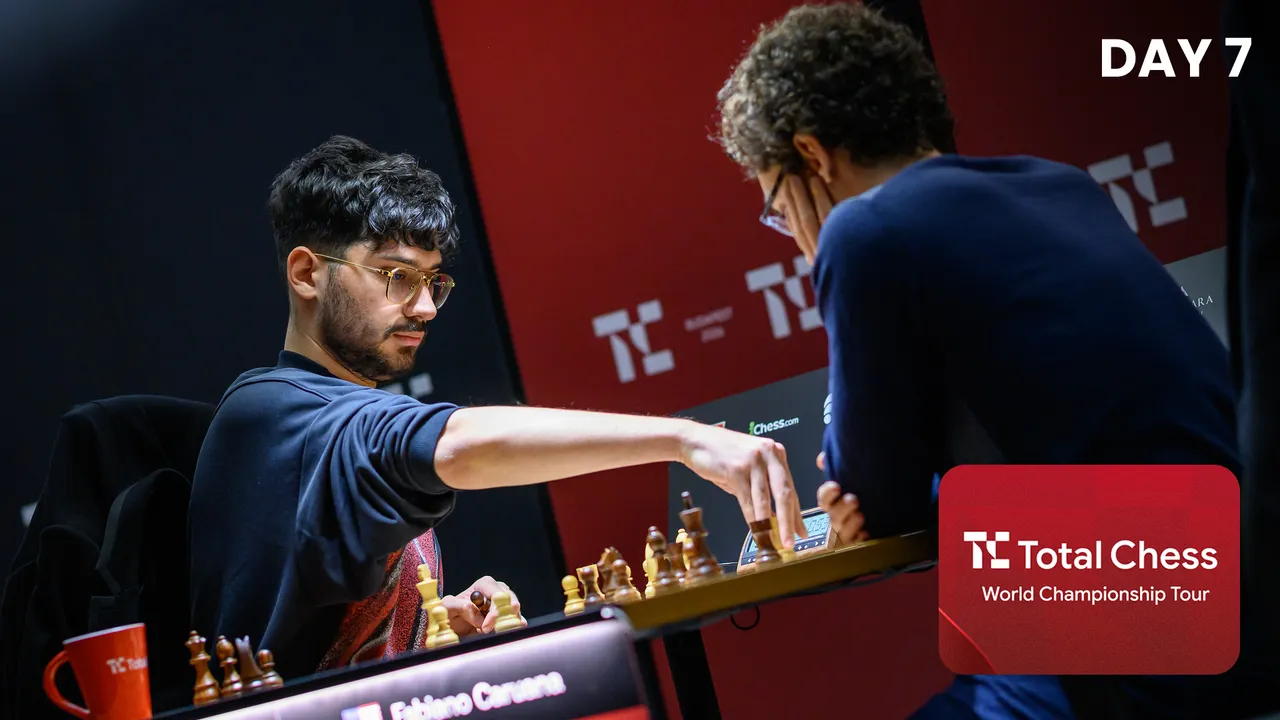
GM Alireza Firouzja started with a 4-0 blitz victory against GM Fabiano Caruana, lost that lead in a single rapid game, but ultimately won the day 12-8 as the grueling Semifinals of the Total Chess World Championship Tour Pilot 2026 began. The other clash in the top bracket went the way of GM Anish Giri, who won the fast-classic game against GM Maxime Vachier-Lagrave to complete a 14.5-5.5 victory. Caruana and Vachier-Lagrave will have a chance to hit back on Wednesday for a spot in the Final.
GM Magnus Carlsen got off to a near-perfect start as he scored 11.5/12 against GM Bibisara Assaubayeva, becoming the only player to wrap up victory before the final game. Their matchup ended in controversy, however, since Carlsen declined to appear for that game—where his 2800 status and world number-one spot would be on the line—leaving Assaubayeva sitting at the board until she was awarded a forfeit win to make the score 11.5-8.5.
Day eight, the second of the Semifinals, starts on Wednesday, November 18, at 9 a.m. ET / 15:00 CET / 7:30 p.m. IST.
Knockout 1: Giri, Firouzja Lead Battle To Win Tournament
Knockout 2: Niemann, Nepomniachtchi Lead On 'Tilted Tuesday'
Knockout 3: Martirosyan Comes Back Vs. Rapport, Arjun Leads From Blitz
Knockout 4: Mamedyarov, So Lead
Knockout 5: Carlsen Wins Then Forfeits; Artemiev Dominates Vs. Hong
Knockout 6: Praggnanandhaa, Mishra Lead After Shortest/Longest Matches
If the players felt two games of fast-classic chess a day was tough, most felt the knockout format was even tougher, with seven games and another seven-hour day. When asked about goals, GM Levon Aronian mentioned "at this moment surviving is important," GM Jorden van Foreest commented, "my head is just aching, just too much chess today," while Giri reflected, "FIDE maybe needs a commission to take care of players—the Players Wellbeing Commission."
The format was also unusual, with the day starting with blitz before the time control got progressively longer. GM Hikaru Nakamura described that as "ridiculous," explaining how chess events usually start with the longer formats first. The scoring was also original, with GMs Ian Nepomniachtchi and Shakhriyar Mamedyarov among the players to note it was puzzling that rapid games were worth four times as much as blitz, not double as we're used to from events such as the Grand Chess Tour.
The format is four blitz games (1 point a win), then two rapid games (4 points), then a single fast-classic game (8 points) each day. The margin of victory is largely unimportant, since if the losing player wins the next day the match winner will be decided in armageddon, though there the player with the most points overall does get to choose the color.
You can watch Nakamura's recap of the day's action below:
Knockout 1: Giri, Firouzja Lead Battle To Win Tournament
Although all 24 players are still in action, the one bracket that really matters is the first, where tournament victory and the top-four prizes are on the line. It was expected to be tight, which made it shocking when Firouzja raced to a 4-0 victory in the blitz over Caruana.
"The blitz was really awful, I was just blundering everything every game," said Caruana, who got some fleeting chances of his own.
Firouzja's fantastic start was wiped out in the first rapid game, however, as Caruana smoothly converted a win with the black pieces.
It then seemed as though Caruana was going to take the lead as he built up a close-to-winning position with the white pieces, but Firouzja is one of the most resourceful players in chess, and he turned things around with a dramatic attack. That's our Game of the Day, which GM Rafael Leitao analyzes below.
That meant Firouzja took a four-point lead into the classical game—with Caruana needing to win on demand. Of the nine players in that situation, only two managed, and only one with the black pieces.
Caruana did well out of the opening, with Firouzja admitting the game "got out of hand, out of my control," but he found a narrow path to safety and then was even winning before taking a draw that clinched the day's match 12-8.
The winner of that matchup will play either Giri or Vachier-Lagrave in the Final, with Giri emerging on top after the first day. What was perhaps surprising was that he took the lead in the blitz, though as he noted: "On a good day I can play well! I’m much less stable than Maxime, but I have days when I play like a world-class blitz player."
I'm much less stable than Maxime, but I have days when I play like a world-class blitz player.
—Anish Giri
Three blitz games were drawn, with two missed wins for Giri, but he did win the remaining game when Vachier-Lagrave grabbed a pawn.
The rapid games were both drawn, with Vachier-Lagrave pointing out that Giri wasn't too focused on taking his winning chances in the second since a one-point lead or a five-point lead would make no difference to the match situation. Vachier-Lagrave in either case knew he had to win on demand with the black pieces to turn things around.
The Frenchman came to the confessional after the opening to note that he preferred the position Caruana had achieved in a similar situation. Vachier-Lagrave got little, and said he "over-pushed." Giri was able to take over, as his "hanging pawns" went from a weakness to a huge strength.
That win took Giri up to world number-eight, but Vachier-Lagrave has a chance to hit back. What lessons from the day will he take into Wednesday? "Hopefully I don’t remember anything I’ve done from today!"
Hopefully I don't remember anything I've done from today!
—Maxime Vachier-Lagrave
Knockout 2: Niemann, Nepomniachtchi Lead On 'Tilted Tuesday'
The best description of one of the battles for fifth place came from Nepomniachtchi, who commented: "Today’s Tuesday. It was a little bit of tilt, first for me after the first blitz game, and then for Jan-Krzysztof. We missed Titled Tuesday, but Tilted Tuesday is all down here!"
We missed Titled Tuesday, but Tilted Tuesday is all down here!
—Ian Nepomniachtchi
That saga began with GM Jan-Krzysztof Duda winning the first blitz game in a queen endgame with two pawns apiece.
Duda won another two blitz games for a 3-1 scoreline, but then in the second rapid game Duda lost an exchange-up position. The Polish number-one suddenly found himself needing to win the classical game on demand, but he only fell to defeat in what should have been a holdable position.
In the other match, GM Liem Le started with a sparkling blitz win and took a 2.5-1.5 lead, with GM Hans Niemann later saying that the stress of having to come back from that was "borderline unhealthy." Both rapid games were drawn, so that Niemann had to win on demand in fast classic—which is just what he did. "I’m coming in clutch when needed!" he said, after Le stumbled into a lost position at the very end.
Knockout 3: Martirosyan Comes Back Vs. Rapport, Arjun Leads From Blitz
By the third knockout, players are only playing for ninth place, with GM Arjun Erigaisi commenting, "I don't think it's super important!" The Indian star took a 3.5-0.5 lead over Van Foreest in the blitz, then the players exchanged wins in rapid. It came down to a must-win game for Black in the classical chess, but instead we got a fast and contentless 30-move draw.
Arjun explained: "Classical first would have been a nicer order. This way it came down to classical and I had White, and I tried to play safe." Why didn't Van Foreest try to rock the board? He said he might have done if he was incentivized by a battle for first place, but as it was: "Honestly I’m pretty happy with the draw. It sounds weird, but first of all my head is just aching, just too much chess today, and let’s be real, we’re not really playing for anything major. In general a draw against Arjun is good."
Let's be real, we're not really playing for anything major.
—Jorden van Foreest
The other match in the bracket at least featured one of the day's most memorable moments. GM Richard Rapport, who won the blitz 3-1, also won the rapid after pulling off a great escape with the help of a desperado rook.
That was a swindle comparable to landing mate-in-one against GM Praggnanandhaa Rameshbabu from a lost position earlier in the tournament, but karma came back to bite in the next game.
In fact, the miss by GM Haik Martirosyan had made no real difference at all, since in either case he would have to win on demand with the black pieces in the classical game. That's just what he did, with Rapport's position collapsing until he resigned on move 26.
Knockout 4: Mamedyarov, So Lead
Aronian vs. GM Shakhriyar Mamedyarov has been one of the big duels in chess for decades, but while age brings experience it also has drawbacks. Aronian won the blitz but lost the rapid and then commented, "I just got way too tired," to mount a comeback in the classical game.
In the other clash, meanwhile, GM Wesley So, rather than continuing his earlier criticism of the tournament, was surprisingly revitalized. He said, "the rest day really helped everybody," thanked his chess colleagues for supporting him, and said "we're getting to the exciting format!"
The players traded wins in the blitz and drew both rapid games, so that this was the one classical game where both players could afford to make a draw. That also looked the likely outcome, but at the end So took over, with GM Vincent Keymer missing a remarkable chance to escape.
Knockout 5: Carlsen Wins Then Forfeits; Artemiev Dominates Vs. Hong
When Carlsen was asked how his day was going, he responded briefly, "I’m in a little bit of the wrong bracket—otherwise, it’s fine!"
I'm in a little bit of the wrong bracket.
—Magnus Carlsen
Carlsen had ended up in the battle for 17th place after a winless 10 fast-classic games, and the first blitz game could easily have continued that sequence. Carlsen gave up his queen but followed up badly until he was completely busted, but Assaubayeva couldn't quite hold things together at blitz pace.
That win opened the floodgates, as Carlsen went on to score 3.5/4 in blitz, and 8/8 in rapid. With a score of 11.5/12, he was the one player who had wrapped up victory for the day before the classical game.
He had nothing to play for in Total Chess terms, but curiously, his game against Assaubayeva arguably had the highest stakes and was the most anticipated of the day. A draw, and Carlsen would drop below 2800 for the first time in 17 years, while a loss would put him just 0.7 points above Nakamura, or cost him his 15-year unbroken streak as world number-one if Caruana won. As it happened, however, the game was never played. Assaubayeva waited at the board, and after 15 minutes was given a forfeit win.
What had happened?
Carlsen told Norway's TV 2 that he considered the match over and that if a game was nevertheless going to be played it should be unrated.
A rule to avoid rating games after a match is decided does exist—for instance, there was a controversy back in 2016 about a match between GMs Nigel Short and Hou Yifan—but it's worded to allow exceptions:
6.2 Where a match is over a specific number of games, those played after one player has won shall not be rated. This requirement may be waived by prior request.
In this case the organizers had received a waiver and had communicated to the players in the technical meeting before the event that all games would be played and rated. That was confirmed by numerous sources, including Niemann.
Wesley So was one player who could see Carlsen's point of view.
The immediate question was whether there would be consequences for the decision, but it seems those are limited to the forfeit loss (forfeits aren't rated), which meant the match score ended 11.5-8.5 in Carlsen's favor.
Total Chess (and Norway Chess) founder Kjell Madland explained: "He didn’t want to play the last game, and he didn’t need to do it." He said no changes have been made and, "The rules are the same for everyone," while implying that any other player in the same situation can now make the same choice with no fear of consequences.
Perhaps this is one rule that will be clarified (or changed) before the main tour in 2027, but we can only hope that in a repeat situation on the second day, Assaubayeva won't be left waiting alone in the playing hall before the match is ended.
If Carlsen does get through to the final of the fifth knockout bracket it seems likely he'll face a tough test against GM Vladislav Artemiev, who overcame GM Andrew Hong 17-3.
Knockout 6: Praggnanandhaa, Mishra Lead After Shortest/Longest Matches
The final bracket, for 21st place, featured an extraordinary clash of top-10 players, Praggnanandhaa vs. GM Nodirbek Abdusattorov. Praggnanandhaa, who hit back in rapid after losing the blitz, wasn't surprised that Abdusattorov took a quick draw in what should have been a "must-win" final game instead of risking his rating: "It’s nice to play against Nodirbek, but considering what we’re playing for, it’s funny!"
The chances of Praggnanandhaa meeting his sister GM Vaishali Rameshbabu in the Finals decreased as she lost to GM Abhimanyu Mishra, but not without a fight—their last game stretched to 123 moves!
On Wednesday, the players return to face the same opponents for the second set. Nothing is yet decided.
The Total Chess World Championship Tour Pilot 2026 takes place on November 10-21 at the Anantara New York Palace Hotel in Budapest, Hungary. The event is a trial run for the official event in 2027, which will crown the first FIDE World Combined Champion. The event consists of a round-robin group stage and a knockout combining blitz, rapid, and fast classical time controls. The time control is 3+2 for blitz, 15+10 for rapid, 45+30 for fast classical, and 10 minutes (White) vs. 7 minutes (Black) with a one-second increment starting on move 41 in armageddon.
Previous Coverage: