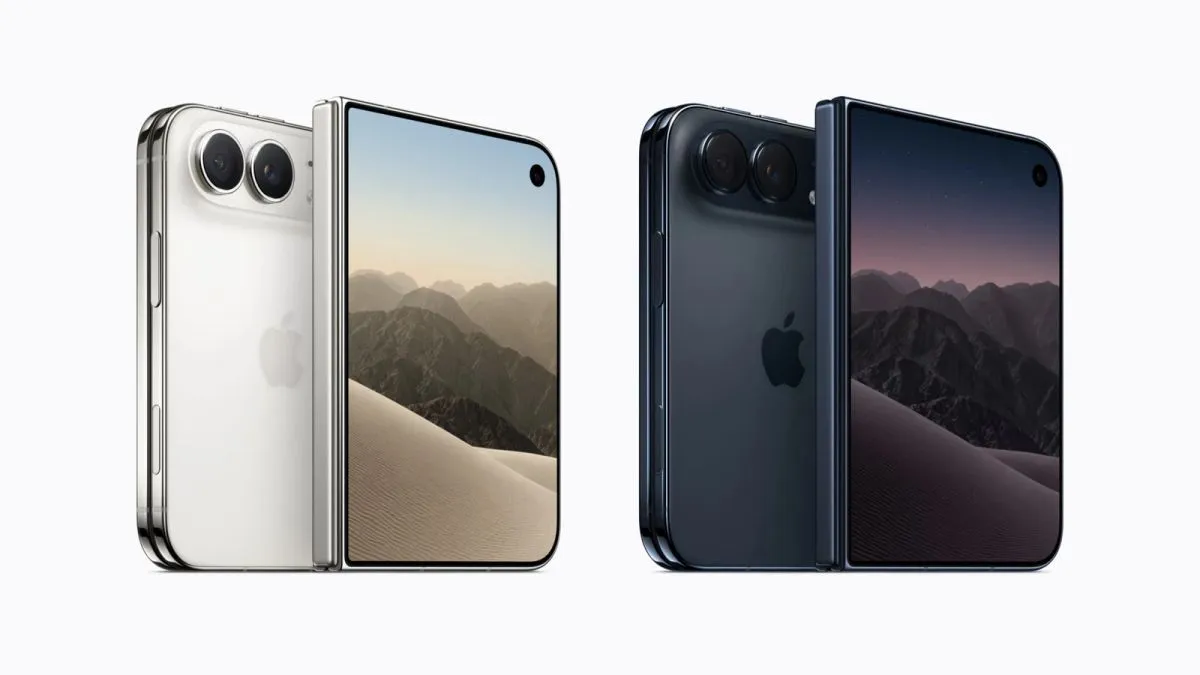
Apple Inc. has begun testing a facial-recognition unlock option for its iPhone Duo, giving owners of the $1,999 foldable a faster way into the device without the depth-sensing hardware that powers Face ID on other iPhones.
The feature arrived Monday in the second developer beta of iOS 27.3 and appears under Touch ID & Passcode in the Settings app, where it is labeled "Unlock with Front Camera." Apple's on-screen setup text tells users the option "provides convenience" but "isn't as secure as Touch ID or Face ID," and that face recognition data never leaves the device.
The Duo, unveiled in September, is the largest redesign in the iPhone's roughly two-decade history and the company's most expensive handset. It carries regular cameras on both the outer and inner displays but no TrueDepth sensor array, which is why it shipped relying on a side-mounted fingerprint reader. Early buyers have complained that Touch ID is slower and less fluid than the Face ID system on standard models, and the new beta option is aimed squarely at that gap.
The mechanism resembles the one Apple built into HomeView, its recently announced smart display, which also lacks Face ID and identifies users through simpler visual characteristics. On the Duo, recognition runs through the front camera on the outer screen. Testing indicates it unlocks more quickly than the fingerprint reader and was not fooled by a photograph of the owner's face held up to the lens; it also functions in some dim conditions, though not in total darkness.
Apple has wrapped the feature in several restrictions. Facial recognition only bypasses the lock screen. Unlocking apps, viewing stored passwords and paying with Apple Pay still require Touch ID or a passcode. The option also shuts off after 45 minutes without an unlock, forcing a fingerprint or PIN check before it resumes, and it does not work when the device is unfolded, most likely because the under-display camera has a very low resolution.
A second change in the same beta adds a setting, found under Display & Brightness, that locks the Duo when it is folded shut instead of shifting content to the outer screen. Leaving the cover display active can invite accidental taps and drain the battery. The toggle is off by default and must be switched on by the user.
Apple has not said when iOS 27.3 will reach the public, though the release is expected around mid-December. Access is currently limited to developers and beta testers.
The software fix lands as Apple maps out the next generation of the device. Bloomberg has reported that a second-generation Duo is targeted for fall 2027, roughly a year after the first model, with a thinner and lighter body, a telephoto camera, the programmable Action Button and secure 3D facial recognition through Face ID. That last item is said to be the top priority, but engineers are reportedly struggling to fit the module into a chassis about 5 millimeters thick, leaving open whether Face ID arrives with the second model or a later one. The current beta does not change that hardware equation: it delivers convenience through software, not the security of a depth-mapped face.
For Apple, the stakes are tied to a premium product that must justify its price. A foldable at $1,999 competes against established rivals in a category where polish is the selling point, and authentication friction is one of the first things reviewers and buyers notice. Closing that complaint in a point release is cheaper and faster than waiting for new hardware, but the company has drawn a clear line: the fast path opens the phone, while sensitive actions remain behind the fingerprint sensor.
FeatureiPhone Duo (iOS 27.3 beta)Standard Face ID iPhonesUnlock methodFront-camera face recognition or Touch IDTrueDepth 3D face mappingHardware requiredRegular front cameraTrueDepth sensor arrayApple Pay and passwordsTouch ID or passcode onlyFace IDInactivity cutoff45 minutes, then Touch ID or PINNone specific to face unlockWorks when unfoldedNoNot applicable
Note: Details reflect the second developer beta of iOS 27.3; public release timing has not been announced.