Remember the Apple Vision Pro? That headset that came out a couple of years ago and that everyone relentlessly mocked? That initial M2-based model was expensive at $3,499 and there was definitely an Apple markup in there, but it also contained a lot of genuinely impressive technology that simply cost a lot to include. Knowing all of that, it seems almost inconceivable that Brenpoly was able to build his own Apple Vision Pro for just $5.
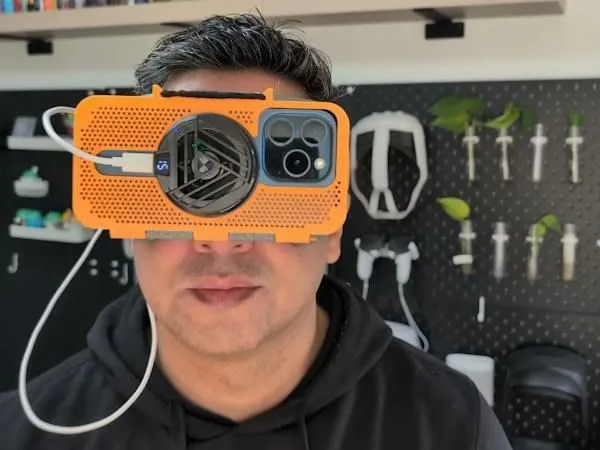
That is inconceivable because it isn’t true. This is not comparable to an Apple Vision Pro — at least not on a hardware level. It is really just some 3D-printed plastic. That’s because it is equivalent to one of those shells you put your smartphone inside and wear on your face. All of the fancy XR stuff happens on the phone, while the headgear is just there to keep it secured to your face.
Brenpoly did design that headgear himself, using an AI agent in Autodesk Fusion via the MCP server to model an iPhone based on official Apple technical drawings. He then modeled the headgear around that and 3D-printed the parts for it. The lenses are off-the-shelf. It even has rack-and-pinion diopter adjustment.
The real point of this project, however, was the software. Brenpoly wanted to find out if he could make his iPhone, worn in the headgear, do the same kind of things that an Apple Vision Pro can.
To attempt that, he started by using Unity to build an app. He then started layering on functions based on the integrations available to take advantage of the phone’s hardware. While Brenpoly developed this for his iPhone, he wanted to leave the door open to Android and so he set everything up to use each platform’s own integrations. For example, an iPhone will use ARKit, while an Android will use ARCore. Unity just selects the appropriate one for the build.
With that methodology, Brenpoly was able to slowly recreate the Apple Vision Pro’s functions. For instance, local AI running on the phone’s own hardware tracks hand movement to enable gesture control without a controller.
That all worked pretty well and genuinely does the majority of what the Apple Vision Pro does, but it consumed a lot of power and all of that power became heat. To compensate, the software automatically throttles some functions when the phone gets too hot. Brenpoly also added active cooling with a MagSafe fan and a supplementary battery.
I’ll be honest: I’ve never given smartphone-based VR headsets any real consideration. I assumed they were gimmicks, at best. But what Brenpoly achieved here is impressive — and a whole lot cheaper than an Apple Vision Pro.