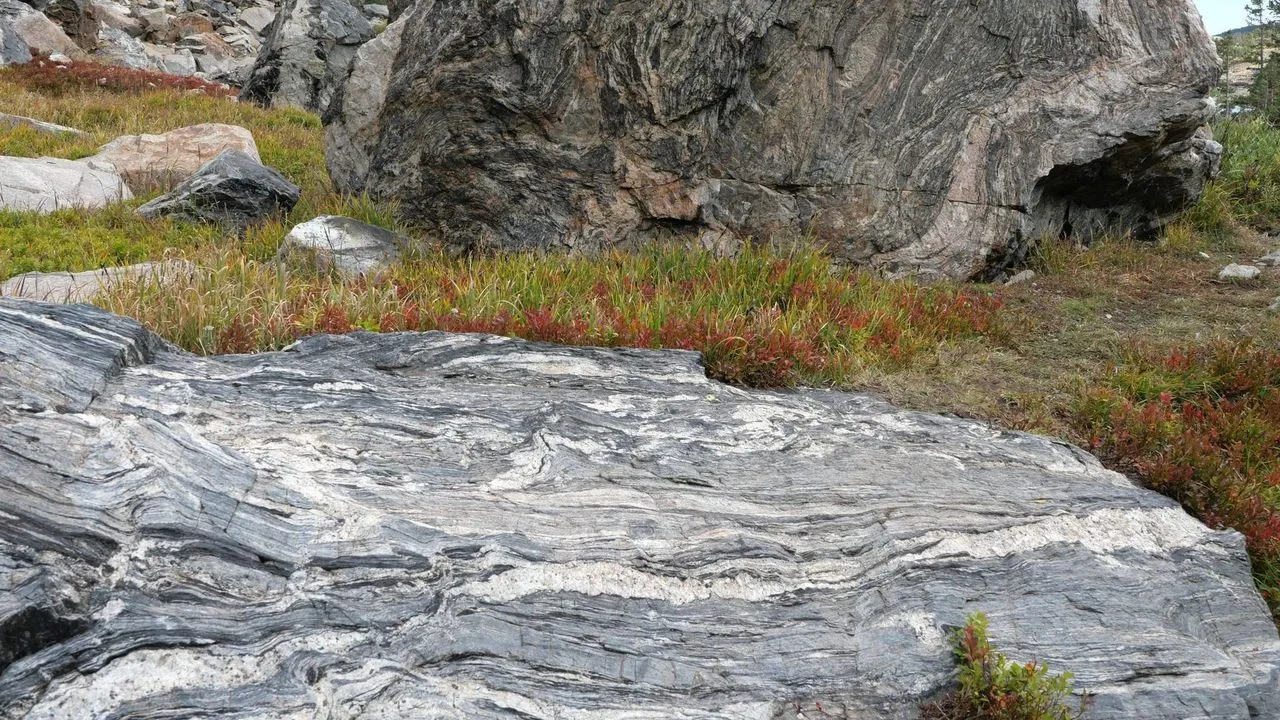
Earth’s surface is made of plates that slide, collide, and sink back into the planet, and it’s tempting to assume it has always worked that way. Rocks older than about 2.6 billion years carry a chemical signature that says otherwise.
The signature comes from a pool of crust that formed roughly 4 billion years ago and kept getting remelted in place for more than a billion years.
Between about 2.75 and 2.63 billion years ago, the pattern changes sharply. One source’s signature vanishes from the record, and the other turns up only rarely after that.
The researchers interpret the shift as a possible sign that modern plate tectonics was taking hold and reshaping how Earth recycled its crust.
The study is an interpretation of a global compilation of lead measurements, and the authors call their explanation a testable hypothesis rather than a settled fact.
Janne Liebmann of Curtin University in Perth, Australia, led the work with colleagues at Curtin’s School of Earth and Planetary Sciences and Queen’s University in Canada.
“New crust often forms by melting older rock, leaving behind a distinctive chemical fingerprint,” Liebmann said.
Lead records its source
The fingerprint is carried by lead. Uranium and thorium decay into three different forms of lead at three different rates. So the mix of lead in a rock records how much uranium and thorium its source held, and for how long.
Some minerals, including feldspar and certain sulphides, take in lead as they crystallize but almost no uranium or thorium. Their lead mix is fixed at the moment they form, which makes them a record of the magma they grew from.
The team compiled published lead measurements on such minerals from rocks whose ages were known independently. They added eight new feldspar analyses from China, West Africa, and Finland.
After discarding samples whose lead had been disturbed, 1,235 remained, with ages from 3.8 billion years to the present.
Two sources, 4 billion years old
In rocks older than about 2.6 billion years, the lead points to two sources that split from the mantle between 4.0 and 3.7 billion years ago. One was rich in uranium relative to lead, the other poor.
Both show up in rocks from ancient continental cores around the world.
For those signatures to develop, the two sources had to stay chemically isolated for at least a billion years.
The authors’ explanation is a primitive crust split into an upper layer and a lower layer, each with its own uranium budget, that magmas kept tapping without destroying.
Most of the old rocks in the dataset are granites, which can form when existing crust melts. That fits the idea that early Earth repeatedly reworked its crust in place.
Where the signature vanishes
After about 2.6 billion years ago, the lead in new rocks clusters near the average for the whole planet. The spread in the inferred uranium budgets of their sources roughly halves.
A statistical test for abrupt changes, repeated 300 times on reshuffled versions of the data, kept finding the same break between 2.75 and 2.63 billion years ago.
The break held in the full dataset and in two subsets the team checked separately. Australian samples make up 71% of the compilation, so the authors treated the 358 non-Australian samples as an independent test. The break appeared there too.
The uranium-rich source never reappears. The uranium-poor one surfaces only four times afterward, in granites from Russia and Australia between 1.6 billion and 400 million years ago.
A planet that started recycling
Liebmann’s team wrote that the old sources were either destroyed, most likely by being dragged back into the mantle, or cut off from the places where new crust was made.
Both fit a planet that had begun moving crust around and recycling it, with magma production shifting from the interiors of plates to their edges.
Other changes geologists have documented in rocks of that age line up with the break. Continents were becoming thicker and richer in silica. Buried rocks began recording sharper contrasts in temperature. And what may have been the first supercontinent was assembling.
“It marks the transition from an early Earth where ancient crust could be repeatedly melted and reworked in place, to a system capable of moving and recycling crust on a much larger scale,” said co-author Chris Kirkland of Curtin.
Kirkland said the finding helps explain when Earth developed the global system of moving plates that distinguishes it from Venus and Mars.
What the lead can’t settle
Lead isotopes record that the old sources stopped feeding new magma. They don’t by themselves show plates sinking.
The team wrote that direct evidence for global subduction at that time is limited, and that its model is a framework still to be tested.
The dataset also leans on Australia, where recent mapping projects have produced far more lead measurements than elsewhere.
The non-Australian check helps, but a more even global sample would test the result harder.
One detail may prove useful. The rare reappearances of the uranium-poor source suggest pieces of that ancient lower crust still survive under some continents.
If so, they could account for part of a long-standing puzzle. Surface rocks on average hold more uranium-derived lead than the whole Earth should, which implies a hidden, uranium-poor reservoir somewhere below.
The team’s data are available through the EarthBank platform, where other researchers could test the break against new samples as they are measured.
The full study was published in the journal Proceedings of the Royal Society A.
—–
Like what you read? Subscribe to our newsletter for engaging articles, exclusive content, and the latest updates.
Check us out on EarthSnap, a free app brought to you by Eric Ralls and Earth.com.
—–