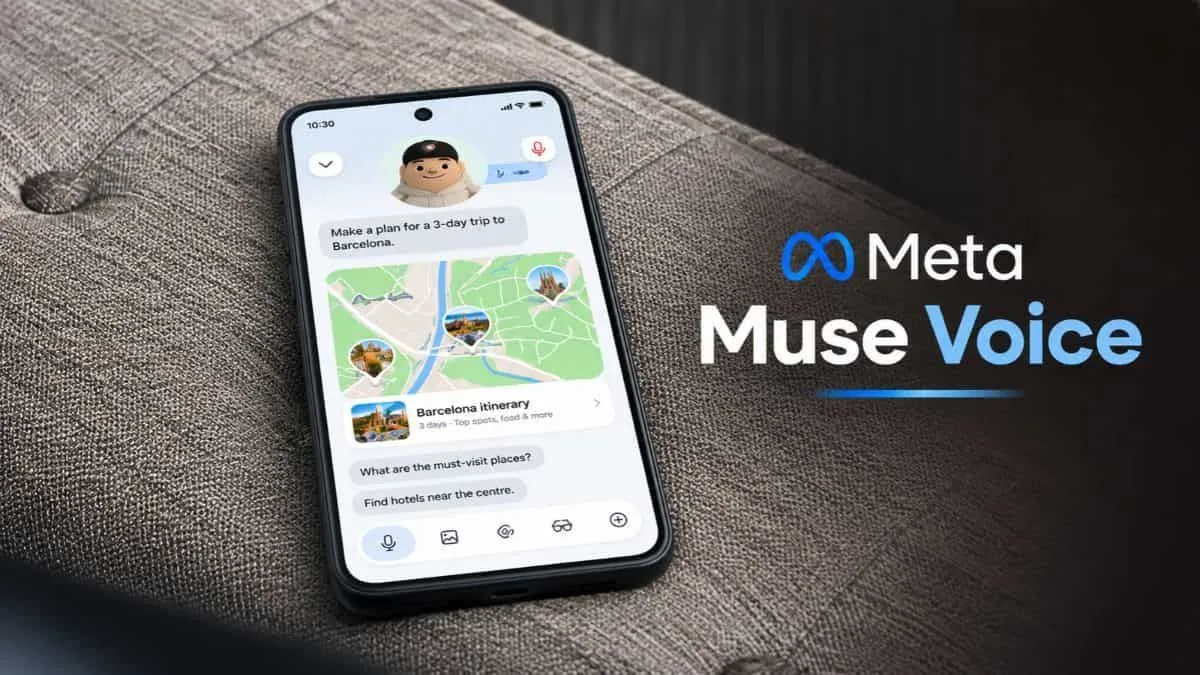
Meta is following suit with a new feature, Muse Voice, which lets users converse directly with its AI assistant and watch an animated avatar respond in real time.
The feature is a fusion of voice interaction and Meta's Muse Realtime Avatar, a technology that creates the visual expressions and gestures that accompany a conversation. Rather than type questions and read answers on a screen, users can interact with a customised digital character, which responds as they speak.
App developers announced the development on November 6, 2026, stating that Muse Voice will roll out to mobile devices, web and Mac. The feature will be available in the U.S. initially, with plans to be available in additional markets in the future.
The update further serves as one of the latest signs of Meta's plan to provide its new assistant, Muse, with greater conversational capabilities than what its current chatbots can offer on other platforms.
How does Meta Muse Voice work?
Muse Voice lets users initiate an audio conversation with an AI assistant by tapping a phone icon in the interface. With the start of the conversation, users can select their preference of how the assistant will look.
There are three options for the experience:
Face-to-Face conversation: Users can interact with their personal AI avatar in a video call manner.
Avatar in the middle of the text conversation: A digital avatar appears in the middle of the conversation and enables users to use speech and text in combination.
Voice-only mode: Users can talk to the assistant without showing an animated character.
It is powered by Muse Realtime Avatar technology and is designed to make the assistant's facial expressions, gestures and movements correspond to the conversation's tone and context.
For example, an avatar can have different faces when talking about various subjects. It's meant to make interactions more like talking to a digital partner than software.
Another characteristic is the ability to interrupt the assistant while he speaking. This lets them resend the conversation or pose a new question without having to wait for the AI to complete its response.
Users can customise their AI assistant's voice and personality
Other options include enabling users to customize how Muse Voice sounds and looks. There are hundreds of voices and styles to choose from, allowing users to design their assistant the way they want, according to the company.
The customisation is important, as it is not a typical chatbot interface, but a persistent digital identity.
Unlike the Meta AI chatbot that appears in services like WhatsApp, Muse also provides a distinct look and feel to its user interface. The traditional chatbot is mainly based on the ability to answer questions or respond to prompts in the conversation, while Muse incorporates animated avatars, voice interaction and agentic AI features.
It also has a long-term memory. Muse doesn't just remember information from a one-on-one conversation; it retains it over time to enable it to give more personalized chat experiences.
Its agentic features are designed to enable users to go beyond simple question-answering and leverage AI support for more tasks.
When will Meta Muse Voice be available?
Muse Voice is now rolling out to the United States. Meta has said that the feature will be available in more markets in the future, but hasn't given any specific international release dates.
Muse is an assistant that was originally released in the U.S. in September 2026 and has since been rolled out in Canada. It is only available in certain regions (such as availability in App Stores).
Meta's announcement also includes plans to introduce Muse Voice to its upcoming Muse Charm device, as well as its AI glasses. The company has not, however, revealed any launch dates for both the integrations.