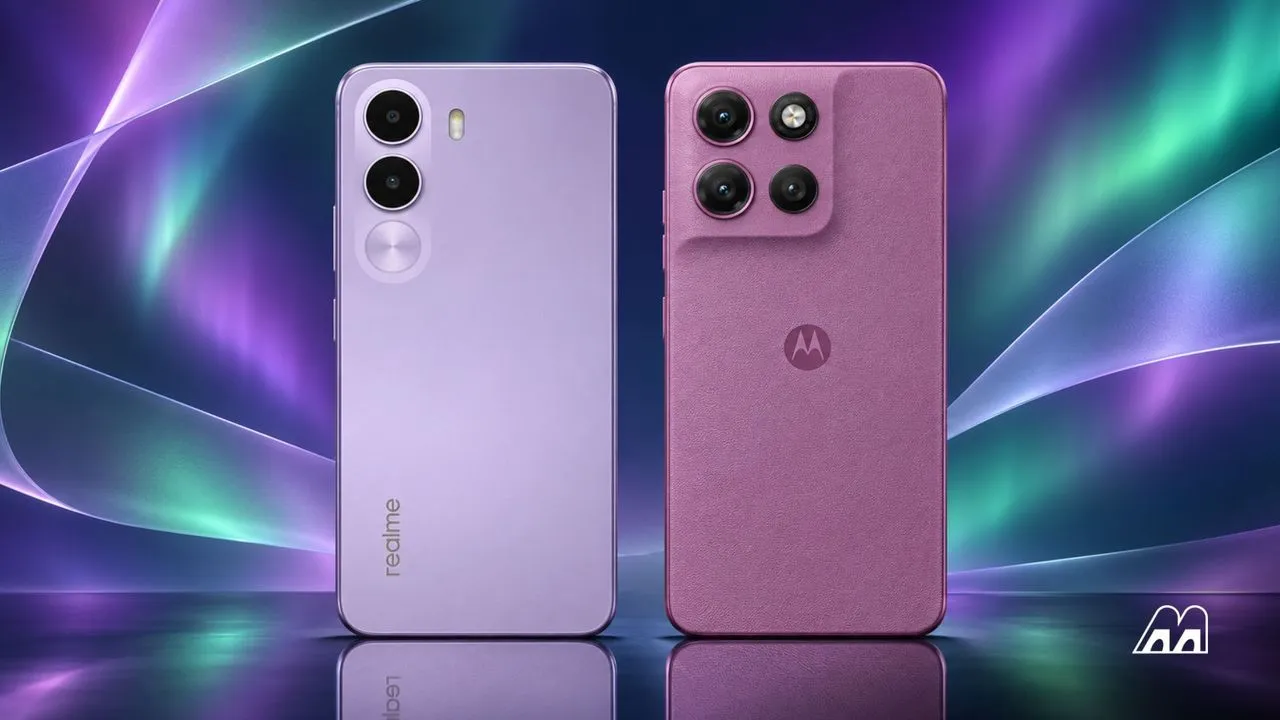
The Realme C100i vs Moto G17 matchup is a clean trade: one phone is built to last all day, the other is built to look and sound better while it does. Realme put the C100i on sale in India on August 27, 2026, for ₹14,999 (about $159), with a 6,500mAh battery and a 120Hz screen. Motorola launched the Moto G17 in Europe on January 29, 2026, at €199 (about $223), with a 50MP camera, a sharper FHD+ screen, and stereo speakers.
If you’re shopping for a phone at this price, you’re probably not chasing benchmarks. You want something tough, reliable and cheap to run. So we compared both phones across seven rounds using the official spec sheets, launch details, published lab numbers and our own math.
First, Which Realme C100i Are We Talking About?
There are two versions, and that matters before you compare anything.
The global C100i was announced on April 30, 2026. Spec databases list it with a 7,000mAh battery and a street price of about €110 ($124), with memory options up to 6GB of RAM and 256GB of storage.
The India C100i 4G launched on August 27, 2026, with a smaller 6,500mAh battery and a single 4GB + 64GB model for ₹14,999.
The rest of the spec sheet is essentially the same. Throughout this comparison, we use the India model as the baseline, because it has an official launch price, and we note where the global model changes the answer. Realme is also preparing the Realme C01, which certification records suggest is the same phone under another name.
Neither phone supports 5G, and both are sold mainly outside the US. The Moto G17 isn’t sold in India at all, so for many readers, this is really a comparison of what $150 to $225 buys in different parts of the world.
Design and Durability: Realme Is Tougher, Motorola Is Lighter
Both phones carry an IP64 rating. An IP rating has two digits: the first is for dust, the second for water. A 6 means fully dust-tight, and a 4 means the phone handles splashes and rain, but not a dunk in the sink.
Realme leans into toughness. The C100i is certified to MIL-STD-810H, a US military testing standard for things like drops, vibration and temperature changes, and Realme says it survives drops of up to 2 meters. That’s not a promise your screen won’t crack, but it’s more than Motorola claims. We found no MIL-STD rating for the Moto G17.
Motorola leans into comfort. The G17 weighs 190g against the Realme’s 210g, so it’s 20g (about 11%) lighter. It’s also a little thinner, at about 8.2mm versus 8.7mm. Its back uses a soft, leather-like silicone finish, which tends to feel less slippery than plastic.
This round is a draw. If your phone tends to hit the floor, pick the Realme. If you carry it in a shirt pocket all day, the Moto will feel nicer.
Display: Smoother on Realme, Sharper and Brighter on Motorola
This is the most interesting round, because each phone gets one big thing right.
DisplayRealme C100iMoto G17Size and type6.8-inch IPS LCD6.72-inch IPS LCDResolution720 x 1570 (HD+)1080 x 2400 (FHD+)Pixel density~254ppi~392ppiRefresh rate120Hz60Hz (listed)Peak brightness900 nits1,050 nitsProtectionPanda glassGorilla Glass 3
Motorola wins on sharpness. By our math, the G17’s screen has 2.3 times as many pixels in roughly the same space. In practice, that means crisper text, cleaner photos and less visible “grain” on small fonts. It’s also about 17% brighter at peak, which helps outdoors.
Realme wins on smoothness. Refresh rate is how many times per second the screen redraws itself. At 120Hz, scrolling through social feeds looks noticeably smoother than at 60Hz. One caveat: two spec listings put the G17 at 60Hz, but Motorola’s own materials weren’t available to confirm it, so treat that figure with some caution.
We give this round to Motorola. You look at text and photos all day, and resolution affects all of it, while 120Hz mostly helps when you scroll.
Performance: Two Chips With the Same Recipe
Here’s the part most spec pages skip: both chips use the same basic design.
Realme C100iMoto G17ChipUnisoc T7250 (12nm)MediaTek Helio G81 Extreme (12nm)Fast cores2x Cortex-A75 at 1.8GHz2x Cortex-A75 at 2.0GHzEfficiency cores6x Cortex-A55 at 1.6GHz6x Cortex-A55 at 1.7GHzGraphicsMali-G57 MP1Mali-G52 MC2Memory4GB LPDDR4X4GB or 8GB LPDDR4XStorage64GB (UFS 2.2 or eMMC 5.1, sources differ)128GB or 256GB UFS 2.1microSDYesYes, dedicated slot
A chip’s cores are the parts that do the work. Both phones pair two faster Cortex-A75 cores with six slower, power-saving Cortex-A55 cores, built on the same older 12nm process. The Motorola simply runs them faster: its fast cores are about 11% quicker by clock speed, by our math. One spec database measured the G17 at 401 (single-core) and 1,298 (multi-core) in Geekbench 6, a popular benchmark app. We couldn’t find an independent score for the C100i, so we won’t put numbers side by side.
Storage may matter more than the chip. Launch reports list the Realme’s 64GB with UFS 2.2 storage, while spec databases list slower eMMC 5.1. Either way, 64GB fills up fast once you add WhatsApp, a few games and a year of photos. The Moto’s 128GB gives you twice the room before you need a memory card.
Motorola wins this round. Neither phone is fast, but the G17 should feel a little snappier and run out of space much later. If you’re curious what happens when budget phones get a cheaper chip and a higher price, the Moto G47 Power leak shows Motorola facing the same squeeze.
Cameras: Not Close
This is the biggest gap between the two phones.
The Moto G17 uses a 50MP Sony LYT-600 main sensor at 1/2 inch with an f/1.9 lens, plus a 5MP ultrawide for wider shots and a 32MP selfie camera. A larger sensor collects more light, which usually means cleaner photos indoors and at night. The ultrawide is handy for group photos and small rooms.
The Realme C100i has a single 8MP rear camera with an f/2.0 lens and a 5MP selfie camera. By our math, the Moto’s main camera has more than six times the pixels, and its selfie camera has more than six times as well.
Neither phone has OIS (optical image stabilization), the tiny motor that steadies the lens to reduce blur. Both record video at up to 1080p and 30fps, although the Realme’s selfie camera tops out at 720p.
Motorola wins easily. If you video-call family or post to Instagram, this round alone could decide it.
Battery and Charging: Realme’s Clear Win
Realme C100i (India)Realme C100i (global)Moto G17Battery6,500mAh7,000mAh5,200mAhvs Moto G17+25%+35%—Wired charging15W15W18WWatts per 1,000mAh2.3W2.1W3.5WReverse wired chargingYesYesNo
mAh (milliamp-hours) measures how much charge a battery holds. The India C100i holds 25% more than the Moto G17, and the global version 35% more. Since both phones use similar, low-power chips and modest screens, that extra capacity should turn into real extra hours.
Charging is the catch. We divided each charger’s power by battery size to compare refill speed fairly. The Moto gets about 3.5W per 1,000mAh, while the Realme gets about 2.3W, so the Realme will take noticeably longer to fill from empty. In other words, you’ll charge it less often, but each charge takes a while. Overnight charging hides that problem.
The Realme also supports reverse wired charging, so you can top up earbuds or a friend’s phone with a cable.
Realme wins this round. For more phones built around long battery life, see our list of the best battery life phones.
Software and Support: Newer Android vs. a Written Promise
The Realme ships newer software. It runs Android 16 with Realme UI 6.0. However, we couldn’t find an official update promise for the C100i.
Motorola promises less, but in writing. The Moto G17 launched on Android 15, and spec listings show one Android upgrade and two years of security updates. By our estimate, that means it tops out at Android 16, the version the Realme already has, and gets security patches until around early 2028. Security updates matter more than new Android versions on a cheap phone, because they fix holes that scammers and malware can use. Neither phone is a good pick if you plan to keep it beyond 2028.
This round is a draw: Realme is newer today, while Motorola has the clearer commitment.
Price and Extras: Realme Costs Less, Motorola Gives More
ModelMarketPriceIn US dollarsRealme C100i 4GB/64GBIndia₹14,999~$159Realme C100i (global)Europe, Asia (street)~€110~$124Moto G17Europe (launch)€199~$223Moto G17UK (launch)£149.99~$202Moto G17Europe (street)~€170~$191
On launch prices, the Realme costs about $64 less in India than the Moto G17 does in Europe. On storage value, though, the Moto is better: about $1.75 per GB at €199 for 128GB, versus about $2.48 per GB for the India Realme, by our math.
The extras also lean Motorola:
Stereo speakers with Dolby Atmos on the Moto; Realme doesn’t list stereo sound.
NFC for tap-to-pay on the Moto, in some markets; the Realme has none.
A 3.5mm headphone jack on both, plus side fingerprint sensors.
We give the price to Realme because it’s the cheaper phone to buy, but Motorola gives you more for each extra dollar.
Realme C100i vs Moto G17: Which One Should You Buy?
RoundRealme C100iMoto G17Our pickDesign & durabilityIP64, MIL-STD-810H, 2m drops, 210gIP64, 190g, leather-style backDrawDisplayHD+, 120Hz, 900 nitsFHD+, 60Hz (listed), 1,050 nitsMotoPerformanceUnisoc T7250, 4GB/64GBHelio G81 Extreme, up to 8GB/256GBMotoCameras8MP rear, 5MP selfie50MP + 5MP ultrawide, 32MP selfieMotoBattery & charging6,500mAh (7,000mAh global), 15W5,200mAh, 18WRealmeSoftware & supportAndroid 16, no stated policyAndroid 15, 1 upgrade, 2 years of patchesDrawPrice~$159 (₹14,999)~$223 (€199)Realme
That’s three rounds to Motorola, two to Realme, and two draws.
Get the Realme C100i if your phone mostly handles calls, WhatsApp, YouTube and maps, and you hate charging during the day. It’s also the better pick for a first phone, a backup phone, or a phone for an older relative who’s tough on gadgets, thanks to its drop rating and bigger battery. If you can find the 7,000mAh global model, even better.
Get the Moto G17 if you take photos, watch a lot of video, or play music out loud. The 50MP camera, sharper screen, and stereo speakers make it the better everyday phone, and 128GB of storage gives you room to grow. It’s the one we’d pick, as long as you’re in a market where it’s sold.
If neither feels right, our list of the best cheap phones compares more sub-$250 options by total cost, and Realme’s own Realme C100 shows what an 8,000mAh battery looks like at this price.
The short version: the Realme gives you more hours, while the Moto makes those hours look and sound better. Decide which one you’d actually notice every day, and the choice makes itself.
FAQs
Can a 4G phone still work well in 2026?
Yes, in most places. 4G covers calls, video streaming, and maps comfortably, and carriers in many countries will keep 4G running for years. You’ll miss faster downloads in 5G areas, and some carriers are shutting down older networks, so check your carrier’s plans if you’ll keep the phone for three years or more.
What should I look for in a first phone for a child?
Durability, battery life, and parental controls matter more than speed. A cheap phone with a tough body and a big battery is usually the safest start.
Why are budget phone prices going up in 2026?
Memory chips have become far more expensive as AI data centers buy up supply, and that pushes up the cost of every phone with RAM and storage. Samsung’s Galaxy A08 4G now costs twice what the A07 did in India, with nearly the same hardware.
Is a bigger camera megapixel count always better?
Not always. More megapixels can capture more detail, but sensor size, lens quality, and processing matter just as much. A 50MP sensor usually helps in good light, while low-light results depend more on sensor size and stabilization.
How much storage does a budget phone really need?
For most people, 128GB is the comfortable minimum today. Apps, messaging media, and photos add up quickly, and 64GB can fill up within a year. If your phone has a microSD slot, you can move photos and videos to a card, but apps usually need to stay on internal storage.