Researchers led by Canada's McGill University have developed an experimental computer that uses living bacteria to explore multiple mathematical solutions simultaneously.
Published in the journal Microsystems & Nanoengineering, the research could open new possibilities in molecular biology, encryption and artificial intelligence. However, the technology is still in its early stages.
Imagine computers of the future that use living organisms relying entirely on electronic chips. Scientists are exploring this possibility through an experiment that uses bacteria to solve complex mathematical problems.
The idea of a bacteria powered computer is fascinating. A research team led by McGill University in Canada has developed a bacteria powered computer, also known as a 'biocomputer'. Instead of using a traditional electronic processors, this computer uses the movement and multiplication of bacteria to explore several possible solutions at the same time.
The study, published in the journal Microsystems & Nanoengineering on August 11, 2026 is part of an international research collaboration involving scientists from Canada, the United Kingdom, the Netherlands, the Czech Republic and Australia.
The researchers believe the bacteria powered computer could eventually help solve problems in biology, encryption and artificial intelligence. However, the bacteria powered computer is still a system and cannot replace conventional computers.
The basic idea behind the research is to use living bacteria as biological processors. Conventional computers process information through circuits and processors.
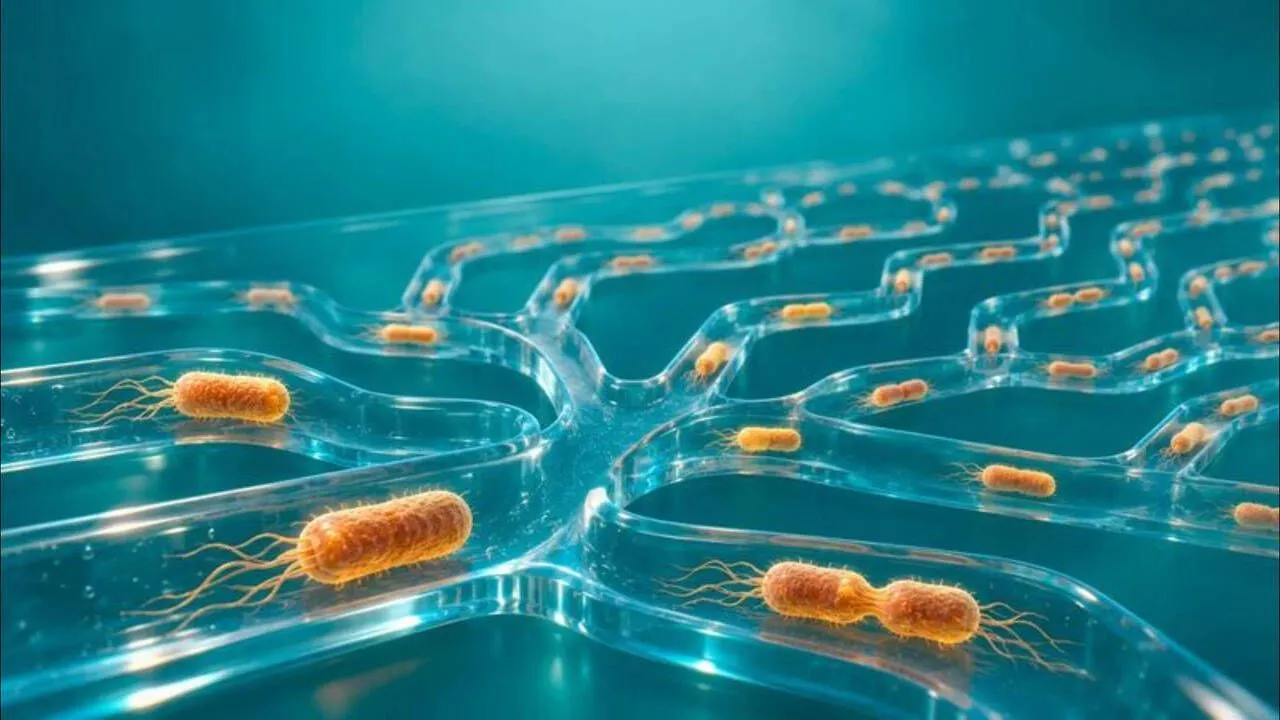
The researchers have taken an approach by allowing bacteria to move through a specially designed network of microscopic channels.
First, scientists converted a problem into a network of interconnected routes. Each route represented an answer while the junctions between the channels acted as decision points. They then introduced bacteria into this network, as the microorganisms moved through the channels they explored routes simultaneously.
The interesting part is bacteria can multiply while moving. This means that one biological processor can produce processors through natural cell division. As their numbers increase, possible routes can be explored at the same time.
The researchers used automated image analysis to track the movement of bacteria and identify which routes produced answers. According to senior author Dan Nicolau, a professor of bioengineering at McGill University the concept is similar to having millions of computer chips working together rather than depending on a single processor.
The researchers tested their system with a challenge known as the Subset Sum Problem. In terms, think of having a group of numbers and being asked if some of those numbers can be added together to get a specific goal.
For example if the numbers given are 2, 4, 6 and 8 can some of them add up to 10? The answer is yes because 2 and 8 or 4 and 6 make 10.
This might seem easy but the number of possible combinations grows quickly as more numbers are added.
Checking all the combinations can become very hard for computers.
This problem is part of a group called NP-problems. These are math and computer problems where finding a solution can become very tough as the size of the problem grows.
The research team used two types of bacteria: Escherichia coli (E. Coli) and Vibrio natriegens. The experiments showed that the bacteria could search the network and find paths that met the rules.
The researchers also looked at how the system could be made bigger to deal with complex problems.
The researchers think biological computing might help in fields where many different combinations need to be checked. One area where this could be useful is biology. Scientists often work with biological systems and try to figure out how different molecules behave around each other. A system that can look at a range of options might one day help them in this kind of work.
Another area is encryption and cryptography. In these fields math problems are key to keeping information safe. Biological computing could possibly be used to tackle some of these problems in a way.
The researchers also believe that using bacteria for computing might help in intelligence research. It could offer a method for finding solutions to difficult problems.
However, these are potential applications. The current experiment has not demonstrated that the system can independently solve practical protein-structure, encryption or AI tasks.
Scientists have found several challenges but the main problem is overcrowding. As bacteria multiply, bacteria can fill the channels, which makes it hard for other bacteria to move freely.
The errors at the junctions are another issue. Bacteria may sometimes take a route and this can hurt the accuracy of the final result. The team has tried to control growth by adjusting temperature. Keeping the right balance between bacterial movement, bacterial multiplication and available space is still a challenge.
There is also a difference in speed and accuracy. Electronic computers are very precise. Can do millions of operations in a short time. Bacteria move and multiply more slowly, and their behaviour is less predictable.
The researchers clarified that this system is not meant to replace quantum computers. Instead it could be a tool for solving problems that are hard to tackle with current computing methods.
The bacteria powered computer represents a different way of thinking about technology.
Instead of making electronic processors increasingly powerful, scientists are exploring whether living organisms can perform certain computing tasks more efficiently.
The research is also an example of how biology, mathematics, engineering and computer science can work together to develop new technologies. As of now, the experiment remains a proof of concept. Much more research is needed before such systems can be used outside laboratories.
However, the study raises an interesting possibility: the computers of tomorrow may not rely only on silicon chips. In certain applications, living cells could become part of the technology used to solve some of the world's most complicated problems.