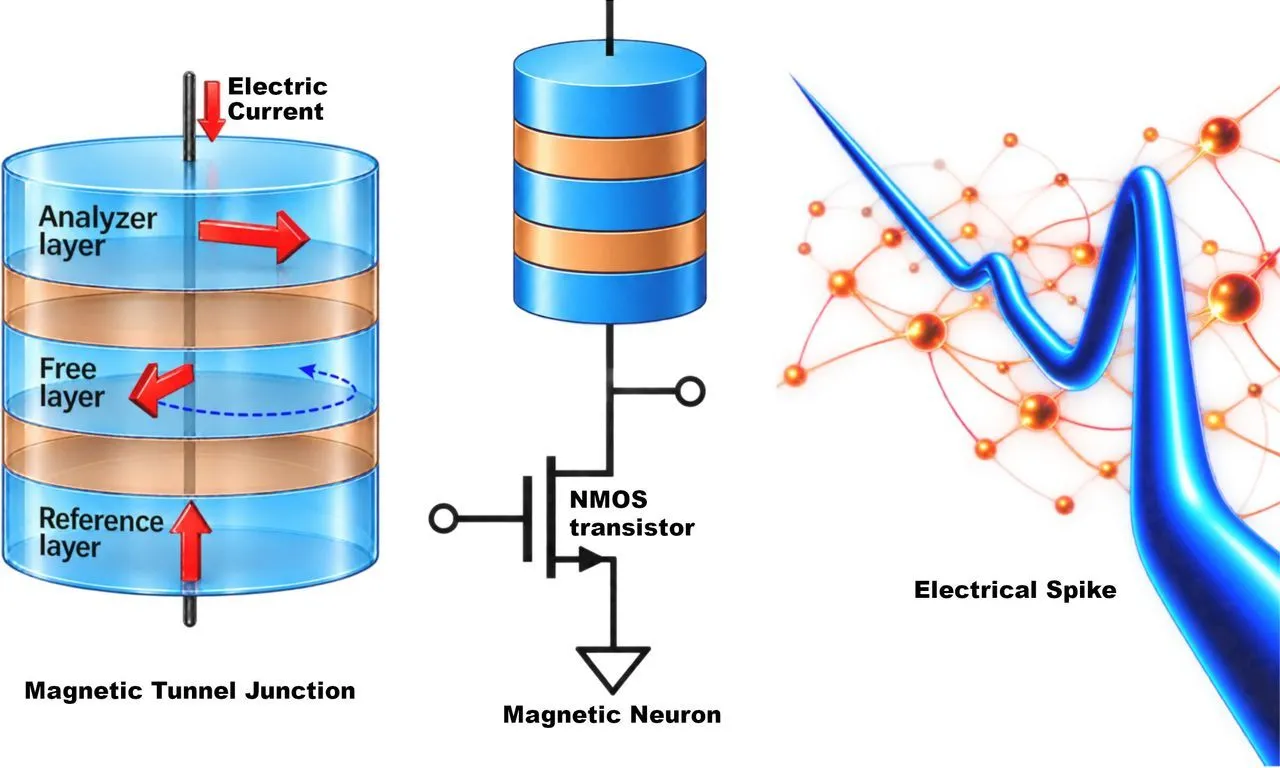
Researchers have designed an electronic neuron that combines two simple elements, a conventional transistor and a nanoscale magnetic device, to reproduce the behaviors of biological neurons. Unlike conventional electronic neurons, these behaviors emerge naturally from the magnetic properties of the device, without requiring complex control circuitry. The circuit can generate precisely timed electrical pulses that resemble those of biological neurons and, in a small demonstration, perform machine learning.
The latest incarnation of AI has an inconvenient appetite: The larger the models become, the more chips, data movement and electricity they require. Therefore, one goal for next-generation AI hardware is not simply to make computers smarter, but to make computation far less wasteful.
A team at Oakland University in Michigan has proposed a way to scale back much of this waste: build artificial neurons from a standard electronic transistor paired with a magnetic tunnel junction, or MTJ. In simulations, networks made from these components learned a standard machine-learning benchmark, the XOR gate, by using the timing of electrical spikes rather than conventional digital signals. The research was recently published in IEEE Transactions on Circuits and Systems.
The work remains simulation-based, but it points to a possible way to make AI hardware behave less like a conventional computer and more like a brain: active when something happens, and able to let the physics of its materials do part of the work.
"The human brain uses 20 watts of power to work; the typical AI model needs about 500 times that for inference and another 50 times for each question you ask it," said Dr. Steven Louis, lead researcher on the OU team. "That's too much power for everyday devices. We want AI to work locally, without relying on massive data centers. Mimicking biology may be the way to make that possible."
Letting a magnet help compute
MTJs are already widely used in MRAM (magnetoresistive random access memory). They contain magnetic layers separated by an extremely thin insulating barrier. One of those magnetic layers can change its orientation when current passes through the device.
That happens because electrons have a property called spin, which behaves somewhat like a tiny magnetic orientation. As current flows through the MTJ, those spins can exert a small twisting force on the magnetization. Researchers call this spin-transfer torque.
The effect is tiny, but at nanoscale it can produce a measurable change. As the magnetization shifts, the MTJ's electrical resistance changes. In memory chips, that change can represent a stored bit. Here, the researchers are using it for something different: to help generate the short electrical pulses, or "spikes," that biological neurons use to communicate.
The MTJ is paired with a single NMOS transistor—the basic on-off switch found throughout modern computer chips. The transistor controls the current flowing through the magnetic device. As the magnetization moves, the resistance of the MTJ changes, altering the voltage in the circuit. Under the right conditions, that produces a spike. Together, the MTJ and transistor form a "magnetic neuron."
Biological neurons do not respond to every incoming signal. They gather inputs, fire only when those inputs pass a threshold, and then enter a brief refractory period before they can fire again. The simulated magnetic neuron reproduces several useful neuron-like behaviors, including threshold spiking, latency, refractory periods, synaptic integration and inhibition.
In conventional electronic neurons, reproducing these behaviors often requires complex circuits containing many transistors, yet here the behaviors emerge naturally from the magnetic dynamics of a single MTJ.
It is not a biological neuron. But it can mimic the computational behavior that makes neurons useful.
Why not just use a normal chip?
Conventional computers keep memory and computation largely separate. A processor fetches data, performs an operation, writes the result back and moves on. Modern AI accelerators, including GPUs, are extremely good at making that process efficient—but moving data between memory and processing units still consumes enormous amounts of energy.
Neuromorphic hardware tries to blur that boundary. A physical device can hold a state that both stores information and participates in computation. In this design, the changing magnetic state of the MTJ is not merely something the circuit measures. Its dynamics help determine when the neuron fires.
That could matter for AI systems that do not need to run continuously. A spiking circuit can remain largely inactive until a spike arrives, rather than repeatedly performing energy-costly calculations on data that has not changed.
That makes the approach potentially interesting for power-constrained, event-driven applications: industrial sensors, robots, cameras, audio systems and wearable devices, where data often arrives intermittently rather than as a constant stream.
When timing carries information
The important twist is that the circuit encodes information when a spike occurs.
In a conventional digital system, a signal is generally read as a logical state: a one or a zero. In a spiking system, a pulse that arrives early can mean something different from one that arrives later. Timing becomes part of the information being processed.
In the Oakland University simulations, the artificial neurons communicated through spike timing on nanosecond timescales. The researchers report typical neuron response latencies below five nanoseconds, with the network operating in a regime where each neuron produces at most one spike per input pattern.
That timing is not just an output. It becomes the basis for learning.
A simple learning test
To see whether the proposed neurons could do more than fire, the researchers connected them into a small multilayer network and trained it on the XOR gate, a standard benchmark for nonlinear machine learning.
The network began with synaptic weights that did not produce the correct answers. During training, it repeatedly ran inference, compared the actual output spike timing with the desired timing, and adjusted the synaptic weights using a gradient-descent-based rule. After training, the network could reproduce the XOR function.
The researchers report that the network converged under the modeled conditions, demonstrating nonlinear processing, multilayer communication and weight adaptation entirely within the analog simulation. Even the training happens inside the simulated analog circuit rather than being performed externally in software.
That is a very small demonstration, and no one is suggesting that a handful of magnetic neurons will replace a GPU, but the more interesting point is that the physical dynamics of the magnetic device participate directly in the computation, rather than simply storing data for a conventional processor to manipulate.
A practical starting point
The OU team describe their approach as "CMOS+X." In plain terms, it does not abandon the technology used to make today's chips; instead, it adds another type of device—in this case, spintronics—alongside conventional electronics.
That makes the idea less far-fetched than it might first appear. MTJs and related magnetic devices already have an established manufacturing and research base because of their use in MRAM and sensors. The open question is whether the same devices can also become practical building blocks for computation.
The catch: It has not been built yet
While the published results are promising, thus far they have only been proven on circuit simulations using LTspice. Fabricating the proposed neuron and demonstrating it in a laboratory will be a matter of time and funding.
Further efforts will be important, as real magnetic devices are messy. Manufacturing variations can alter their behavior. Thermal fluctuations can disturb magnetization. Temperature, resistance differences and self-heating may all affect how reliably the spikes are produced. Hence, the next step will entail establishing just how robust the spike timing will be under real-world conditions.
Some parts of the simulated system are also idealized, and certain synaptic and learning circuits are represented with functional models rather than a complete transistor-level implementation.
The magnet is only the beginning
A practical neuromorphic processor would need much more than one working artificial neuron. The next phases of the research would have to connect large numbers of devices, create practical synapses, manage variation between components and develop training methods that do not quietly turn the system back into a conventional digital computer.
Still, the proposed architecture is appealing in its simplicity. A transistor controls a magnetic device. The magnet changes state. That changes the electrical signal, and the circuit produces a spike whose timing carries information.
"Put enough of those elements together, and the result begins to look less like a conventional processor and more like a collection of biological neurons," said Louis. Yet whether that translates into faster or more energy-efficient AI remains to be seen. But his work suggests a possibility: future AI hardware may not need to calculate every part of a neural network explicitly. Some of the computation could happen because the materials themselves behave in the right way.
And in this case, one of those materials is a very tiny magnet.
This story is part of Science X Dialog, where researchers can report findings from their published research articles. Visit this page for information about Science X Dialog and how to participate.
Steven Louis teaches electrical and computer engineering at Oakland University. His research turns discoveries in magnetism into practical technologies, from computers inspired by the brain to faster ways of analyzing signals.